Links to Brian Diamond’s work online:
New Vilna Review
42opus
Verse Daily
Flashquake
dmqreview
_______
Poems
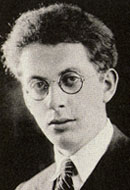
by Yankev Glatshteyn (Jacob Glatstein)
Translated by
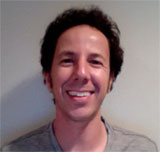 Brian Diamond
Born in Lublin, Poland in 1896, Yankev Glatshsyeyn (Jacob Glatstein), spent his entire writing life in New York City (where he immigrated to in 1914), writing in Yiddish. His poetic career was long for any poet (he published his first poems in 1919, his last collection in 1966), but particularly for one writing exclusively in Yiddish in the 20th century. While many of Glatstein’s poems have been translated, it is his later work, from the Holocaust onward that receives the most attention. No doubt, these are some of the most moving poems ever written in Yiddish, and reflect a mature Glatstein who has blended the impulse and experimentation of Modernism, with the urgency of a poetry of witness.
But while the subject matter of his early, largely un-translated, poems may appear “lighter” (where we may read “slighter”) than his later work, these early poems are no less important. For it was in these poems that Glatstein boldly pushed Yiddish poetry forward, out of the sweatshops and poetic conventions of the old world, and into conversation with a larger Modernist, poetic movement. Glastein’s first two collections, the self-titled Yaakov Glatshteyn and Fraye Verzen (Free Verse), where the following poems first appeared, were the first two volumes of Yiddish poetry written entirely in free-verse. The poetry abandons the formal meters of previous schools of Yiddish poetry, finding rhythm from the natural cadence of human speech. What’s more, Glatstein’s early work demonstrates a fierce assertion of the individual self, perceiving and filtering the world around him. It is a tone wholly appropriate for one of the founders of In-Zikh (the Introspectivists), who in their manifesto declared they were interested in poets that “created poetry drawn from their own soul and from the world as reflected in it.” The result of this introspection is a poetry that creates a “kaleidoscopic, contradictory, unclear or confused” view of the world.
Translating Glatstein is no easy feat, even for a native speaker. He has a habit of inventing words, making nouns into verbs and adverbs (he describes a sky as lighteningy in one poem). He’ll borrow words from other languages, and he departs from YIVO standards (particularly in his preference for spelling out Hebraic words phonetically). I’ve done my best at all times to honor both accuracy, and the poetic qualities in the work (even as these two goals are often at odds). In the end, in deciding whether to go with a literal translation or an approximation, to maintain a play with sound or maintain original meaning, to preserve his long, often (intentionally) unwieldy lines or to tighten them, I’ve come back to one guiding principal: these poems are good Yiddish poems. If they are not good English poems, I’ve failed as a translator. If I succeed in producing a good poem, regardless of any intentional or unintentional errors within the poem, I’ve succeeded in my most important task.
The City
1. My pale head laid itself down on
the street, the city’s telephone poles fainted away before my eyes. My bones were empty, light as birds until I, as if on a stranger’s feet,
faltered. Through my flimsy eyes the city fainted. The city’s clamor, a hardening hung in air. 2. Suddenly, a hand threw me unconscious in the middle of the
market. Above me people spread, buzzing like bees. My limbs were wires; two great ears lay on the ground and a cry drilled through me: Drum-drum, drum-drum, drum-drum. 3. Once, the city spurred me toward
it, so invigorating that it drew me in like a spinning top. I let myself be pulled until I was
overcome by its impulse; I was content, yet around me my people spun, pressed in pursuit until the years, in manic motion,
disappeared, and I was on a corner only wanting to catch my breath— everything fainted before me. The city’s drumming dead in the air. You
You, you, you, flesh and bone, you. I’ll be damned if I know what fuses your bones, unless it’s the force of fire inside you. You will not, however, die; the fire inside you will simply smolder out (as even the sun will someday cool) and you will become a shadow, a pile of bones on the floor. You, you, you, you suck out my blood, you suck out my marrow, you make black rings under my eyes. I’ll be damned if I know, what this power in you is, unless it’s the power of fire alone that burns your weak body together, which is, eventually, ravaged, which is, eventually, fed, skin and bone and me. Flesh and marrow and me. You, you, you, in wild pursuit of me. Fire— snake-slither, with your shoe pressed on my heart, on my blood. Suddenly, that fire in you dances wildly with me. Hop-Gallop. Hop-Gallop. Deep caves. Black rings. You, you, you, Your existence will not end, though it must, like forest fire, extinguish itself. Only flesh and bone, and what power in you. . . Park Avenue
Praise to God on his heavenly
throne. Praise to Caesar on his earthly
throne. Praise to the
iron fist holding pocket change for my daily
bread. To you, decadent Park Avenue, my
revelation. To you, trembling dream, substance
for my poor-rich life. Filled with joy, music for my
eyes— praise, praise, praise. Progress burns under the rubber
breaks of your cars, on 10th Street it
dances, embraced by the ticking of a clock. From your cars one sees through sheens of rain my idleness, covered with pillars
of dust kicked up by the rhythms of your
hurried life. Your traffic presses and burns the
road, but from under your breaks little worms save themselves,
aspiring upward. And yesterday, God played at night
on a fiddle in Carnegie Hall, and Caesar sat with his wife in the
balcony, and I carried the change for my
daily bread to Carnegie Hall to hear God play for Caesar and his
wife (wealthy Park Avenue, my
revelation). God played gallantly and wore a
black frock. And Caesar traded his scepter and
crown for a black coat. And God bowed before Caesar. Italy flung two Italians on a ship
up the river— a tall one and a short one on a
ship up the river to the land of Park Avenue, my
joyful land (Aspiring to reach the sun, aspiring upward). The short one is blind with a gray
mustache and his face hardened in
lament. And the tall one must see for both
of them, two eyes for both. The short one plays on a street
organ and the tall one sees for both, one
penny from a window thrown for both— from
a window on my wealthy Park Avenue (Yesterday, God in a black frock bowed to Caesar). Cars with rubber breaks, I swear to
you, they do not trample the two men, one
sees for both, one penny for both, they
aspire to reach the sun, between
road and rock, they aspire upwards. Evening Sky
The evening sky lit up in my eyes, a song of color. My veiled thoughts linger on a
quiet breeze. Alone on the road, my mind occupied by the stillness of a sorrowful
hand that no longer shapes my life. The river and God doze together. Only a few mossy-pebbles whisper
quietly to the rhythm of my nascent
longing. It changes color quickly, my
desire, mixed with the sky’s complexion.
