See the interview with Sam Hamill in a previous issue.
_______
_______
_______
Floating Bridge Press, Seattle, will be Pisan Canto. 6X9 perfect bound, letter-pressed cover by Sam Hamill. Ten bucks.
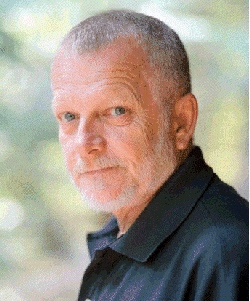 Sam Hamill
A Pisan Canto
You can fly all night above the Atlantic
in time to see the bluest, brightest dawn
emerge as you cross the Alps, wingtips glinting,
horizon a blue-yellow haze—
and glide down over green and brown farmlands,
olive trees in the breeze,
pine trees and olive trees, down
as the sky grows brighter,
into Milano—
and I, emerging from the bowels of Hades,
having tasted the Lethe,
emerge from the dark night of my nation,
from my own darkest night,
bruised by a diffidence that faltered.
But to depart is not
to depart from the way.
“Caritas! Caritas!” my Olga sings,
bringing the heart of the Greek,
ancient and modern, into her adopted tongue.
Caritas, Kannon—
a temple is not a business…
Who would betray
a monk’s vow of service?
Sail not into an artificial Paradise
built of fashion and money—
place they crucified Il Duce the second time,
and who can blame them?
And now another Boss in the White House,
exporting a fascist state,
man of some fortune
whose true name will come—
but enter the new old world, old errors repeated,
Pavese’s workers and hookers
rubbing shoulders on a train with lawyers
in suits that cost more
than my hermitage in the woods.
I am not Odysseus, but a monk in a poet’s order,
a traveler in Toscana, a tourist in Venice.
“Travel not merely to see famous places,
not merely to appreciate the past,”
the haiku master instructed, “but to learn
to accept the kindness of strangers.”
Such kindness I have known, almost more
than one can bear,
and suffering also, and
not a little anger on my journey.
The journey itself is home.
I’ll take my coffee in the Piazza
and learn to say Please and Thank you.
I am not an Ezra, calling upon his gods
in his hour of desolation,
‘though I’ve desolation in my hour,
not the panther in the cage,
studying Confucius.
I know Chung Ni, poet that I am,
I know the master; call me
son of Lu Chi who barred the door—
two decades on the classics.
Great tragedy of my generation, KR said,
is that it’s no longer possible
to know the poetry of the world.
“To extend one’s knowledge to the utmost,”
Ez sez as K’ung-fu Tzu.
Peace begins only in the heart:
the poem as koan or case:
the model given is not the answer,
but provides
a direction: “I will GO to the door/
I will BE a romantic…”
fer instance, Creeley’s idiomatic measure
I put on a blackboard years ago
and challenged the MFAs of a fine institution,
“Go ahead and scan it.”
The great heave to free the American line
from the dictates of the iamb.
Composition by line because it’s more honest
than the beat of the metronome.
Charlie Olson saw th’advantage
of the typewriter, first time,
in Saint Liz, visiting Ez, reading a script
of the Pisan Cantos.
All Romance, from them A-a-a-arabs.
Bombing the cradle
of civilization, this President smirks,
translating the Spanish for “shrub”
into “bush,” which passes for humor,
I suppose, in some parts of Texas.
Oil and blood also from the cradle,
savagely rocking,
man of what god, what destroyer?
I will not surrender my Constitution:
Madison stood for something:
a little dignity, a little justice
the right to read and speak in peace,
to follow the romance them A-a-a-arabs gave us.
And rhyme, too, from the Arabic,
and the holy calligraphy of the Aleph:
mixed in Provence with French and Italian,
Langue d’Oc changed western poetry forever.
All born between the Tigris and Euphrates,
the cradle the Shrub has rocketed.
Drop no bombs on a people
whose poetry you have not read!
And if your song is not at least
as beautiful as silence,
keep your mouth shut,
the Arab proverb says—
traditions brought into English, perfected
by “our brother Percy”
as he strolled the Arno in Pisa.
And not far from Pisa, nearby in Coltano,
the home of the DTC,
built by the Fascists to house a fair city
of Commies and Catholics
who opposed’em, then by the Allies,
where the panther was caged
and the Pisan Cantos begun.
Fifteen minutes by car these days
from the noble old Royal Victoria Hotel,
haunt of Dickens and D’Annunzio
(I read their guest book)
where Lady Churchill observed,
“The hotel
is quite adequate.”
Fifteen minutes by car,
across the Arno to narrow roads
canopied by red-barked pine,
through farmlands with soil
the very color of oil, Piero behind the wheel
and Alessandro in the back,
offering directions—to Coltano,
village the size of a thumbnail,
ragged old schoolhouse with rusty gate,
a mill, the well kept manor
beside the impoverished,
the smell of last’s night rain,
and a tiny store like those in mountain villages
in Japan, smelt-like fish
soaking in olive oil,
blocks of cheese, olives,
a pork round, all under glass,
where we went in for directions.
Immense tragedy
in the old partisan’s stooped shoulders,
but grit in his eye, gravel in his tongue
when we asked the whereabouts
of the DTC:
“Are you fascists?”
Then, reassured, pointed the way…
We walked east and then back, north and then back,
rich black earth of the fields,
tethered dogs barking, tails wagging,
long-tailed doves
along the power line—mud everywhere—
“’Fifth element,
MUD,’ sd Napoleon”—
and you can still smell sweet mint
Ez smelled under his tentflap,
in his cage, old lion
calling up his gods
in his hour of desolation,
the poet not yet broken
over “stupid suburban prejudice,”
and here a white horse at roadside
munching lion’s tooth, a favorite in salads,
slightly sweet, about the size and shape
of dandelion leaves,
and beyond the fields,
gray marbled clouds over Taishan,
hardly a mountain at all
by Chinese standards—
Chinese standards by which he measured the man,
Legge’s Four Books, the Ta Hsueh,
foremost among them,
great learning
demanding exactitude—
to know the root
and have an orderly mode of procedure—
an orderly mode of procedure
born of respect for one’s elders…
of finding a noble tradition…
Mon frere may speak of justice, libertá,
but all dignity is in the deed,
in the friendship or allegiance sustained,
nor is Paradise artificial,
but is one’s own good nature.
Odi et amo. Catullo on the banks of the Po
felt the shiv in his back
and lived to tell… and lived to sing
his glorious invective.
And another:
Et tu, Brute?
Who would unmake the word’s temple?
A grinning daemon
with poisonous charm,
wearing a mask of Janus.
I woke in a sweat. Who would unmake
the house of poetry,
who ignite my inferno?
I crossed over the Arno,
stone arch of the bridge just at daybreak,
below the clock tower,
grieving, and there were three white birds on the water.
The first step into hell
is to demonize,
to create an other: Berlusconi
calls his detractors commies,
and Bush says his support terror
as he shreds our Constitution,
a pox on Madison’s endeavors,
the rich serving the rich
no less than in feudal manors,
the American Medici
lining the pockets of the shamefully rich
with Arab blood and Arab oil,
and where are his splendors,
our Texas Medici, where
his hallmarks of civilization—
ash and rubble and a smirk;
cluster bombs, smart bombs…
with a bang and then a whimper, Possum.
Alessandro says the children
are rapidly forgetting
how all this has happened before.
Hence a school program
“to keep the memory alive.”
Dove sta memora?
Lest one’s former friends forget—
ah, Catullo! the worst indeed is the one
who once was an ally,
who once was our partisan.
Dante had a place for those who defiled the word.
I’ve seen Ugolino’s cell, worn old hall
in the corner of the piazza
across from the elegance of the Medicis’.
Dante, under sentence of death,
composed his hell, he made his Paradiso.
He damned and praised.
In Coltano, I remembered,
and in Venice,
and on the radio in Firenze—
American poet on Italian radio again,
sixty years later,
to speak against the fascists—
if poetry is a poet’s religion,
what happens to the practice
when a sacred trust is broken?
Kannon, Kannon,
a President telling lies that lead to slaughter,
reporters repeating lies that lead to slaughter,
and what’s a little feces in your burger
if it don’t impede production
and thereby assures a profit?
contra naturam
A moth escapes through a smoke hole
and nations crumble. A President lies
and a nation lies in rubble. When
one’s allies can’t be trusted,
the arts of even poetry will suffer,
and when there is no harmony in the heart,
when there is no loyalty to the word in one’s heart,
there can be no allegiance.
No humanitas.
With usura
we have entered another age of savagery,
antiquities of Baghdad plundered,
wonders of the world sold for profit,
no house of good stone,
no manufactured Paradise of word or wood,
no temple made of words,
no real conviction, no sacrifice for the common good,
nor character in the man,
nor integrity in the work,
nor in the poem,
no Hikmet to rise from the bilge
and look up at the faces of his oppressors
with a song in his heart
and courage enough to sing…
no don Pablo Neruda,
no real conviction.
Art aint a bean-counter’s business.
Though the beans need counting.
What is made to endure,
what is made to live with,
cannot be commodified,
is one with nature.
Is nature. Is our nature
healing the heart with a song.
To be makers, not destroyers.
In Coltano, where the poet was caged,
I remember.
And found, finally, just south of the road,
beyond the narrow stand of pines,
a simple flag, a small hand-tied cross
in a little square of junipers,
an indentation in the ground
where a stone had stood
till the mayor of Pisa took it down
to quell the bickering
of the Reds and the Blacks,
but bickering is eternal—
now just a sheet of paper, a few sad facts
protected from the drizzle
by plastic, where the fascists held
35,000, a small city,
Alessandro said, now long empty fields
of silence, furrows cut straight
where Ezra sat, held by the Allies,
reading the clouds,
searching the horizon
for the white baptismal dome,
for the alabaster tip of the tower,
caged panther
with his Four Books of Confucius,
not yet assaying
the pain and wreckage of his hubris.
Ol’ Ez, the Idyho Kid,
lost among the Medicis.
And even despite his errors, his wreckage,
there is great beauty
and not a little wisdom.
Just weeks before, Camilla drove us out
to Rivalta,
the great medieval mansion
miles across broad fields,
Piacenza,
storehouse hung with thick hams
and strong cheeses,
wine cellar stacked to the ceiling,
and across a dinner to die for
looked at me with piercing eyes
and cried, “Too many mistakes!
We make mistakes!”
Gray and I praised her,
and our friend Sara praised her,
and Camilla cried, “Too many mistakes!”
Sweet Camilla, an Ezra,
so beautiful, so determined
to orchestrate perfection: the struggle
to organize the lit-fest, to find
the rose in the steel dust,
flower of the eternal
in the transitory heart of the traveler.
The flower that is
the lesson of the Buddha.
Oh, Italia, what people, what kindness
in the hearts of people—
the mayor of San Giuliano
brought me to talk with the council
and gave me the rainbow banner:
Pace, a token.
Arturo brings me my poems from Bolzano,
freshly into Italian,
and poems too from Alessandro.
And when I speak against the war,
there are tears in Sara’s eyes
as she translates
into the French: Vaison la romaine,
Provence,
birthplace of western Romantics—
first time, she says,
she’s ever wept in public.
And tears again, listening
in Livorno.
Aieee! Thales cries,
they have hope
who have nothing else.
Where there is Kannon,
there is Kali, the destroyer.
To believe in poetry
is to believe the heart can be opened,
and in the commerce of the heart,
thrift is ruin.
Le Paradis n’est pas artificiel
Olga has embodied it in her song,
and old Billyum,
translating Neruda, almost anonymous
in the snows of Spokane.
The translator’s art is provisional
conclusion, the art
of the invisible. And I too
have found life among the dead.
It’s all there— not in the gift
but in the giving,
living up to those few chosen words
we can stand by
and die by when that time comes—
just a few words,
[because it is so very difficult
getting news from poetry,
news that stays news]
libertá, justice and mercy,
a little love to thaw the heart in dead winter,
a little conviction we can live by.
Hayden embodies it,
and sweet William—
what is made to endure, to live with.
I have tried to build a Paradise,
a temple for poetry.
Now it threatens to crumble.
Is this my hubris? Paradise
revealed by the eye of its maker?
I am not
the megalomaniac Ezra,
though I love him,
grieving for his errors,
but am an American
where his cage once was,
where the old man called upon his gods.
I have my own errors to live with.
“When studying the work of the Masters,
I watch the working of their minds.”
Here the long furrows for planting,
deep rows of pine lining the roadway
to and from Coltano,
gray doves silent,
farm dogs and manor dogs still barking,
and out behind the store, a small club
where Partisans still dance on the weekends,
the good smell of woodsmoke,
everything passing.
Palms together: gassho.
Kannon, Kannon, tomorrow
the long road home,
long road stretching out behind:
the journey itself is home.
I lie awake in my narrow bed,
sweating, on the banks of the Lethe,
listening to the voices of my dead:
“These running dogs
of the Capitalist bourgeoisie,”
KR intoned, and, “I write poetry
to seduce women… and to overthrow
the Capitalist system—
in that order,” and his grand guffaw.
And Old Tom,
devoted to a lost revolution,
“Time comes,
I got my gun.” And he did.
And he killed a man.
And it tormented all his days. Who could sing
like no one sang in his
great Irish joy and Irish sorrow.
And dear Denise
who found compassion
even in “those groans men make,”
her simple cotton dresses and her tea,
like steel in her conviction.
And the wars came and the wars changed.
Another Third World country.
We stood for something—
the word writ large:
to be makers, not destroyers.
Un poeta contro Bush
Un poeta contro la guerra
I have made a gift, whatever it’s worth.
I stand for something.
The line between being murderers
and the accomplices of murderers
and true resistance
does actually exist—cf.
Albert Camus—
and me in a Marine Corps pup tent,
Okinawa, forty years ago—
and a line between
duplicity and truth.
By a few clear words and long practice,
the vision.
A few words can change a life,
which is a world.
I gather my masters
in my hour of desolation.
The answer is in the poetry.
The poetry
is my answer.
Rumi after
September 11;
Hikmet in the face of oppression;
and Hayden and Merwin,
Adrienne, et alia
for almost anything—
but always the mystery—
kado—the way of poetry.
Kannon, Kannon,
the poem is a mystery, no matter
how well crafted:
is a made thing
that embodies nature.
And like Zen,
the more we discuss it,
the further away…
Well, at least I have a few masters.
I have my practice.
Hayden says since his ex
spiffied up
the little barn where he wrote through all those years,
“It don’t smell like cow piss
when it rains any more.” Who knows something
about Troubadors and the way of poetry,
about a Paradise made of words, knows
there is no Paradise,
but there is Hell also within it—
