Eleanor’s new poetry collection The Mystery of Meteors, Sarabande Books, 2002 is also featured in this issue.
Eleanor’s bookpage at Sarabande
Eleanor’s Observers, And Other Stories is featured at Artemis Press
Interview with Nickole Brown and Eleanor Lerman used by permission of Nickole Brown, Eleanor Lerman, and Sarabande Books.All rights reserved.
An Electronic Chapbook by
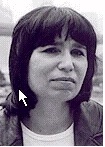
Eleanor Lerman
Interview with Nickole Brown of Sarabande Books:
Eleanor Lerman: Oh boy. Well. I wasn’t exactly “silent,” I just wasn’t writing poetry. When I was younger, I thought that I was supposed to make some sort of progression (the American work ethic right? Keep trying to do better!)—you write poems, then stories, then novels. I did write some short fiction, and then struggled with writing several novels, but I’m not a novelist, which actually, was kind of a relief when I finally figured that out. Also, the poetry was making me face some very obvious sexual identity problems that I was finding hard to resolve; the more I wrote, the more it became clear that the poet was not heterosexual, which, believe it or not, was kind of a surprise to me. (I’m very good at disassociating.). . . All of this was part of my attempt to live “a normal life,” since when I was writing poetry, my life was extremely chaotic, a little dangerous, and so were my feelings. I just kind of moved away from poetry, because it was making me experience a lot of very raw feelings that, when I wasn’t writing, were making me think I was crazy and getting way out of control. I thought I could stop this by deciding to live a normal life, and that a normal life (whatever that was), was going to save me. Ha!
As to what inspired me to write again: let’s start with the fact that I don’t have any psychic feelings about anything, ever. I wish I did, but it never happens—except once. I came home from work one day and the doorman said he had a Fed Ex package for me. As he walked across the hall to a cabinet, opened the cabinet, and walked back to me with the package, I had the distinct feeling that opening that package was going to change my life. So I didn’t open it all night. About 11 o’clock, I read the letter inside, which was from Sarah (Sarah Graham of Sarabande Books), asking if I was still writing and if so, would I be interested in showing Sarabande some of my work? At that point, I decided that my dog needed to go for a walk (she had already been for her evening walk so was puzzled by my waking her up and dragging her outside again); I walked her all over my neighborhood, thinking about the letter and wondering if I actually could write poetry again, and if so, did I have anything to say? Poetry is tremendously personal, and as I may have been trying to describe above, I was trying very hard not to have a personal life—at least not one that was going to raise any troublesome questions (not just about sex, but about the reality and self-esteem and the value of my life, things like that). But somehow, at the end of the walk, I decided that maybe I could do this again, no matter what that means confronting. I don’t know where I got the courage from, because I knew that all kinds of cans of worms were going to get opened again. The strange thing is that doing the actual work turned out to be remarkably easy: the issues I had to (have to) deal with around the work are still very difficult.
Nickole Brown:How has your work changed stylistically and in subject matter since your last collection of poetry twenty-five years ago?
Eleanor Lerman:I think my subject matter has widened to include how I experience and relate to American culture, not just my own personal longings and anxieties. I was brought up to love TV, and I still do; once, there was an event called “Hands Across America,” in which people were supposed to form a human chain of hand-holding all across the U.S. Some of the people in the chain were actually down at the end of my block in the Village; I went to look at them but then went back to my apartment and saw the same scene on TV, where it looked much more real to me. I don’t think I’m alone in that experience. Culture, the weirdness and craziness and earnestness and speed of it all is breathtaking and wonderful, but you kind of need a filter to see it through, to give you just a little bit of a delay, because it’s all coming at you so fast. So I think I’m trying to write about things like that: being alive in a time when so much is happening so fast, and you can see it all on TV or access it online, immediately, the second it’s taking place. How do you take it all in? How do you decide what’s real and what’s not? What’s important and what’s not? Maybe the truth is that it’s all important: aliens and roller coasters and nuclear missile defense and magic and history, all equally important and strange.
Nickole Brown:You have an obvious interest in the occult and in offbeat subjects like alien abduction that these days we’re more likely to find in the tabloids than in contemporary poetry. We feel both seriousness and humor in the treatment of these subjects. What is it in tabloid journalism that everyone in the country, except poets, feels?
Eleanor Lerman:Life can be very boring. We spend whole stretches of the day, whole days of the week, just stapling papers or traveling down some road we’ve traveled a thousand times to get to work, or walking down the aisles of a supermarket wondering if we buy Rice Krispies, how angry is everyone else in the house going to be because they really wanted Raisin Bran? It would be nice if once, in the middle of all of this, an alien did interrupt to tell you the secrets of the universe, or a beautiful vampire pulled you into an alley and said, hey, would you like to live forever? You’d probably say yes, just to get out of your rut. Instead, what ends up breaking the usual routine is that your lover leaves you or your aunt gets cancer, or something else pretty awful. So it all begins to seem kind of absurd: you mean life turns out to be either about stapling papers all day or else getting cancer? There must be something else. The tabloids tell us that there is: celebrities are living wonderful lives, occult secrets are locked up in the Vatican, spaceships are circling overhead, right now, just waiting to be summoned to earth. . . . After a while, you don’t have to look very hard: it is all kind of funny and silly. This is the way life works? You’ve got to be kidding.
Presto Chango
In a dream, I look around the corner of the terrace and see
the ocean. This is a surprise because I thought this building
was in a dry county: indeed, if I go back and sit in my
usual chair, ahead of me is the usual view: tall towers with
blind windows, a park, the gray haze of a cool afternoon
It is anxiety—the uncanny prickle, the silent, gagging
scream—that prevents another look at the deep water, the
abandoned blankets of bathers who have wandered off
into the cloudy day in search of cigarettes. You are
thinking, Well, if you had more money, you could have
rented an apartment with a direct ocean view. But you
are forgetting how scared I am. And that this is a dream
My explanation of the scene is inelegant but direct, based on
years of sitting knee to knee with gray eyed women who say,
Calm down. What’s wrong? Why don’t we think about that?
These voices are the madrigal music of west side rooms,
waiting rooms and antechambers and bedrooms converted
into space for treatment. And these voices say, The ocean,
of course, is the symbol of the unconscious. Perhaps you
just forgot that it was there. Perhaps I did. As Jung explained
in 1956, it is often difficult to assess the significance of
contemporary events—so never mind what’s going on beneath
the surface: I don’t understand the things that used to happen
I don’t understand the things that are happening now
Now I can hear Jung sigh. It’s really too easy for him, but he
suggests teaching by example: in a famous dream, a woman
walking down the Champs Elysee, which is improbably deserted,
is threatened by an object in the sky. The object is in the form
of a drop that may fall to earth, which is the danger that it
represents: what if it is the manifestation of a deeper dream,
of the wonderful solvent, the dissolver and binder of the soul that
no one is prepared for? You would say, Think harder. You
have been preparing for this all your life. But maybe not
On the Champs Elysee, the woman is banging on doors that are
locked against her while in the distance is the sound of footsteps
belonging to someone who is either fearless or unaware
Clearly, this cannot go on forever. Jung is on the phone and he
is growing impatient. Presto chango, he is muttering, presto chango,
and I am forced to agree. This all may be a risk more than a process
In other words, there is the infinite: stop asking questions and just go
Our Post-Soviet History Unfolds
This is what she says about Russia, in the year 2000, in a restaurant
on Prince Street, late on a summer night. She says: all the
chandeliers were broken, everywhere, and for three weeks in the
winter you couldn’t get a drink, not even that piss from Finland
The whole country was going crazy. She thinks she is speaking
about the days before she left, but I think, actually, that she is
recounting history. Somebody should be writing all this down
Or not. You can decide. Perhaps the transition from Communism
to a post-Soviet federation as seen through the eyes of a woman
who was hoping, at least, for an influx of French cosmetics is of
interest only to me. And why not? It seems that the fall of a great,
weeping empire—revolution! murder! famine! marshal music!—has
had a personal effect. Pretend that you are watching an old movie:
here is the spinning globe, the dotted line moving, dash by dash,
from Moscow across the ocean to New York, and it’s headed straight
for me. I didn’t know that, a year ago, when she came up to me in a bar
Another blonde with an accent: the city’s full of them. Nostrovya!
A toast to how often I don’t know what’s coming at me next
So here is a list of what she left behind: a husband, an abortion,
a mathematical education and a black market career in trading
currencies. It was expected she says. Everyone who could manage
it had at least two jobs. And here is a list of what she brought with
her: a gray poodle, eighteen dresses, and a fearful combination of
hope, sarcasm, and steel-eyed desire to which I surrendered myself
ten minutes into our first conversation. And now I know her secrets:
she will never give up smoking. She would have crawled across
Eastern Europe and fed that dog her own blood if she had to. And
her mother’s secrets: She would have thought, at last that I was
safe with you. She hated men. Let me, then, acknowledge that last
generation of the women of the enemy: they are a mystery to me
They would be a mystery even to my most open-minded friends
That’s not to say that the daughter, this new democrat, can’t be a
handful. And sometimes noisy: one of those girls you see now—
pale blue manicure, real diamonds, real investments and lots of
DKNY—leans over from the next table and says, Can’t you ask your
wife to hold it down? My wife? I suppose I should be insulted,
but instead, I think it’s funny. This is a dangerous woman they want
to quiet here. A woman who could sew gold into the ragged lining
of anybody’s coffin. Who knows, absolutely, that money does buy
freedom. Who just this morning has obtained a cell phone with a
bonus plan. She has it with her, and I believe she means to use it
Soon, very soon, she will be calling everyone, just to wake them up
In the Ansonia
Out of the hot day into a cool corridor: light squared off in
cement gives way to wide shadows. Twenty steps to the
elevator with a bronze gate that opens like a braced mouth
How much human food it has swallowed of this strange
generation! Outside, the sun has been burning for days
The air is like a sizzling skin around the world. No one
can breathe. On the fourth floor, where the people from
the movement live, children have been encouraged to use
the hallways to ride bicycles for peace. Women who
thought that motherhood was politics have left their doors
open so you can watch them fold their Indian-print bedspreads:
red, violet, madras green. I am contemptuous of their
money—and they all have money. And I am envious of their
money: how else could they live in the Ansonia? I pretend
that I belong here, even though I don’t belong here, I,
who am walking into the hell of love. In a corner apartment
the movement is speaking through my friends, who will leave
eventually because I won’t cooperate. The role model is already
growing older and refuses to say any more on the subject of
sex, which has become, finally, both desperate and real
There is someone I want to corner in the kitchen—and this
is not about all women. This is not a statement or a movie
This is not a speech. And this does not belong to anyone but
me. There is someone waiting to break with the movement,
to use me as an education, someone willing to be poor if it
turns out that we are going to be poor. This is not an edict
or a position. And this is not a manifesto: it is a body and it
already knows everything—everything—it can afford to risk
What will come later? The longing for meaning. Prayers
to raise the dead. But for now, in the background, the phone
keeps ringing. We don’t answer. She locks the door. A kiss
that finally, is both desperate and real. And my life begins
For E., Departing Tonight to Medjugurje
Freydl, the tall German doctor, has come here to discuss
school reform. She proposes a network of learning across
central Europe and the British Isles. I propose dinner
because I am desperate for someone to talk to—about
architecture, energy, the tragedy of ethnic cleansing. And
if the hour gets late enough, I may even mention the many
times now that I have changed my life. Freydl, Freydl, what
can I do about the fact that I don’t feel the transitions anymore?
I propose dinner to E., who is departing tonight for Medjugurje:
a midnight flight to Split, Dubrovnik, into the war zone to
hear a message of transcendent hope—or doom, depending
on a mother’s mood. Over Manhattans, safe in Manhattan,
we discuss the teachings: a Judeo-Christian dialogue served up
with shepherd’s pie. What does she want? I ask, and E., in
radiance responds, just love and prayer. Though I would have
thought these would be easy enough to give Her, E. says
no: not in heaven or on earth has there ever been enough
Why not? Why should it be so hard? Why does E. have to
strip down for the border guards, climb the path of broken
stones to receive the revelations? Why do hungry angels
descend on children playing in the barley fields, swords
of vengeance appear in the grip of the blind? At the
airport, E. embraces me and I can feel that she is fading,
dying from the need to hear, to know. Her fellow travelers
have faces like moons and candles: O bright and fragile
Christians, let us hope that you are carried into the absolute
If not, that you are carried safely home. Later, in her sleep,
the German bites my arm or kisses it—you could convince me
either way: mine is the last generation that will never trust
the Aryans, though this doctor’s experiments have been nothing
but kind. In the morning, I will write out a list of contacts and
send her deeper into North America with her briefcase and her
textbooks and her theories about molding children’s minds
Everyone wants to help: everyone is speaking, listening; radios
are on, computers, televisions; ghosts and saints and fiends are
whispering to the satellites that whisper to us in the night. Dear
physicians, friends and pilgrims: I have tried so many times to
change the way I feel. What if it’s true that life is unlivable without
the charismatic? Then here I am, I who have learned nothing but to
expect the holy teeth of faith to rip like love into a weakened heart
Living With the Red Menace
The Red Menace used to live upstairs from me
This was in the Bronx, on the Grand Concourse,
in the spring of 1953
Everyone was afraid of him but I could relate to his
inner child (agrarian reform) and so we got along
We used to read Ferlinghetti together—remember, the
Red Menace was something of a rebel once—and go
to Yankee games (presaging his Cuban phase: both he
and Castro were crazy about baseball)
He felt bad about the blacklist and missed his days
in Hollywood—what a comedown for him, living
among Poles and Czechs!
(Refugees from simple satellite countries, no less)
But he still retained a fondness for Jews, which caused
no end of trouble later: one more decade and all you
had to do was say “fellow traveler” in front of a rabbi,
and he’d faint dead away
And was he a talker, that Red Menace! We’d sit for hours
on the fire escape
(just like in West Side Story) and he’d go on and on about
celebrities he had known: Lenin, Anastasia, General
Zukhov—you wouldn’t think it,
but apparently they all had a lighter side. And he liked
to speculate about collectives, though he focused more on
the unconscious than five-year plans
This was during his spiritual period, when he decided
to make pilgrimages to far-away countries, which always
turned out badly for them
(He was a user, I have to admit that, and for all his
fancy philosophy, he really didn’t know how to share)
Then there was that night in ’57 that he threw the
Sputnik party
Of course, no one came, but the Red Menace was
in his glory
He munched on deli sandwiches and speculated on
the bright promise of the future. Beep, beep beep,
his ham radio replied
Now, of course, he’s just a shadow of his former self
I still visit him occasionally at the King David nursing home
in West Orange, New Jersey
(Yes, the Jews again—when they heard how far he’d fallen,
they felt sorry for him
and took him in.) Sometimes his mind wanders and he thinks
he’s on the phone to Mao
(who he detested: Kruschev, he said, at least had a sense
of humor)
But mostly, he just sits in his wheelchair and drinks tea
Oh, he still gets mail and the occasional student comes
to see him, but otherwise, he seems to have lost interest
in the outside world
If he dies, he wants to be buried near Los Alamos
Now those were tricksters, he says,idealists–they knew
how to invent death and sell it to the common man
But that’s just the cynic in him talking: we were always
smarter than that. When we wanted to, we were perfectly
capable of giving it away for free
Tales of the Mohawk Valley
The old cities are coming back to life again: Oneida, Utica,
Syracuse, Ilion
Their motto of service and industry has replaced even the
extremes of upstate weather as the topic of conversation on
everyone’s lips
Brickfaces have been repointed, geraniums snapped into
new windowboxes
and the papers have added food columns and sections on
the arts
The spirit is municipal, the worship, Presbyterian, and everyone
is busy, busy, busy—even prayer is jobbed out for a purpose:
Keep the frost off the asparagus, the trout eager for
the sportsman’s hook
In the summer, contented people fall asleep in Adirondack chairs
and their dreams are scented by valley crops and hilltop flowers
But in your mother’s house on Eller Street, with Canada
in the window,
the wind sweeps in, already thinking about winter. This is
the Leatherstocking wind that closed the old factories, that
brings the headless horseman and blows witches into the yard
to steal our housecoats from the line
And in your mother’s house on Eller Street, progress has not
reached us:
I sleep too much and you have managed to remain unemployed
Every afternoon, the pots and pans bang out their grief: who will
make our stew,
who will pour out the batter for our flapjacks? Every night,
the house weeps and refuses to be sold. Every morning,
I try to make it to the store, and every street is like a bridge
across a mill basin,
and the mill wheel is turning and we are the labor of its years,
the poor grist
So come. If the house will not join with the community, just
lock the door and walk away
We can cross the Mohawk Valley while the seasons are
still turning,
walk beneath the waterfalls, across great tables of broken schist
to where the earth has cleaved open and peer into its iron heart,
its silver veins
At the end of the valley there is a lake with a monster who lives
in a deep, cold pool
That can be our destination. We can buy a guidebook and
some chocolate
and picnic on the shore. Thus will we partake of the bounty
of the state,
participate in its rejuvenation. We will blend in with the
tourists, be indistinguishable from people with money and
plans and things to do
We will ride a boat that glides above the monster’s house and
speculate with strangers: How do you think he makes his living?
How has he survived so long, unknown, unseen, and free?
The Drought Summer
Newburgh, New York, 1970
It’s hotter than it’s ever been, says the announcer
I trust the tv, so begin to worry that this might be
like one of those old movies where the earth
stands still and fireballs rain down from the sky
Huge, overheated dinosaurs could climb out of
great cracks in the earth and knock down our house
Oh for God’s sake, you sigh. Why are you so
morbid? Turn off the television and let’s go out
So what’s your idea of something fun to do
when it’s 100 degrees in the shade? Our neighbor
is in his lettuce fields and you decide that we
should help him water. Our dogs greet his dogs
and go off to chase wild pea hens in the meadows
as we set up the irrigators: silver wheels that
span the rows of tender Butterheads and Salinas.
Like little green brains already plotting to avoid
the dinner table, these baby salads drink their
cocktail of spinning water, chemicals and old
radiation leeched from the soil. They could be
bits of jade scattered in this thirsty field. They
could be thinking about how to poison us all
For lunch we have sandwiches and sun tea,
sunshine, no rain in sight; the woods beyond
the barn are dry as tinder. We listen to
the crop report and hear that even the vineyards
to the south are suffering. The countryside is
brown; twigs, grass, soil, all crackle underfoot
This is getting pretty bad, our neighbor says,
By August, even the witches will be hauling water
And I, of course, want to know what witches? Where?
But you’ve had enough of this now, and push me
down the porch, across the road, towards home
I should be writing, you should be in your
workshop, but it’s too hot to even think
We inflate two kiddie pools we found in the
basement and float around all afternoon,
listening to the radio. Later, in the evening,
we drive across the county to a fair
At the nickel pitch I meet our neighbor’s son
and ask him about the witches. I saw one
once, he tells me, in the woods. I threw
a rock at her. Later, we decide to ride the
Ferris wheel, another spinning, silver wheel,
this one with lights and music. As we are lifted
into the sky, into the deep, mysterious, blue-black
night, I see you down below, at a farm stand,
methodically inspecting cans of peaches, beans
and beets. And then I know that you are already
planning for the winter, which gives me hope
For I depend upon the future that you believe in
I rely on the practical wisdom that I am only
capable of borrowing from you one small,
neighborly handful at a time. So I am willing to
believe that we will survive this drought summer,
feast on its few precious fruits while the land
recovers with us, heals for us in the long season
of salvation that will begin with the first snow
Mountain Lakes
Now do you believe that we are out of harm’s way?
Having made the pilgrimage through the Holland Tunnel
we are old enough, in fact, long overdue in this bare suburb
The house imagines that we are any couple moving in
It presents March robins, throws stones, thinking they
are windy flowers. We have purchased this blindness,
used your mother’s money. The last trip she didn’t make
to Europe has brought us to New Jersey, to this town where
there is no mountain, no plurality of lakes. And thus it is a
perfect painting: an illusion into which, slowly, we progress
On the first day I give you the kitchen: linoleum, ice cream
chairs, Fiestaware. You will be blonde here, and fortunate
Creamy cakes and fat pies will bake up in the strong
seasons of your heart. I will prowl the corridors
of light and shadow, stunned by the long gray days,
stunned by the silence of the morning. Years later,
having come and gone a thousand times, having done
everything I thought I could, I will finally settle on the
red sofa, the color old and plush, from a Hopper print
You walk in carrying a tray of sandwiches. We recognize
each other. And I wonder: do you still love me? Still
practice that old trick of being both merciless and kind?
Listen: give me some bread and milk. Sit down beside
me and help me with my plan. Somewhere, there is a jury
waiting. I am going to tell them that it has taken a boy’s
courage to live this life. When I do that, you nod your
head. Then the light will fade into that old, dark red
And that’s it. That’s all. There is nothing else to explain
The Orbit of the Moon
Decades later, after I made the worst of my mistakes
I realized that it was my uncle who I had followed
into the city. I took a room near Cooper Union so
I could ride buses past the scene of his departure into
physics, understanding he was the reason that fate
had spared the family: to save the boy who had to be
smuggled out of Odessa, the genius who had to grow up
When he was twenty-three he designed a satellite and
launched it from a dream. It was a secret among young
men, the fellow travelers, but I can still feel it in the
night sky, sleepless and forgotten, completing its
dark orbits year after year. Now I study because he told
me to: God leaves his messages in literature and science
Perhaps He can’t keep himself from wanting us to know
In this life, moonlight lies in slices across the city. Tall
black buildings with white windows conceal what they
conceal. As the engineer became the physicist, converting
motion into theory—Thus do the wheels grind, the stars
provide, and heaven turn upon the milky river that is
the fodder for the mill—so have we converted rumor
into memory and memory into mind. All these lives
later, what was really learned in the yeshiva? That
the studious Jew was sifting through the universe, that
what he found was lonely and everlasting, and now
it comes to me. It comes to me: the love that began
the rumor, the philosophy that failed, the lives we
lived in the hope that there was something more. The
American wife. The autistic child. The stars, the mill,
the universe, the dream. A room where someone is still
studying. The past, the future. The orbit of the moon
Boats in the Snow
Port Washington, Christmas 2000
Two days before Christmas, I am the woman on the eastbound
platform in the long black coat. The trains steam as if London
were the backdrop instead of the last city stop on the Independent
line. I have gone this way as far as I can go, which is, of course,
the distance to the holiday. Which is, of course, the risk that comes
with travel: the stations are on fire. There is no rest, no food. The
body understands that it is money and the money, darlings, is always
spent. I have gone this way as far as I can go, which is the way
that you must find me. You with your small hands and bright smile
Two days before Christmas, and I have been thinking about the risk
of taking second chances. This may get harder as I get older, and I
don’t know if I remember all the human elements (help with the
dishes, offer to run errands, compliment the cooking and the clothes)
I don’t know if I remember what to exchange for sex: not love or
pain—you’ve thought through those before. Not houses you can enter
with a woman’s keys. Not dreams, not healing, not the eternal medicine
of time. What can I give you that you don’t have? The stations were
on fire, but I came anyway. In my fortune, you were the child in the
spring. Are these the things that otherwise, you would never know?
Two days before Christmas, and I am feeling the cold. You will have
cleared the eaves and hung the lights before I even set myself to walking
the right road. You with your small hands and bright heart: let me tell you
how I will travel as I get older. By your house, in a locked yard, there are
boats in storage for the winter. In April—or the latest, May—people will
feel the rising wind. They will undo the locks and haul the boats out to
Head of the Harbor, where there is good fishing, good waves. So you,
with your eternal kindness, that’s where I am going. You, who were
promised in the springtime. You, who are speaking of blue water and
silver starfish when you tell me that next door, there are boats in the snow
Cambodia
There is nowhere to begin but in metaphor:
the temples are as ancient as the fields of heaven,
the dead as numerous as the cobra’s coils
Thus may we understand our journey through Cambodia,
which is a dream, a luminosity, a message
buried beneath a heap of bones
In the market, there is a Frenchwoman buying a songbird
and we must remember that she is not at fault: she represents
only a sojourn in a distant latitude—only a woman in sandals
and a summer dress. Walking through the heat of August,
along a flowery road she sees pythons at her feet and dragons
in the sky. But she can tell us nothing, she is not the colonizer
though her presence on the road is, itself, a metaphor:
the blossoms are the pathway, the pathway is the Mekong,
and the Mekong is the infinite, which she is walking towards
Then there is the tiger and the lake, the lake,
the mountain and the stone. They represent mythology
and the power of mythology to redeem the natural world
which is, itself, the message, and the message is a metaphor
for tigers prowling in the darkness, for sacred lakes and
sacred mountains, for a stone that has been lodged
at the center of the universe, a stone that can be moved
Which is nature of Cambodia: to be the instrument of
incremental movement, the churn, the mill, the mind that
turns the sky’s machinery. Which is, itself, a metaphor.
that represents a woman in a market who buys a songbird
and so sets the night in motion, who feeds it seeds and honey
to restore to us our privilege to see the revelation of the days
Radiation Sickness/Learning to Drive
Turn on the porch light and bring me something cool to drink
Bring me aspirin and damp cloths. Bring me injectibles
for tonight I am feverish. I am filled with dreams but I can’t sleep
I sit in the lamplight with my book open and my head in my hands
This is deep summer and I remember everything
In the time of the blackout, the radiation days
You came up the dark stairs with fruit and bread and said
that it was safe to eat. You said we could do anything and never
regret it—live like vampires or angels, no one would care
And we could get good jobs, even without an education:
how much science do you need to lounge around the death house?
We could make money off the end of the world
That’s why I had to learn to work the stick shift
in the truck we borrowed (ha ha) from the university
Midnight on the New Jersey turnpike: we could buy guns
in Livonia, drugs in the Amboys—whatever we needed to get
where we were going with our glowing green seeds and our
fifty coiled feet of destruction. That’s how I felt then:
I would have done anything for you
The trouble is, I miss is all. The trouble is,
I’m bored with being good. You bit deep, dearie,
when you sucked that vein—the sickness tastes like cobalt
to me now, hot and icy and pure, pure. If we go back
to the radiation lab, I’m sure we could think of something new
to do: we could listen to the hum, crack the interstellar whip
I bet if I channel really hard, I could even remember
how many miles were left to go before we parked the truck
So is that what you had in mind, honey, when you taught me to drive?
The Sex Trade
Blonde beauties, she suggested, can survive years in the
sex trade. Chinese mistresses will endure. Even some
children—though diminished and enfeebled—will strike back
only softly, forgive everyone, and find a way to go on
Then why did she stop me, call this house Golgotha,
point out this street and say, Baby, baby, how much longer
will you carry your sacks home to Golgotha? All before
she opened the windows to the rain and walked away
And so I look at you, sleeping in all that deep water, that
lake that is a dream, a memory, a mist, and could try to
convince myself that you are floating like a hyacinth in
some pool of shared desire. But she would know that I am
lying and besides, you are not paying me anymore. Instead,
I am getting out of bed. I am putting on my clothes. Baby,
baby. Wake up, little flower. Everything is going to explode
in wet sparks, fire cracks, lightening and hurricanes
I am turning to you. I am turning to fight
Sunset Hammers
When the phone rings in your office, receive the news
as calmly as you would another memo. Another inventory
sheet detailing cost and value. The price of the goods
we have in stock is fluctuating. The physical integrity
of the materials is of concern. And as calmly as you
would write an answer (then stabilize the prices; restate
our faith in the processes and manufacture), get your
coat and get out the door. Your colleagues will remain
at their stations: behind the business of blue eyes the
phone will go on ringing and must be answered. Even
with faith, with planning, there is just no other way
And so. Go into the city of tunnels. Of bridges, of
elevated light. Go as a writer, a sailor. Go up the
Mekong, up the Congo, go up the lines of distance
that are laid out like a summons. Go as a visitor,
because in the future, you will be the patient. Go,
because time is getting short, because your dreams
may be prophetic; go because you need to, because
you want to. Go quickly, go now. Already, sunset
hammers at the windows on Mt. Eden Avenue; the
panes burst into red and that vibrato is what you have
begun to hear. Go, because every day there is someplace
you have to be. Work with that feeling. In the end,
nothing else (Get it? Nada) may turn out to be true
Last Night in Another City
for Robin Lea
There is the winter river and the monuments. There is debate
about the national business. In the Willard Hotel, the
concierge sends faxes to Lagos for the worried Swiss while
in the ballroom, we focus on developing a policy: children or
missiles? Manganese or salt? Should fresh water define
the trade routes or access to the sea? The world is spinning
endlessly, forever. Our only power is to think about it. What
we think, we write in Romance languages on yellow pads
The Swiss has diamonds in his pocket smuggled in from
Kimberly. He scatters them like crystal fruits and
crystal kisses across the palms of busy men. He says
that slaves still mine the earth. Slaves make the beds we
sleep in with the slaves we buy with food and wine. He
says there is an international regard for money, a disregard
for women and their work. He says, he says—and what
he says is written into the record: we all agree the world
is full of pain. We all agree that in every room there is a theory
and a problem; urgent needs arrive like telegrams from every
outpost in the desert, from the continents of rain. We all agree
the rooms are endless. We write this down on yellow pads
And I walk between the rooms. I listen and I breathe
Last night in another city, I stood behind you and listened
to you sigh. How do I reconcile the difference in these
hours? The difference you have made in me? (As I walk
between the rooms. As I eat cake for breakfast, cake for
lunch.) Last night, in another city, I opened you as I would
open the earth, set free the slaves, fling wide the door to
granaries and mills. Oh multiply, oh multiply the longing
of the lover for the lover in another city, the taste of sweet,
the sound of breath. Though these will not reconcile the
dying to the reaper or forestall the agony of wind and storm,
they also are written into the record. They are the notes
made by a human in a romance language, in a steady hand
Eleanor Lerman made her debut in 1973 with the publication of her first book of poetry, Armed Love (Wesleyan University Press), which was nominated for a National Book Award. Her second book of poetry, Come the Sweet By and By, won the inaugural Juniper Prize of the University of Massachusetts Press in 1975. During the next five years, she managed a harpsichord kit factory, worked as a comedy writer and produced a series of poems about T.E. Lawrence, which were published in Christopher Street. During that time, her work also appeared in the Chicago Review, The North American Review, Amazon Poetry, First Love, Last Love: New Fiction from Christopher and other journals and anthologies.
For twenty years after that she did nothing particularly creative until she accidentally acquired a small dog. About the same time the dog came along, so did a letter from Sarah Gorham and Jeffrey Skinner of Sarabande Books asking if she was still writing, because if she was, they might like to publish her new work. The letter—perhaps along with the stimulation of all the exercise she was getting from the dog-walking—prompted her to see if, after so many years of silence, she still had anything left that she wanted to say. The answer came in the form of her third book of poetry, The Mystery of Meteors , which Sarabande published in 2001. Since that time, she has continued to write and her poetry has appeared in online journals such as Blue Moon Review; a new collection of her short fiction is available from Artemispress.com and she recently won the Joy Bale Boone Poetry Award.
Eleanor Lerman is a lifelong resident of New York City even when her address indicates that temporarily, she might be somewhere else.
