Rosalind’s poetry in Spring 2002
Poets In Marseille
by Rosalind Brackenbury
One morning in January, I received an invitation by e-mail to join
something called “Le Scriptorium” that was to take place in Marseille
in May
— an international get-together of poets, who would discuss what
significance
poetry has in the contemporary world from the points of view of our
different
countries. “Poesie hors frontieres” (poetry without frontiers, beyond
frontiers) was the phrase used by Dominique Sorrente, whose idea this
was,
and who had been nursing it for a couple of years.
“In these times in which private property battles with the idea of
sharing,
the Scriptorium proposes a breath of fresh air.” A recent article in
Le
Monde accused French poets of being arrogant, individualistic and
career-minded, but it was long before this that Sorrente, a teacher and
writer, Marseillais to the core, had had his idea. “Poetry without
frontiers, because those who write in different geographies come
together,
made allies by language.” (My rough translation.) We were to have no
“ivory
towers in our baggage” and no dreams of personal fame, or at least no
visible
ones This was to be a collective enterprise. Collective enterprises
in
France are probably as hard to bring off as they are in the US, but for
different reasons. In France, everyone has the theory of collectivism
at
their finger-tips, but is basically reared to be individualistic and
combative. In the US, collectivism is a dirty word, redolent of
communism,
yet everybody knows how to behave in groups. So in France, the theory;
in
the US, the practice — or at least, this is how I saw it, and I was
getting
into the French habit of formulating theories at the drop of a hat, by
the
time the Scriptorium was under way.
So here I was in Marseille with a group of poets, all of us invited
both
for our poems, which had been solicited over the internet and duly
translated, and for our commitment to the collective of international
poetry.
The first evening was social, with wine and pizza and slices of quiche
and
little bits of smoked salmon on toast. I noticed how poets are always
hungry, and how we love to meet each other. With poets, there’s this
other
kind of hunger too — to come out of isolation and meet up with other
weird
people who do this compulsive thing without any hope of ever making any
money. We like each other. It’s different from meeting as novelists,
who
are wary animals, don’t want to give things like agents’ names and
sizes of
advance away. Poets don’t have agents or advances, on the whole. Our
baggage, as Dominique requested, did not contain ivory towers. Come
from
Canada, Switzerland, England, the US and Haute Savoie in France, we
visitors
began quickly to feel at home.
The three days of the seminar were intense, beginning at 9 am. The
Canadian poet Douglas Burnet Smith, from Halifax, Nova Scotia,
commiserated
with me over our jet lag. The two Swiss poets had driven from
Lausanne, and
Jean-Yves Vallat, who lives on a mountain in Savoy, had come by car
too.
There were twelve of us, including two translators and the Marseillais
poets.
I couldn’t help wondering how ideas suggested here would compare with
those
of the Key West literary seminar (featured in Spring 2002) for next year, which will be on
poetry.
Being in French, the discussions were high-powered and tended to be
theoretical, but first we each had a chance to speak to the others on
what we
considered the importance of poetry to be in the world today. Douglas,
Tony
Baker the Englishman and I both sounded more pragmatic than the others,
speaking about what we saw happening in our respective countries; but
there
were definite points of connection in everything that was said. Poetry
as
the opposite of “le monde marchand”, the world of money, advertising;
poetry
as a way of linking people, especially after major distresses like
September
11; poetry as expressing the voice of a people, as does the Palestinian
poet
Mahmoud Darwish. Poetry as a way of speaking of the private and
public, the
solitary and the shared, at the same time. Poetry as the opposite of
globalised cliche. Poetry as the rescuer of language. Poetry as
action, not
contemplation. Poetry hijacked by the media, used in advertising as
music
and art both are. Poetry as resistance. And so on.
The discussion ran deep; sometimes I thought, there are things you can
say in
French that would just sound pretentious in English, but never mind,
it’s fun
being pretentious from time to time with nobody demanding, “What the
hell do
you mean?”
We worked hard, talked hard, thought hard, and then magically it was
time for
lunch, which was waiting for us down at Chez Jeannot, with Jeannot who
looked
about a hundred, surveying things while his son and daughter in law ran
the
place. Serious thought gave way to serious eating and much
contemplation of
wine lists, another thing poets seem to enjoy wherever they come from.
After
the feast, we went on a “Marche Poetique” to read poetry, our own and
others’, perched on rocks by the Mediterranean, with the Chateau d’If
on
view; and some of us made it to Rimbaud’s memorial, where Dominique
quoted
Rimbaud from memory and children came round to stare at us where we
camped on
the grass.
It was all great fun, but two things struck me particularly: that on
the
evening of the second day we were able to put on a poetry reading, or
poetry
show, with music and poetry in two languages, with the minimal of
rehearsal
time and with people we’d only just met. A large crowd of Marseillais
came
to it – about 70 people, a good crowd for poetry anywhere – and it was
amazing that this worked the way it did. The other surprise was that
on the
third morning we were invited to envisage a book, which was to come out
next
winter. Our contributions would be in by the end of the summer, so
that a
grant could be applied for. The topics were laid out, we had our
homework,
our thoughts and our poems would be expected to arrive by e-mail, and
the
Marseille team would edit it. Just like that. And I believe it will
happen,
and that we’ll do what we were asked; because of the peculiar spell of
the
time, and our strange sudden commitment to each other, under
Dominique’s
persuasive, charming but very determined eye. His nickname, “Capitaine
Metaphore” (Captain Metaphor) makes him sound more airy than he is.
“Poetry has a role, and it’s always the same. To open up the
imagination.
It’s an offering which one should make every day.” He quoted Breton
to us,
“l’imaginaire, c’est ce qui nous invite a la reelle.” ( it’s what
invites us
into reality) and reminded us of Rimbaud’s phrase, “les voleurs du feu”
(thiefs of fire, stealers of fire). It was a little like being handed
the
Olympic flame, thinking of fire. What can you do but run with it?
So we worked out “l’architecture du livre” and how we’d make it, and
we
had one last delicious lunch, and a last coffee down by the water, and
group
photographs, and it was time to write down e-mail addresses and say
goodbye.
Till next time, in Marseille.
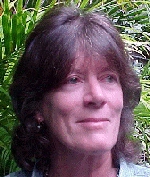 Rosalind Brackenbury
was born in England and has published both fiction and poetry in the
UK.
She now lives in Key West, Florida with her American husband. Recent works
are
The Beautiful Routes Of The West (Fithian Press, Daniel & Daniel,
CA), a
collection of poems, and a novel Seas Outside The Reef. She has a
short
story collection, Between Man and Woman Keys coming out in May, and
has
just signed the contract for another novel, The House In Morocco with
Toby
Press. A new collection of poems, Yellow Swing is in the works and
looking for a publisher. She will lead The Gaia Workshop, focusing on the connection between ourselves and the earth at the Island Muse Writer’s Retreats and Workshops featured in this issue. Her poetry appeared in Spring 2002.
Rosalind Brackenbury
was born in England and has published both fiction and poetry in the
UK.
She now lives in Key West, Florida with her American husband. Recent works
are
The Beautiful Routes Of The West (Fithian Press, Daniel & Daniel,
CA), a
collection of poems, and a novel Seas Outside The Reef. She has a
short
story collection, Between Man and Woman Keys coming out in May, and
has
just signed the contract for another novel, The House In Morocco with
Toby
Press. A new collection of poems, Yellow Swing is in the works and
looking for a publisher. She will lead The Gaia Workshop, focusing on the connection between ourselves and the earth at the Island Muse Writer’s Retreats and Workshops featured in this issue. Her poetry appeared in Spring 2002.
