
“All occasions invite his mercies, and all times are his seasons.”
—John Donne
________
Walt’s poetry in Summer 2001
Winter 2002
________
For books at bn.com by
Walt McDonald
________
Walt’s webpage at Academy of American Poets
Ploughshares
Walt’s webpage
______
For more Poetry
________
Email Walt
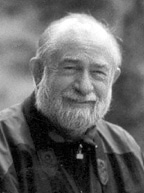 Walt McDonald
October Compost
Fall hauls us to the dump
and plows the plunder under,
corners of our backyard steamy,
compost of leaves and lettuce,
peach halves the old dogs gnawed.
We toss whatever’s ripe for silage—
coleslaw, okra and squash
too long after harvest, tomatoes
soft as English sausage. Chop,
stir it in, vegetable shepherd’s pie,
leaves layered like a flaky crust.
Now let the dark pot boil,
autumn sun turned down,
continual simmer into December,
nights chilly enough for fire.
On the sofa, we lean
and hold each other’s hands
and watch flames leap
and flicker, children long gone,
scattered like pollen,
skin of our arms and knuckles
shriveled. Logs in the hearth
break apart by midnight,
orange embers holding heat like fists.
After the Madness of Saigon
Nights, my skiff stalls in the fog
until I swing legs down and wade ashore,
disgusted. At dawn, black coffee
to drown the dreams. No keg of beer
for breakfast—this is yellow Texas sun
like eggs over easy, not Vietnam.
Songs of daily bread belong to finches
giddy in the sycamore, feeder packed
with pounds of sunflower seed.
I’m back at my fighting weight. On the deck,
I’d rather sing than eat, no arias of ham
and grits, thick bacon and imported cheese.
Doves coo like slow maple syrup
over Willie Nelson’s twang on the radio.
Rocket attacks came back last night,
crackling like static from Saigon.
In the shower, I throw my head back
and shout old bawdy squadron songs,
no one to stop me. I try to wash it
down the drain, memories of sausage
in the mess hall after the night’s attack,
more bodies in the morgue, somebody
splattering catsup over eggs and steak,
pumping up for battle, hot food to die for,
Billy Joe and the Outlaws blasting songs
on the jukebox, fat cooks shouting
and big lids slamming down.
When My Sister Turned Eighty
My sister was a wife until her boys turned fifty.
Lucinda’s husband was a lout, loud-mouthed
old bachelor who left his plows to bed her.
He called all women them, kept his wife in Cadillacs
and deer meat, freezer big as a bedroom.
She was taller than him and handsome,
ten degrees smarter but shy. She almost died
with triplets, and only the twin boys lived.
Her husband hated dogs, gave his boys dollars
for all stray mutts they shot. After teenage battles
and boredom, my sister learned to smoke and vote.
My brother-in-law always interrupted,
whining opinions without listening,
mistaking her silence for reverence.
She shut him away in a rest home at eighty,
yelling from his bed in a whisper, Don’t, don’t.
In baggy pants and a haircut, she checked herself
into the all-male wing of that rest home.
She smokes cigars in the day room, tapping her cane
and laughing. She hustles old men for hours, cards
and dominoes, rodeo facts and football.
She’s one of the guys and they like it, calling her Luke,
Big Guy. When I visit, she calls me Kid Brother
and ignores me, shuffling for her buddies,
doling bawdy jokes and cigars. If they notice
her earrings, her water-balloon breasts like bellies,
they think she’s what she claims, a wrestler
retired fifty years ago, the better half
of a tag-team that won the belt in North America,
her half-blind partner gone to Mexico for gold.
Uncle Bob and the Weather Girls
Uncle Bob thought watching weather
could change it. Nobody talked in his parlor
when weather girls came on.
Aunt Edna shelled peas and rocked
softly to please him, glancing up
at the screen now and then. She knew
what she knew. Corns grew on his thumb,
clicking from shows she watched
to the weather. Old Uncle Bob
was a monk devoted to weather girls.
He loved the flow of their tailored clothes
when they strolled from the Midwest
to Maine, like dancing, exposing
squalls in Illinois, showers of their long,
blonde hair. Blue skies or blizzards
depended on secrets those women
kept hidden behind their backs
until they twirled, revealing
regions of highs and lows,
the fronts he wanted most.
He studied their codes and curves,
the color of hail in their eyes,
the angle of clouds dangling danger—
tornadoes, drought, a sudden freeze.
