Essay on Slovenian poetry
_______
_______
Other featuresin this issue
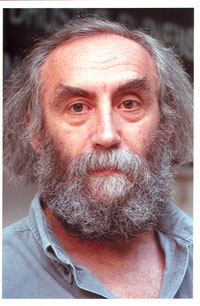
Josip Osti
Translated by Evald Flisar
IN MY POCKET I STILL KEEP THE KEY
TO MY FORMER HOME
In my pocket I still keep the key to my former
home, which, since the last war in my
home town, has been lived in by strangers
who have changed the lock on the main door
a long time ago … I know that a key without a lock
no longer has a reason for being, but
this key means something higher to me, just like
many other generally useless
objects … The dry chestnut I picked up
on a tree-lined avenue leading to the source
of the river Bosna … A saucer for the beer mug from
the Golden Tiger Inn in Prague, where I
met Hrabal … The napkin on which
the English poet Adrian Mitchell
drew me an elephant … The dust of a lemon
flower whose unforgettable smell reminds
me of our walks along the seashore
between Podaca and Brist … Objects which
warm the palm, like the egg my neighbor
brought me as soon as it was laid,
and which stir the memory … In my pocket
I still keep the key to my former home …
I don’t know if this key dreams its own memory,
its other half, as I dream my
beloved wife, equally dark and
mysterious, to whom for years in my dreams, although she
sleeps next to me, I have been writing poems
instead of love letters. All I know is that,
inexplicably, she shows me the way to the darkroom
of language, in which alone I feel perfectly
free.
BUILDING A HOUSE AFTER THE WAR
After the war we’re building a house … After yet another war,
during which many people have remained without a roof over
their heads, we’re building a house and arranging the garden
around it. We’re building it on the scale of a snail’s house,
small and beautiful, but for two. We learn from
the sparrows. We ask the wind for advice, and
the rain. We build it with hands that smell
of soil into which everything that comes from it
always returns. With hands that gently
touch and, exhausted, laugh loudly like
an elder-tree in bloom. We’re helped by stone and water,
which we unite with the smell of lavender and
images from a dream … After the war we’re building a house …
For two bodies that will lie in bed as if
under a blooming apple-tree, and for two souls that will
silently wander around it like the soul
of an old woman who had lived and
died among its walls … We’re building little walls
that will cut us off from cruel reality,
and stairs that will lead us beyond
the known, to where only two who love
each other ever get … After the war we’re building a house … Day
and night, although we’re only too aware that we are
building tomorrow’s ruins.
THE SUN WARMS EVERYONE EVERYWHERE EQUALLY
The sun warms everyone everywhere equally … There is no
alien sky with an alien sun,
as you claim, my good Aleska, in your poem Remain
here. Neither in your time nor in mine, equally
taxing. Only people are alien to each other under the common sky
and the common sun. Especially full of hatred
for one another are the brothers you
refer to. From Cain and Abel onward. The most reliable
witness to that is precisely the sun, who decides whether
crops will mature or burn, whether there will be bread
and wine. Also a witness to the fact
that the homeland for which everyone
should lay down their life is not a mother … I do not believe
a man is born to die for his country. Especially not for the one which has
always been a battleground, an arsonfield and a slaughterhouse.
Which, if a mother, is a murderess of her children …
The sun warms everyone everywhere equally …
There is no alien sky with an alien sun,
as you claim, my good Aleska, in your poem Remain
here. For a human being among human beings,
as long as he or she is a human being and truly
among human beings, flowers and wormwood grow equally.
That’s why I advise all those you’re asking to remain here
to go and remain where
they won’t have to ask themselves who is going to kill them,
but who is going to love them.
WITH A RUSTY BAYONET FROM WORLD WAR ONE
With a rusty bayonet from World
War One I weed the garden. Thrusting
it deeply into the soil as it might have been thrust
into hard bread or soft human flesh in the times
long cleansed from its
memory. When its former shine
mirrored the fear and uncertainty
of the beautiful young man who,
at the war cemetery, has for decades
been feeding flowers and weeds
as nameless as himself … With a rusty bayonet
from World War One I weed the garden …
Pulling out nettles, dandelion … When the bayonet
touches a brass cartridge in the soil
I blow in it the way I learned as a child.
The silence of the Karst is broken by an unusual sound
to which a wood-owl responds. A wood-owl
whose measured, ominous voice
fills the air all night long.
COME, LOVE, QUICKLY INTO THE GARDEN
Come, love, quickly into the garden!… Before
the shadow of the cloud changes its image.
Before the splendor of the blooming flowers and ripening
fruits I have planted and cultivated for you disappears…
The sunflower will bend its head and look
blindly into itself like you and I, after silently
looking at each other and waiting in vain for an answer to an
unspoken question. The shine of olive silverlings will darken,
and the golden sun will no longer be reflected in
your eyes, and mine, and those of the cat… Come, love, quickly
into the garden!… Before the shadow of the cloud
changes its image… Because after that, nothing
in our life will be the same again.
I DON’T KNOW WHEN I WILL GO BLIND
I don’t know when I will go blind, as I don’t know
when life or death will tear me away from my
beloved wife. That’s why in my treasury of memories
I collect and keep everything I have experienced and
got to know with awakened senses. With my sight,
hearing, taste, smell and touch… I look
for a long time and attentively at everything, listen
to different, loud and quiet voices, smell
more or less strong, pleasant and unpleasant
scents and fragrancies, taste sweet and bitter
fruits, touch soft and rough, hot and
cold shapes … I don’t know when I will go blind,
as I don’t know when life or death will tear me
away from my beloved wife. But I do know
that even then I will recognise by smell every
flower I have ever smelled, by sound
every bird I have ever seen, by touch
every shape I have ever touched.
But above all I will unmistakably recognize every
woman I have ever loved and caressed for
a long time. Even when she will silently stand
beside me, naked and washed with a soap smelling
of roses. And if time will have changed
her body, I will still recognise her— by the
unchanging smell of her soul. Bitter-sweet. Poisonous and
healing at the same time.
WHENEVER WE MEET,
WE GAZE AT EACH OTHER FOR A LONG TIME
Whenever we meet, we gaze at each other for a long time…
When unexpectedly we meet on the path
that leads through the wood or vineyard, and also
when in the orchard, through the grass overfilled
with star-shaped dandelions, she approaches
me naked. With sprightly movements. Without
a sound, as if walking on toes. In her
beautiful eyes, which hide the coolness
of the deepest fountain, I see every time my
own eyes, and in them two burning suns.
I don’t know if she feels my desire,
as I feel hers, that we should at least once
engage in a passionate kiss… Whenever we meet,
we gaze at each other for a long time… That’s how
it always ends, my meeting with the snake.
MOST OFTEN I SPEAK TO THE DEAD
Most often I speak to the dead…
Especially to poets and writers. Only they
come as soon as I call them. When I am,
frequently in a crowd, desperately alone.
Only they have enough patience to
listen attentively and with understanding to my
dirges, even when I forget that they are
with me, and carry on talking,
as I have done all my life, to myself…
Most often I speak to the dead…
Especially to poets and writers. Only their
living words, and even more so their living silences,
which I read from their lips overgrown
by grass, are in accord with their deeds.
I also speak to some of the living. But since the
war, during which many of those I knew,
also friends among poets, for a few years
besieged and destroyed Sarajevo, I speak
to them very rarely. And more and more frequently
not in the dying tongue of my mother,
but in the tongue of the dead poets that is
coming alive in these new poems of mine.
ALL MY LIFE I AM SAYING
GOOD-BYE TO LIFE
All my life I am saying good-bye to life…
To everything beautiful and bad in it. To
parents and other relatives. Some dead,
some still alive. To friends and enemies.
Also to those friends who have
in the meantime changed into enemies, just as
some of my enemies have changed into
friends. To victories and defeats, of which
there were many, not only in youth, but in
the losing race with time. I am saying good-bye
to all my loves. To the moments of
greatest pleasure and greatest pain,
the pain which has often, to tell the truth,
brought me joy… All my life I am saying good-bye
to life… To you, too, my dear soul, just as
to myself, I am saying good-bye all the time.
I watch you, caress you and kiss you, as if
every time were the last time.
WHEN YOU ARE NOT WITH ME IN TOMAI
When you are not with me in Tomai I chisel you day and night
in the middle of the garden out of the crystal clear
air of Karst. . . From the memory of the eyes which have
looked at you, and of the hands which have caressed you
for a long time. From the memory of my heart which has heard
the beating of yours, beating with it in harmony.
From the memory of the soul, which has kept the indelible
traces of our laughter and weeping, sadness and joy. . .When
you are not with me in Tomai I chisel you day and night
in the middle of the garden out of the crystal clear
air of Karst. . . In natural size and invisible
to all but me.
“In My Pocket I Still Keep The Key To My Former Home”
Hrabal: Considered one of the greatest twentieth century Czech writers, the poet and novelist Bohumil Hrabal, wrote Closely Watched Trains and Dancing Lessons for the Advanced in Age. He died in 1997 from a fall from the fifth floor of a hospital in Prague.
“The Sun Warms Everyone Everywhere Equally”
Aleksa:. Bosnian-Serb poet Aleksa Štansić, who lived during the late nineteenth and early twentieth centuries, is known for the beauty and patriotism of his poems and songs written in Serbian. “Remain here” is still memorized by Bosnian schoolchildren.
“With A Rusty Bayonet From World War One”
Karst: Mountainous region of Slovenia known for the beauty of the landscape where Osti has lived since moving from Bosnia and Herzegovina.
