Also in this issue, Rika Lesser’s translations of Elisabeth Rynell
_______
Photo credit for Rika Lesser: Photo by Perry Cohen
_______
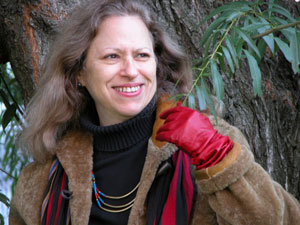
Rika Lesser
After Nine Months
Past death
and over the hill
(my godchild
does not under-
stand “on the level”)
I begin to reclaim
my body, my youth
This
is no ghastly exer–
cise of the imag–
ination, no exor–
cism of spirits, nor mere
wordplay It is again
a discipline A different
training An
arrival
(Ania)
I no longer know
who died first your
father or my mother
Or whether you and I, Polish
sister gained in Sweden
over three decades
ago, are related
by blood, no
matter
I do not want simply
to find fault
The lines
are everywhere finer
or longer Those of my
body strengthen Mine
alone?
Mine simply dis–
solves while extending
into the anima
mundi
If such a thing
should ex-
ist If I do still
If ever I did
(John Plant)
Another friend writes of the death
of his mother He has reworked his
setting, “in the world of zero,”
replaced the words his mother
took to heart: “we have no parents”
Now they’re sung by a horn, not in
his wife’s mezzo He asks my
permission, which went without
saying My poem one translation
His music another We are
in this together now, Göran
responds, more than ten years
since his own mother’s death
I am
nobody’s muse now that I know
of Nobody’s daughter either
9 September 2007
Lady, Weep No More
(Moirologia)
When I leave this world
I will leave this world
like my mother
a corpse on a bed
Attended, perhaps, by
helpers, perhaps
not Women who
weep
or don’t any more
(When Mother died
I spoke with one who
put the doctor on . . . )
Is that how it went
fifteen months ago
home alone I can’t
quite recall but know
I
wept instantly
profusely
not hired to any more not here
“allowed” “permitted” “sanctioned”
—so it is said in our
time, by our mores—
to do otherwise, ex-
press themselves, us all
(it would seem) other-
wise
women
“weird” women,
“becoming” women,
were they our sisters
those women who howl
the night through when it
grows still? Some of them
surely—or merely
dramatis personae—
who can tell
I have seen persons—
stone-cold smiling
marble faces—shed
streaks of mascara
wipe them away, swiftly
recompose They were
not blood relations—
neither mine nor the
dead’s—they were wives
Back once again to the—
to my beginning, when
I began (What does “End”
mean?) Made by people who
made children—why?—to last
Born of woman, born last
of three, not one of us
had children
Sometimes the
circle simply closes:
hell, purgatory and
heaven coincide, the
frame dissolves, the mirror’s
surface is clear
Begin Again
Shell-shocked by particles
streaming, small and swift,
I lie on a seed-bed
planted with dragon’s teeth
What can be shed What
saved What time is it
Now On this earth this
orb this planet we
all call home—Do we?
All of us wander
wonder more now than
before, even as
I want more and more
simply to dig in
root stay put in just
one place Wherever
thoughts go
Into which
broken land, into
what loam shall I sink
the tip of my tongue
its spear-blade and turn
the soil over, mull
over bone-shards and
diatoms, culti–
vate monocots
In the Neighboring Room
Late Schubert Strong reserve
An absent woodchuck
An attractive man
in the neighboring studio, not
too attractive for he’s of an age:
Worried about his fitness, freedom,
position, maintains a distance
apart while conversing, ultra-
smart, thoughts racing, cold to the touch
(laments a decade of less than enough)
I feel–what exactly?–-drawn to ex-
tend myself Toward him? His brain? His
type The scent of pain How well I know
how we can hurt each other without
intention (we’re here, cause enough, and
yet there’s no effect) and without
a doubt we do
A cobweb builds in
a low corner that joins the screen
to the window frame, daily grows
more complex, catching smaller and
darker specks Draws my attention
to the center it lacks: The spinner
remains unseen
7 August 2010: In memory, again
It’s not that I look for death
It’s here with me all the time
A given the day of my birth with Mom’s
mother’s name Now again with the thought of
your birth, five years before mine
your death, more than seven years back,
Fran,
the groundhog who comes to munch grass
afternoons at this time reemerges,
slips back in among riverine grasses,
chews heartily while I take pictures
as our father might have. . . Suddenly stands–
russet underbelly upright, sunken
Crow caws I can’t see the bird until two
or three land on lines strung above, crossing
the river Cries, persistent, raw Brown
Gihon, rush softly, till I end my song
Mandorla
“We Swedes don’t like to share.”
Ricki Neuman, at the conclusion of an interview for Svenska Dagbladet
That’s it! The hard core truth
broke open: an almond
whose brilliance is diamond
My gaze, long attentive
fixed, staring, blinded
Am I like that? Neither
gladly nor easily
Absolutely not we
Some of us, born elsewhere,
naturally take a neutral
stance, give as soon as get,
at times sooner Train to
learn when Are slow to make
assumptions
You asked, too,
what I think of Swedish
poetry—as opposed
to American I
do not