In a previous issue, an interview with Arthur Sze
_______
More poems and contributor notes in Chinese feature
_______
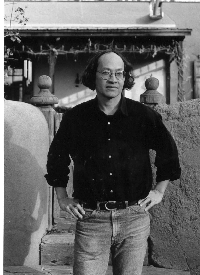
Arthur Sze
The Negative
A man hauling coal in the street is stilled forever.
Inside a temple, instead of light
a slow shutter lets the darkness in.
I see a rat turn a corner running from a man with a chair trying to smash it,
see people sleeping at midnight in a Wuhan street on bamboo beds,
a dead pig floating, bloated, on water.
I see a photograph of a son smiling who two years ago fell off a cliff
and his photograph is in each room of the apartment.
I meet a woman who had smallpox as a child, was abandoned by her mother
but who lived, now has two daughters, a son, a son-in-law;
they live in three rooms and watch a color television.
I see a man in blue work clothes whose father was a peasant
who joined the Communist party but by the time of the Cultural Revolution
had risen in rank and become a target of the Red Guards.
I see a woman who tried to kill herself with an acupuncture needle
but instead hit a vital point and cured her chronic asthma.
A Chinese poet argues that the fundamental difference between East and West
is that in the East an individual does not believe himself
in control of his fate but yields to it.
As a negative reverses light and dark
these words are prose accounts of personal tragedy becoming metaphor,
an emulsion of silver salts sensitive to light,
laughter in the underground bomb shelter converted into a movie theater,
lovers in the Summer Palace Park.
(from The Red-Shifting Web, Copper Canyon Press)
