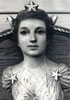
From WOMEN ON WAR: An Anthology of Women’s Writings from Antiquity to the Present edited by Daniela Gioseffi,and published by The Feminist Press @ CUNY Graduate Center, NY, March 2003. All rights reserved.
Translated by Pwu Jean Lee with Daniela Gioseffi
Tsai Wei Ji’s given name was Tsai Yeng. She chose to rename herself “Wen Ji,” meaning “ Noble Woman of Literature.” Indeed she was considered “the Pearl on the Palm of the history of Chinese literature.” Tsai Wen-Ji was the daughter of Tsai Yong (132 – 192 AD)— a leading scholar of the East Han Dynasty of China who revised the six most important classics of Chinese Literature among them, the Shi Ching (The Book of Poetry), I Ching (The Book of Change)- preserving them on stone tablets for the benefit of all. Wen Ji was gifted in music as well as poetry, and famous for her beauty and virtues. Nevertheless, she was exiled with her father for twelve years when he dared to offend the court. During her exile, her literary life came to fruition. Traveling with her scholarly father in areas South East of China enriched her knowledge, broadened her visions and deepened her love for the land and people of China. Her brief marriage ended when both her husband and father died in the political turmoil of war. During the crossfire of civil war and the Hun’s invasions, she was captured by the Tartars cavalry in a rampage, abducted and taken beyond the Great Wall to Inner Mongolia. In her epic poem entitled “Song of Pathos and Wrath”, she described the unimaginable conditions during the war. After she arrived in Mongolia, she was forced to wed the Tartar King, Zo Xie. In twelve years of captivity, she bore two sons. She wrote: “Not that I yearn to live/Or fear to die/My wish is to return to my native land/ So my bones can rest in peace forever.” She was finally released, after the new Chinese regime paid gold and jade for her ransom. But, she had to leave her children behind. She expressed her sorrow and anguish in music and poetry. Her famous “Eighteen Verses in Hun’s Flute Melody” created a new style of music and poetry for China. A cross-cultural flower blossomed from the tears and blood of war. After she left her Tartar children in Mongolia she suffered remorse in never being able to see them again and dedicated her aging years to reciting and writing in calligraphy the many books that she could remember by heart. Without her effort, these numerous volumes would have been forever lost in war.
From The Song of Pathos and Wrath
Tong Zho vows to murder our emperor
and snatch the throne.
He persecutes the good and the capable,
runs them out of town.
The new lord became Tong Zho’s puppet
to hide his own ambition.
All brave men rebelled,
declaring to fight evil to the end.
When Tong Zho’s army headed East,
their shiny armor out shone the sun.
Our men of the plains are soft and civilized,
while the mercenary Tartars hired
by the Huns are brutal.
They pillage towns and cities,
and face no resistance.
These barbarians slaughter our people
sparing no one in sight.
Corpses cluster and lean
upon one another.
On the sides of the barbarian’s horses,
our men’s heads dangle;
Behind the horses’ tails,
our women are dragged in chains.
As captives, we were marched beyond our Great Wall,
mournfully looking back at our misty roads.
The roads ahead wind with danger,
and are lined with dead bodies
exposing rotting livers and putrid guts.
By tens of thousands we slaves walk in silence.
Families are forbidden to speak with their children.
Under threat of sword,
death is constantly bestowed.
It’s not that I cherish my life,
but that I can’t bear the verbal abuse.
Often, they bludgeon us;
pain and sorrow are our company.
We march crying in day,
We sit sobbing at night.
Death is too much to ask for;
living is too hard to bear.
The people of my old village
are innocent indeed.
How could this catastrophe befall them?
It was time to rejoice,
when my countrymen came
to ransom me.
I was liberated,
yet I had to abandon my sons
fathered by the enemy.
Although Heaven links
our hearts together,
there will be no more reunion for us.
Like Life in Death we shall be parted;
how could I stand bidding farewell?
My son approached me and caressed my head.
“People say you will leave me!
When are you coming back, Mother?
You have always been kind to me,
Why are you cruel now?
I’m still a child.
Please think it over?”
The scene is breaking my heart.
My sadness turns into madness.
I caressed him as we wept bitterly.
No sooner had I departed,
than I regretted going.
From Eighteen Verses in Hun’s Flute Melody
My leaving is not for my withering life,
but for returning to my homeland.
The Chinese ambassadors escort me
on four galloping horses.
Who could hear me sobbing?
The sun has lost its radiance,
I wish I could send a bird
with strong wings to carry my sons
back with me.
This is the Third Verse.
My zither plays rapid beats
as if stabbing my heart.
My body has returned home,
But my heart hangs hungrily.
Though seasons change,
My sorrow stays forever.
The mountains are high;
the earth is wide,
and there is no date when I will see you,
my son. Sometimes at night,
you come in my dream.
I hold your hands in joy with sorrow.
After waking, my sick soul will not rest.
This is the Fourth Verse.
I play it as tears cross my face.
My mind is filled with thoughts as deep
as a river racing East..
