Essay on Slovenian poetry
_______
_______
Other featuresin this issue
_______
Published in Six Slovenian Poets Arc Publications, UK, 2006
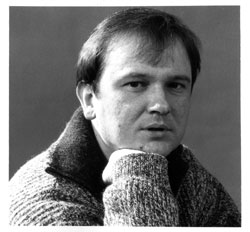
Peter Semolič
Translated by Ana Jelnikar and Kelly Lenox
Homeless Poet Writing To His Love
I’ll build for us a house made of words.
Nouns will be the bricks
and verbs will be the shutters.
With adjectives we’ll adorn
the window sills,
as with flowers.
In perfect silence we’ll lie
under the canopy of our love.
Perfect silence.
Our house will be so beautiful and so delicate
no inflation of words
will endanger it.
And if we speak,
we’ll name only things
we can see with our eyes.
Because any verb
could shake the foundation,
could demolish it.
Therefore, hush, mon amour,
hush, pour le beau demain
à notre maison.
Father
Last night
I dreamt about you,
father.
You came
into my dream
as a deer
and stood astride
a grassy
mound.
I called you
by your name,
father.
I called you
by the word: father
I said:
Look,
my eyes are
two wet flowers
by the mountain
stream.
Come,
let your warm
deer tongue
dry the dew
that fell upon
my eyes.
And you stood
as in another
world,
as in another
dream,
astride a mound
overgrown with grass.
You shook your
mighty
antlers
and vanished in the white
cloud
of no one’s
dreams.
Marezige, 12 January, 1990
Hatchet in a Knot
Father, it is time for us to meet fully awake.
You, entirely of memories and ashes. I . . .
You will recognize me easily.
I bear your eyes, your chin, your destiny
written in my skin.
Father, it is time for us to admit the presence of a hatchet,
driven into a knot.
I’m not asking you for a miracle.
I’m not asking you to tug on the blade.
I agree to the fact
that our hearth will be forever cold.
I am asking you simply to admit:
we did not obey the laws of growth.
And I accept the excuse:
it was cold,
which is why the handle shivered in our grip.
Father, that is all I ask for.
I know you have always said
that birds are merely the trees’ visitors.
That the wind sifts the leaves only for itself.
But I cannot be otherwise.
How can I throw my slender youth
into the fire of memory
if unacknowledged steel is lurking in it?
Let us admit its presence, Father.
So death will be easier for you
and life less of a burden for me.
Fuňine, 20 August, 1998
Morost, in Spring
Fog’s milk spills over the marshes of Morost. The dark
back of Mt. Krim. Above it, like an Aristotelian
cloud, the moon, with the blue
shining through it. Morning. We rinse our sleep-stuck eyes,
we shiver in the spring chill, not yet
fully awake. Pieces of dreams, drifting
toward wakefulness, merge with tufts of mist.
A moment in which we can’t be sure
whether we are truly alive. Who is it that lies
next to me? Person or spirit? My sleeping bag
is wet with dew. The firewood is damp. To start
a fire, take a sharp flame and cut an opening
to the sky, to see the everyday world. Shock! a blade
of grass, just become visible, suddenly grows and bursts
into clumps of grass, around me, wherever I look:
grass grass grass. Somebody’s already made a fire.
I hear the sad moaning of the logs. Someone
has ordered the fog to disperse. High above me, high
above Morost: azure sky. Somewhere inside, my
joints resolve and aching muscles tighten: we must
get up. Take on the world as our own. Get moving.
Writing It Down
When you wait for your bus, all the others
come first, some more than once, before yours,
always the last. It isn’t true that it’s always like this,
but it’s often enough that your skepticism fades and before you know it,
you’re studying the ecliptics of the sun, the moon and the planets; you cast
the cards; you’re trying to trace, in the dim light of a streetlamp,
the uncountable hair-thin lines
branching out from your lifeline.
I tremble—it isn’t true that in the years I wasn’t writing poems
I wasn’t making poetry. I composed them in my head, some
in prose, some in meter, verses, each one shorter, each
more stripped, opaque, ever darker, ever closer
to the spells of black magic. I forgot
most of them right away, or within a few days, but some
got nailed into my brain, pressing harder and harder
on my thoughts, directing my actions. Nothing special—
just the way I lace my shoes, yawn, how I
should scratch my forehead, turn my palm
when shaking hands, how I should cross my legs. Nothing
special. But in each gesture, I saw again a stranger,
a savage, a clumsy shaman who had cast a spell upon himself.
One day I muster the last ounce of my strength. I write
with the tip of my shoe, in the snow, white as paper, my name.
Drive out the demon of superstition.
Lines
A whole day’s ramble in town, socializing with the pigeons.
Up in the blue sky two contrails unlace.
In the emptiness of the computer screen
a multi-colored blossom spins—blossom of miracles.
I am still writing by hand, in an old notebook whose
calendar takes me back to the last century.
One day—I hope not too soon—
somebody will tell me that I am a man of the last century,
a poet of the past.
A slight tremble: the airplanes’ trails have completely vanished.
From Primorska the bora has come and shakes the old apple tree.
The blossoming is almost over, the fruit won’t come for a while yet.
What are the pigeons doing? Are they going to bed?
I cross out a badly written line and write a new one:
the dark silhouette of Mt. Krim was my horizon for years and years.
Now a cloud swims above it, scarlet from the setting sun.
The evening light falls through the window, it falls on these lines
and softens them.
Lavrica, 3 May, 2000
“Morost, in Spring”:
Morost (from French ‘marais’) is a local term for the Ljubljana’s marshes
Krim: one of the higher peaks on the edge of Ljubljana’s marshes
“Lines” Primorska: Slovenia’s littoral
