
In a previous issue a chapbook The Transformation of Salt
More poetry by George in a previous issue
George’s website The Wabash Watershed
George’s Facebook page as
Indiana State Poet Laureate
_______
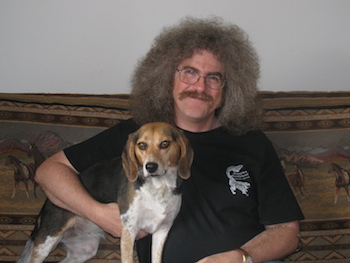
George Kalamaras
Dead Skunk
It
won’t leave me, that dead skunk, thirty-three miles
from Fort Collins. The serum
ran out
of
the medicine moon, and someone minutes ahead
struck the poor thing dumb. The
stupid
and
incessant blatting of sheep
disturb the tranquility of the range.
Black
and white are the same, that zebra hide
of
the heart. It keeps saying up is
hurt, down
is
dead, neutralize the nostrils so both breaths
are
one. For a long time I loved a lie
I
could not tell. We could produce
impressive atavisms
by
simple equations that mirror minor chords.
We
could place Brahms back into the belly
of
sea-lice ingesting a whale. Our
ribs
sour down through prairie flower and now.
I
loved the music of the poor thing’s death,
even where the road bends, and surely she’d love mine,
though with any luck it’s as far ahead as the taxidermy
of
a gnat. I would just as soon pursue
the
study of water cures and phrenology.
Only Ikkyu
and you would write
about a dead skunk, John joked.
It’s
been a long drive from there
to
here. I tried its blood-soaked side
with the finger I’d reserved for my navel,
with the purposeful picking of possum lint
from my marsupial mouth. Some
animals
don’t seem to sleep at all,
even when dead. The mackerel
is
an example of the human nightmare
of
ceaseless swimming. The parrot fish
exudes a mucous blanket to protect itself,
as
do yellow perch and mullet. Only Issa
and you, amigo, could possibly thrive
all light long inside the dumb thing’s death.
Skin,
they tell me, is rarely human
when glimpsed in the wild. Some
part of me
longs for the marsupial pulsings
of
the pouch, for a possum
night without the perfect weather
of
the womb. For a long time I loved a
lie
and
a lie loved me. Moist imprint
from life to life, tonguing me back
time and again into the intimate dark
between her thighs. The black
death
up
the mountain and down makes me
noxious with underbelly-white.
Skin,
I
repeat, is rarely human.
Letter to Roger from Gunnison
The killing
of Curly Bill, Roger. How the Earp brothers left Tombstone for
here in a hurry. The
Spanish Influenza.
Gunnison’s quarantine miraculously didn’t allow a single death, even a
prairie dog or grub. BB holes in
the chest of a pet moth. Someone
has surely been shooting drunkenly again at the moon. There’s an auction on eBay of an old
glass negative of bluetick coonhounds I’ve been
following. Maybe I’m lucky. Maybe I’m not. Maybe the world that tracks us town to
town will never end.
The vast expanse of pasture
is as intoxicating as feeling ordinary.
I swear I’m not being facetious.
Blending in is sometimes what we need. Did you come to Marxism through archery? By respecting the labor of your
physician father? Our complex body
parts are fully awake when a child dislodges the left wing of a fly, curious
about balance? Animals need to
politically survive. Kropotkin was
a prince. His
father, before him. The means of production, he says in The Conquest of Bread, should be guided by termites, impersonating
a bull ant. Okay, it was me who said that. Sometimes there’s death by family. Other times, a dust-covered palomino
coal-steps through the brain. Last
week, driving home from Laramie, I swear I felt the blatting of sheep seep
through the cilia of my right ear, crawl all the way down from pastures of the
Medicine Bow. Don’t forget, my
thorax leaked grief over a dead dog, that beagle hound I held and hold and will
never let go.
The ribcage around the heart
jiggles from time to time, small breaths that keep the fire swooshing. What was it like for Wyatt Earp to
rekindle a romance with Josie Marcus?
How many nights did his common-law wife, Mattie, weep? Why did Doc Holliday leave them, moving
on to Pueblo, then Denver? I keep
asking myself answers. Questioning
you as if you’re me. Some paramecia
can reproduce asexually. According
to the U. S. Census, Gunnison has a total of 3.2 square miles. All of it land, none of it water. Where do calipers go to measure the
difference between flathead and cutthroat trout? How can our amoeba selves ever be fully
seen without a microscope? How many
scissors does it take just to become human, to rip apart our long-longing
heart?
I keep answering myself with
exceptions. Answering your
poems. Your father would know,
convinced you too should have become a doctor. Was it here, or Colorado Mountain
College, where you taught summers?
I’m going to pin a moth to the dark velvet of my mouth and imagine it
here. We have been friends
thirty-five years. In ant-years,
we’ve known each other longer than a chain of bee intestines that could reach
the moon from anywhere in Arizona.
You are a doctor, Roger,
birthing poems, slapping their wailing ass, examining the
sometimes-questionable breathing of friends in this line of poetry or
that. Tombstone is a name bold
enough to honor the longest and loneliest nap. Pagosa
Springs, a cleansing rest, until we realize we are all indelibly human. 1918 took the lives of far too many
gnats, delirious in the multiple rooms of weeping. I’m thinking of 1882. Tombstone. The Earps’ intelligence to flee. To spur their
ponies onward through mountain-blur and snow, across Monarch Pass and all its
metamorphoses of wingèd weather. Imagine you with me here. In Gunnison. You and me together
tracking the Earps into the blowing north. What word, whatever catch. Whatever it means to flee the dust,
pursue the new.
(for Roger Mitchell)