To read an interview with Agi Mishol in this issue.
_______
More poetry by Agi Mishol in Spring 2002 translated by Lisa Katz
_______
Another poem by Agi Mishol may be found online at Mississippi Review Online
_______
Email Agi Mishol
_______
More translations by Lisa Katz in Spring 2002:
Sharron Hass
Admiel Kosman
Rami Saari
Lisa Katz’s electronic chapbook Breast Art
_______
Lisa Katz is a Contributing Editor for The Drunken Boat
_______
#32 first appeared in Leviathan Quarterly 4/England June 2002)
_______
This interview was translated from the Hebrew by Lisa Katz.
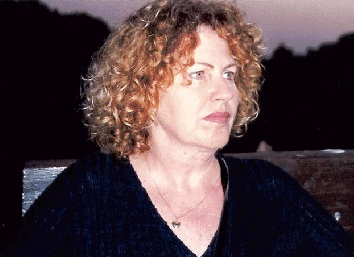
Agi Mishol
Translated By Lisa Katz
from The Dream Notebook (Published in Hebrew in Israel: Even Hoshen, 2001)
“There’s a big disparity between dream poems and poems about dreams. Poems about dreams aren’t different from other poems written consciously, but dream poems are extracted and saved from awareness in time, before the brain, whose nature is to think, becomes involved. They preserve the dream atmosphere and its logic of otherness.”1.
(First
for a thousandth of a second
I knew for certain
the secret of life
even if forgetting descended on me
and I forgot the moment I remembered
and not a word remained
except the taste of knowledge)
2.
If I open my eyes now
my soul will spill blue
over rose pink
and if I don’t open them
the tango will drag me away
to Hernando’s Hideaway
in three beats
3.
When I swam in my brain’s cosmic soup
I met another dreamer
who happened into mine, saying:
if you want to get there,
swim butterfly
4.
I, Marilyn, circulate among the dreamers at a cocktail party,
beautiful people. I’m wearing a black evening gown
with broad straps that cross in the back designed especially to hide
the stumps of my wings. In one hand, a glass of champagne,
a smoking candlestick in the other, my butterfly eyes slant
every which way as I gaily dispense smiles and small talk.
Only I know about the dress strap business
or that’s what I think until an usher enters the room,
points at me and announces: “The lady with the chickens.”
Everyone is stunned into silence when the man approaches
and in one swoop removes my dress with malicious cheer;
underneath pearl-spotted chickens began to cluck and scatter
filling the room with feathers and flight while something
inside me, disbelieving, mutters again and again: “What a blow.”
6.
I’m being filmed. In the clip
I stride into the ocean
after my lover who has sailed
far away.
When my red dress balloons over the water,
like a bell in which I’m the clapper,
I’ll dive into the depths
and they’ll project onto me:
Fin
17.
Identical pairs of husbands and wives sit facing me in the very first row,
pairs of Charlie Chaplins and ginger cats the size of people.
Out of stage fright and perhaps because of the flickering lights, I can’t
tell at first that the orchestra seats and even the balconies are filled with them,
sitting quietly, exact copies, one pair next to another, eyes glued to the film
projected onto me. That was the moment I understood
that I was the screen, and the only way to discover who I was
would be to guess what was being projected,
to decipher the miniscule twitches of their mustaches.
19.
Jose Ortega y Gasset sits under a lemon tree in my back yard.
y Gasset wears an army uniform (reserves, apparently)
and his job is to put my feelings into words
in a literary way. Lemons suit the man with three names
and aristocratic features, unfriendly, preserving
a proper distance from reality.
I sit opposite, feeling I’m in slow gear,
ready out of admiration to bend my life towards
his wonderfully refined phrases
thrust upon me out of the quiet
they indicate.
21.
A very tall and worried Japanese woman kneels before me (her head
reaches my chest). I have no idea who I am but she knows,
otherwise she wouldn’t be here, incensed about something, her eyes
slanting in awe, pleading with me not to leave the realm, not now.
She approaches with a gesture that says she knows she’s exceeding her bounds
this once, begins to stroke my back, her last chance at persuasion:
she, my earth mother, porcelain-featured, loves me more
than is allowed, if there is such a thing, can’t live without me in the palace.
I take in her words. As she empties of speech
I fill with self-knowledge, but her stroking distracts me
from the thick imperial stuff coursing through my veins
and I must make a decision fast:
whether to continue to listen about the palace revolution
I’ve apparently decided to flee, or give up on my curiosity
to know who I am and melt
into her strokes maddening my senses.
22.
I woke up on the wrong side of the bed.
I haven’t been properly developed,
I was supposed to be shiny
and I turned out matte.
23.
I push my new husband Stephen Hawking’s wheelchair over Swiss mountain ridges, balancing what
emerges from his right lobe and the gas angling out of the left, my glance strikes the forested
landscape, happy to discover a rope ladder hanging down from a pine tree because exercise is terrific
for his disease. The place is perfect too
for writing memoirs in old age and the cuckoo bursting from my brain accuses me
of marrying him just for this.
24.
As I ascended to heaven
and opened the gate uncertainly,
no magi shone within
just a huge white furry Pyrenees dog
sprawling on a cushion in the place of honor
and animals all around, down to the last detail:
the poodle from the Humane Society was there
and the mongrel from the road to Rehovot
and the one that was abandoned in the Yavneh station
and not only:
generations of cats whose spirits were refreshed
by the Friskies kit I keep in my car
puppies from the coastal plain
one frozen heron I fan-dried in winter
mice I returned to the field from the house
rats I saved from the cleaning lady’s broom
a porcupine whose fleas I removed
with a tweezer
all of them
all of them were there
the dog’s tenderness and the mercy in his eyes
filled the animals and the hall
not one word remained in the world
all of them
passed away
passed away
and only my love echoed his love
my head resting in peace on his fur.
32.
I stand in an open field, biplanes fly maneuvers overhead.
A cosmic newscaster announces with cheerful pathos:
“The war is over, and, as usual, let’s swing the sea-cow in the air.”
In the silence descending in the sky, a cow appears slowly
east of the dream, with black and yellow spots, looking silly: a huge
plastic cow sails through the sky, propelled by her limbs
as though swimming in the air,
and about to announce a blessed peace settling on the world.
I don’t make the smallest move, let the peace fall on my head,
the only witness to this fateful event. And then, to the clash of
of cymbals, as in a magic trick, the cow vanishes, and in its place
two identical Agis shine, Siamese fairies making up in a new era of peace,
but neither one of us knows which one she is.
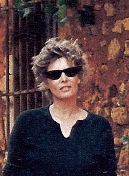 Lisa Katz
teaches literary translation at the Hebrew University of Jerusalem, where she has lived since 1983. Her translations of Israeli literature have appeared or will appear in American Poetry Review, Runes, Bridges, jubilat, the New Yorker and other magazines. Her poetry has appeared in Leviathan Quarterly (England), The Reading Room, The Mississippi Review and Nimrod; her chapbook Breast Art was featured in the Spring Issue.
Lisa Katz
teaches literary translation at the Hebrew University of Jerusalem, where she has lived since 1983. Her translations of Israeli literature have appeared or will appear in American Poetry Review, Runes, Bridges, jubilat, the New Yorker and other magazines. Her poetry has appeared in Leviathan Quarterly (England), The Reading Room, The Mississippi Review and Nimrod; her chapbook Breast Art was featured in the Spring Issue.
