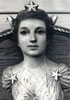
Renata Treitel is also the much-praised translator of Rosita Copioli. For a selection of new translations by Rosita Copioli.
_______
To order Treitel’s much-praised translations of Copioli’s The Blazing Lights of the Sun
To order Treitel’s translation of Susana Thénon’s distancias/distances (Sun & Moon Press, 1994) distancias/distances
________
Poetry by Renata is also online at ArchipelagoVol.4, III
______
Email Renata Treitel
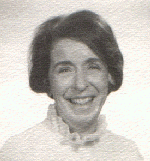 Renata Treitel
Stew
The fish stew I made
has all the ingredients:
a flaming orange pepper,
the sweetness of onions and fennel,
all the fire tomatoes.
I poured my love in the pot
for my son is leaving. Now
he chews morsels
of hake crab shrimp.
Fumes rise from the deep plate.
He gathers sweetness on large
bread chunks he dips in the stew.
I watch him and bleed for his leaving.
Stop. Not bleeding. Starved.
I beg don’t give me scraps.
Let my song be my food.
Here is the leash. Go.
My blessings on all sons.
View from the Gingko
The leaf gives away the tree.
It’s a gingko
tall beyond my fifth floor
taller than the Prudential, than the Hancock,
taller than the skyline’s blinking
red lights. They
and the silver ribbon of the Charles
mark the Logan path for homing planes.
“You yelled so much,” my daughter feels
safe to say. But now she can tell
passions apart by the decibels.
A time to float on waves of light
and bask in the sun that now comes
streaming in. Only I
know the steps it took: the bending and picking,
the folding, the sorting. And now where to?
“Many of my friends don’t speak
to their mother,” says my daughter,
“or only on neutral ground.”
I open the window one inch wider.
A plane enters my vision
making a bee line for my gingko tree.
Will it get caught in its up-thrust branches?
Blue light on top the Hancock.
The weather will stay fair.
“In Nova Scotia,” mentions my daughter,
“meteors popped out of the dark.”
Now the plane crawls out of the tangle
of leaves and branches. The gingko flares
up. I am ablaze too, brighter than the sun.
Talking with Nadine
Piecemeal from Nadine’s lips and broken memory
I collect gold nuggets of burning Vinita air
when even the rodeo signs droop.
“So there was a ro-de-o?” Fervently she answers YESSS.
“A rodeo?” THAT’SSSRIGHT. She adds QUEEEN.
“A rodeo queen?” YESSS. I ask, “What else?” COW-BOY.
I see a Remington bronze,
carved out of ice.
Nadine says CRYSTAL. “Shines like crystal?”
YESSS. DIAMOND RING. I eye the chunk of ice sitting
at the end of the table. Cowboy
high on arched back. Burning air shimmers
between raised thighs. Hat
back-thrust, knees grip panting ribs, two forces
locked in terror. Taut necks. Mane afloat.
Cowboy firm on bucking back that buckles.
QUEEEEN. Gone is the cowboy. Now the rodeo queen
on a firetruck color Oklahoma summer-day red.
Firemen drive down the shotgun streets
queen poised in her haunched seat.
“Bulls?” NO BULLS.
“Just horses?” YESSS. Horses.
No minotaurs. No leaping acrobats. No maze.
Just straight streets of Vinita
and a rodeo queen, fire frost on lips,
fire frost on hair, crystal diadem,
a beauty that says, “Look, don’t touch.”
In Vinita, Oklahoma, memory chunks
spring out of my daughter’s brain,
after the bucking and buckling.
Restoration
A Prose Poem
I.
My great-grandmother tripped and fell in the tall portico of the Pantheon built in Rome 27 BC and broke her nose against a marble column. My father, then a child, told the story years after. Such shock to see an adult waver and fall like a tree falls, snaps down, the earth never solid again. The Kings of Italy are buried in the Pantheon where I, a girl not quite six, signed my name in the guest register under a thick shaft of light, felt nobler for it, of a better breed, my name forever knit with that of kings and queens, barely tainted by my great-grandmother’s broken nose.A Prose Poem
I.
II.
I don’t remember the woman behind the desk— if glasses, if hair away from forehead. I am nose blind, eye blind, mouth blind, all faces blank like a page: four sides to be filled. Sometimes I feel like I’ve lost a lip or nose or grown a beard to hide a chin or scar, faceless like the face in this painting above the couch has no eyes, no mouth, just a glow, a sign of quick departure before the onslaught of glances. I borrow features from the arsenal at my disposal, my memory bag full of noses, eyes, mouths. Confronted with choices before this faceless face should I hang an inquisitive nose or a bulbous one like my sister’s whom we used to tease, “Your nose is like a potato.”
III
Potatoes sprout bountifully in kitchen jars filled with water. Light splinters into rainbow. What was the face like? Now and then, a face emerges out of a thick fog, but the roar of a plane makes the air vibrate, sets something in motion. In the vortex of faces, one face. The face of the one who drowned in an opaque pond. Moss—thick where the edge clings to rock—imparts opacity to the light. The face folds into itself. Gone. I start again but images ooze out of my mind and I’m left where no eye, mouth, or nose ever fit. Noses.
IV.
“Your profile is worth one hundred lire. Cento lire. Fellini line, as if a nose could point to the beautiful Semitic nose hammered out, chiseled anew. And now my eldest sister sports a nose, emphatic statement, upbeat, the old one destroyed, broken, defaced, like my great-grandmother’s under the portico of the Pantheon. We still talk of Cleopatra’s nose. Noses where Romans put coins, the air stopped, so no evil would inhabit the husk, the shell, the emptiness within. Noses like Roman roads, made of stone. The round stone mask has a face of fear, mouth like a cave, mouth of truth, true mouth where, if the hand is caught, a column of air, like a legion, a legacy. And the rest I cannot recall, I cannot detect. Just like air in and out of a broken nose.
Life Extraordinary
It’s my turn to drive Nadine
to the shelter of her workshop.
Nose glued to the window
as if she smelled a rose.
“What do you see?”
“Do you see the sea?”
I like to ask questions
she understands.
She considers and then says,
“River.” I laugh. A river runs:
Nadine’s life,
a flow that keeps all
chaos out. She calls any
crawling creature
spider. And when she says,
“Rid of it,”
I don’t see the black-armored
cockroach
but a trembling spider
caught in its own web.
Buttons
Where the flower was
buttons
the hard tight-clenched
fists
pressed against the sky.
In
and out of buttonholes
buttons
my retarded daughter
drops
on her way to work. Spring.
Green
buttons come earlier than red.
Some
green buttons fail to turn.
Red
buttons sock this bird in the
eye
through buttonholes of
perception
through loopholes of hope
prolonging
this bird’s lifelong
longing.
