See also Liz Hall-Down’s introduction to the Queensland, Australia poetry scene, as well as her selection of Queensland poetry.
See also her article on her performance poetry Fit of Passion with Kim Downs
________
For another chapbook on illness and healing, see Lisa Katz’s Breast Art
________
With this issue, Liz Hall-Downs joins The Drunken Boat as a Contributing Editor
________
Some of these poems were written during a month-long writers fellowship at the Booranga Riverina Writers’ Centre (Wagga Wagga, NSW) in 2001.
________
Liz’s website
by
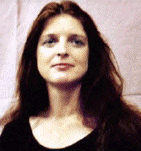 Liz Hall-Downs
The poetry manuscript, My Arthritic Heart, is an autobiographical illness narrative in poetry which deals with my experience of living with the chronic, auto-immune disease Rheumatoid Arthritis (RA.), with which I was diagnosed at 20. It has been submitted as part of an MA (Creative Writing) at the University of Queensland, but as yet does not have a publisher.
I have been writing and publishing throughout the 20 years since my diagnosis, but I have rarely written about the illness. My aspirations as a writer predated my illness, and as a young writer it felt imperative that I didn’t allow myself to be dismissed as ‘the poor girl with the terrible disease’. People’s good intentions can be unwittingly disempowering. The opposite reaction to the young person with Rheumatoid Arthritis is to assume that it’s just a few ‘aches and pains’, a ‘bit of arthritis’. Yet RA is a chronic, serious auto-immune condition characterised by periods of flareup and remission. It is not considered terminal, though it’s been estimated to shorten lifespan by fifteen years. RA affects 1-2% of the population, and occurs in women three times as often as men. It “typically occurs between the ages of 25 and 50 … (but) … has been reported in people of all ages including infants and children.” (Joint Action, Aventis Pharma)
The pain and disability RA causes has taken so much from me personally – quality of life, youthful exuberance, career, family and income. All of this affects lifestyle and the ability to be self-reliant. It is, as a fellow sufferer once ruefully said, ‘the disease that just keeps on taking’. I came to a decision that I was ready to speak out about it through my work, not only for myself, but as a gesture of support for all those RA patients who aren’t writers and therefore can’t express the experience in this way. It should be said that I subscribe to the theory that the disease is exacerbated, if not caused, by the effects of severe stress on the immune system, in my case physical and emotional abuse in adolescence.
At present the prognosis for people in my position is this: The new “biological treatments” (Enbrel, Remicade) have been extremely effective in halting the progress of RA in 65% of cases test-trialed. The drugs have been released and publicly funded in both the USA, the UK and New Zealand. But in Australia they have been twice refused funding by the Government Pharmaceutical Benefits Scheme. (A third attempt is currently in progress.) The sole reason given by the PBS committee for rejecting the drugs is that it would not be cost effective for the government.
The cost per patient for ongoing intravenous or subcutaneous injection of these drugs is estimated at $18,000 Australian ($9,000 US) per year. This should be compared, however, with the cost of maintaining an RA patient’s welfare dependency through disability pensions, carer’s pensions, and the plethora of traditional subsidized anti-inflammatory and steroid drugs that are necessary while the new drugs remain unattainable to all but the wealthy. Would anyone suggest that Cancer treatments (costing between 20,000-60,000 per annum) should not be made available as a matter of course to those who need it? Yet the cost of the new biological treatments for RA is “out of the range of most family budgets yet this treatment can enable someone to go back to work and fulfil their potential in their community … it therefore seems a matter of equity that those with arthritis and their families should have their voice heard in [government funding decisions].” (Kirkham, Arthritis Action 1:1:2002)
No doubt there will eventually be more poems in My Arthritic Heart than exist in the current draft. After twenty years of waiting and hoping for a cure, my own personal battle is still to be fought, subject to the outcome of the current political one. Here follows a selection of poems from the manuscript that might begin, just a little, to chip away at the community’s ignorance of this condition and its devastating effects on the livelihoods and lifestyle of so many young (and young-at-heart) people.
becoming
continually punished
my sin was
that of becoming
her
hitting and hitting
and hitting
me
for not letting
her dictate
my self
to the letter
as if what resides
within this brain
as if this blood
typed rare and strange
belonged to her
to shape or maim
years on
i still carry the thrum
– her hand whipping through air
to connect with skin –
and am grateful that
eyes, spidered
with red capillaries
and skin, blushing red
with the force of her slaps
healed fairly quickly,
(physically).
I learned
to hold elbows in
close to my belly
head bowed and hands
clawed like an eagle’s talons
clawed in the way
later illness would emulate
leaving me, madam frankenstein
to unlearn these things:
pain’s language, politics
of fear, and medical marvels
that leave me lying
drugged and helpless here.
she ran II
she ran
but didn’t get far
the damage was already done
burdened by generational pain
her body completely broke down
it was her own fault. she hadn’t kept up
her end of the bargain she’d never chosen.
for she was the long-awaited girl
got up in pretty dresses like a porcelain doll,
wore shiny shoes that looked alright but were
so tight, followed her mother into fitting rooms,
initiated into that female world
of shopping for pleasure – because that’s
what women do – and the shoes, sliding
their new leather stitching
up and down against still-baby skin
produced blisters, large and fluid-filled
that made the mother whinge ’cause now
the girl needed carrying.
if only she’d known of this bargain
this deal with the devil
she could have held her tongue as she grew
pretended to have no opinions.
still, dutiful daughter
tried to please, worked harder
and harder, turned to jesus
who commanded to ‘honour
your father and mother’
however bad their behaviour
so she did the ironing, scrubbed the dishes,
polished the furniture and silver
and went to school, and studied hard
and hoped to emerge with a future
that would not include those
slaps and screams, the threats to be sent
to the government home for ‘uncontrollable’
teens. she went to church
and studied hard, and ‘honoured’
a mother who was trying to break her.
(other kids took drugs, did break and enters
yet still possessed that indefinable lustre
that drew love unbidden from worried mothers
who held their sweaty courtroom hands,
and made promises to judges)
stress was her killer so yes, she ran
but by then it was too late
fate had leered at her,
and shut the gate
sin of eve, they surmised at the church
when she turned her back on the flock
that had compelled her to stay, to endure
more than was reasonable or possible.
sin of eve, who would not
be dutiful, who would not lie down
to be crushed by the weight
of the role they had made for her.
she read outside the canon, took
lilith as mentor, as teacher
and ran into life, taking enormous bites
of the fruit of youth, stuffing her mouth
and spilling the juice, while the hands
could still open and close, while the feet
could still stamp and dance, knowing
she was on a countdown, time running out,
feeling the cold and the rust eroding
her clockwork, her frail sense of self.
diagnosis
I
at the point of diagnosis it’s all
too much to take in, so you refuse
its clammy entrance, and make plans
– to hitchhike across the nullabor
while you still can
– to go out dancing every night,
to emulate flight, to be high on life
high on the vibration through the soles
of your beating feet
that take you where your brain
commands, without fuss, no refusals
you know that the blood
will refuse soon enough,
and may wage war
on your innocent joints
so you refuse its daily attacks
– its morning conundrums, its
cold night sweats –
take raw life in, pure oxygen
racing against time / to get it all done
all the things you thought
several decades would take
reduced to a slim / volume of years
reduced to diagnosis / tears
II
overnight, the tight spring
that had just begun uncoiling
snapped closed. gone in two words
the dreams of years, the plans
to set my world aright through
hard work and endurance
i did not need
to consult the medical textbooks
still, I looked, vapid hope
that things would be better than
my nurses’ memory had filed away
– ‘rapid degeneration’,
‘out-of-control-
auto-immune reaction’,
a very sad song;
prognosis: lifelong
my own white cells, oh macrophages!
turn against me, eat my substance,
my joint capsules, choosing a specific site
for each feasting, I go to bed and sweat
and sweat, nurse my pain and swelling
with beer and codeine
take the pills, the specialist says, endure
the savages of stomach lining
the fuzzy nodules of fainting
suppress this excess of self-preservation
this immunological self-destruction
and plaster on a braver face
be ‘nice’ inside this iron maiden
take my hopes, abandon them
hospital stay
I
susan who shares this
in the neighbouring bed
keeps a grinning face, she was
eight when she got it
neck bones fused and knees
replaced, her hands
can’t lift a teaspoon
she scares me, takes obediently
the penacillamine, the steroids
turns her head as they
inject her joints
the tea tray comes
but no nurse
i lift her
up the bed
rip open
the plastic packets
of biscuits
II
physio plunges
my hands
in hot wax
the social worker
and the doctor, tag team,
lecture me
wrestle my
youthful ego
say
you must realise
you can’t have a life
III
drag me to
support group
to talk about it
everyone else
in wheelchairs
or on sticks
how can i speak?
i still have feet
funny, he said
i saw you around, thought
you were staff
poverty
poverty
knows the bar-propping stranger’s
hand on my knee, only
an arm’s length from hunger
knows fifty-five brown rice
recipes, winning ways
with plain potatoes
knows how to scam that extra
tenner, how to fight for its rights
with rich doctors
poverty
knows the food store at st vinnies,
knows the well-meaning grin of home visitors
who promise prayers and novenas
smiles and says thanks
for their icons
their ridiculous pictures of jesus
knows to not appear bitter
to not be a feisty fighter
to be grateful for handouts of warm winter clothes,
to be quiet, to be nice, to be nicer
poverty
knows there are no guarantees
that life sometimes throws you a curveball
and as hard as you stretch it sings past
and you fall
knows the cold of winter when the power
cuts out, choice of eating
or paying the bill
knows the paint-peeling dwelling
the room with no view
the carving knife under the mattress
poverty
knows generosity is not the province of the wealthy
but comes from strange quarters – drug dealers,
hookers, and toothless young men with stealthy grins
who shout you bread money, or coffee
knows about invisibility, how to be a nameless statistic
knows there’s no social status, no respect when you’re sick
– you’re a vagrant, a loser, no-hoper
if pride is a sin
call me sinner
– this, or open my legs
to the monster
they run away
took it personally at first
then came to see
– to be abandoned is part of the curse.
underneath it all they see
that you are the coalmine canary
a reminder of the body’s mortality
but why contemplate this? it makes for
knowledge of futility – and how then to go on
making babies, reputations, money?
better to ignore the sick
or beat them with the stick
of good intentions
lock them up young in the terminal ward
– i have seen them there, the cerebral palsied,
the iron-lunged, the undeserving poor
dying their days in front of television soaps
being fed milky tea and lunchtime trolley slops,
shitting their beds – it is a power
for the powerless, of sorts.
my flatmates packed in seconds flat
on learning the truth of chronicity
helped me to the bathtub once
but might as well have drowned me.
the friends i have now understand me
with their quadriplegia, MS, their diabetes, HIV.
we comprise an exclusive club, society of illness.
its motto? abandon hope, all ye who enter here.
sometimes i’m
(for Christine Ferrari)
sometimes i’m these cockatoos
flashing my sulphur crest and screaming
sometimes these unripe olives
bitter and small amongst silvered leaves
sometimes i’m that raven, too much to say
and saying too loudly, caw in the naked tree
and sometimes i’m currawong, defiant song
chasing everyone else away
i’d rather be these rocks
solid, serene, slow changing
or that red-breasted wren, twitching my tail
alert, but careful, delighting the new spring
i’d rather be that shy wallaby
self-protective, scratching my sleekness
then bounding away to where green shoots grow
alert and silently watching
but mostly i’m that old hills hoist
skewed and broken and rusting
my lines all stretched and sagging
useless for holding the washing
and thankful for the friend
who’ll call maintenance in
to straighten me out again
