My Hypertropes: Poetry, Translation, and Transversion
of Paul Braffort
By
Amaranth Borsuk
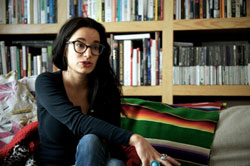
and Gabriela Jauregui
The first
elected member of the Oulipo (Ouvroir de Littérature Potentielle,
or Workshop for Potential Literature), Paul Braffort is a poet, computer scientist,
and songwriter. He has published five books in the Bibliothèque
Oulipienne, as well as numerous textbooks on artificial intelligence and
programming. Braffort published Mes hypertropes: Vingt-et-un moins
un poèmes a programme in the
Bibliothèque Oulipienne in 1979. The book pays homage to the other writers who were members of Oulipo at the time through
twenty interlinked “programmed poems,” which operate according to the
mathematical theorem (Zeckendorf’s) that any number can be expressed as the sum
of two or more Fibonacci numbers. Part of the content in each poem is thus “programmed”
by the poems containing those numbers that can be added to make it (for
instance, the 20th poem contains words that appeared in 13, 5, and 2). The
numbers and arrows on the left-hand side of the page indicate places where
language from a previous poem enters the current one.
With Braffort’s
approval, our project takes a twofold approach to the work, providing direct
English translations alongside poems of our own: "transversions" that
intersect, re-create, and occasionally subvert the source text, attempting to
provide a window into the somewhat untranslatable nature of such intricate and
inventive constraint-based work while also pointing to our own concerns (and
influences) as contemporary writers.
Hypertrope 15
is dedicated to Michèle Métail (b. 1951), who joined the Oulipo in
1975. A scholar of German and Chinese language and literature, her texts draw
on the visual and sonic qualities of words, particularly through alliteration
and assonance. Métail pioneered the practice of “oral publication,”
incorporating slideshows, collages, and images into her readings, for which the
text serves as a score that only takes shape in performance. Although she
distanced herself from the Oulipo after 1998, she continues to explore
permutation and linguistic play. In 2003 she published a series of Huiwenshi
poems in the journal Action Poétique. Huiwenshi is an ancient form
that uses the polysemous quality of the Chinese language to create palindrome
poems that can be read in any direction. Her highly visual works utilize a grid
of Chinese characters that may be read up, down, across, diagonally, and
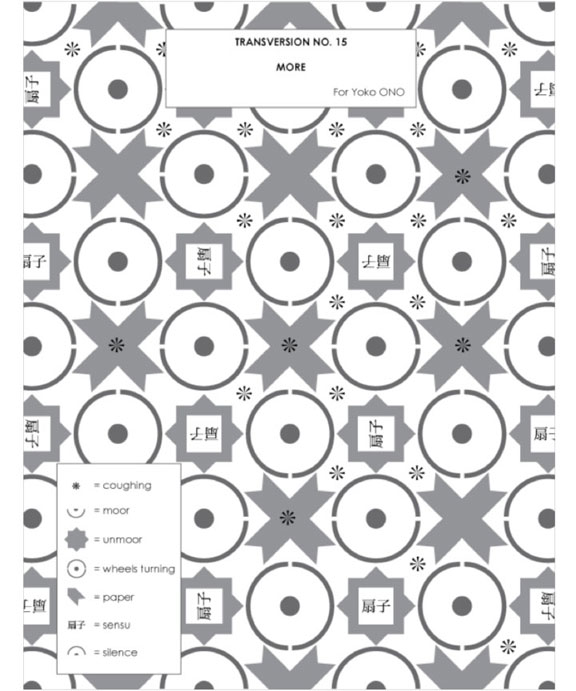
backwards. Our transversion provides a visual performance score in homage to
both Métail and to Yoko Ono, whose work we admire.
15
Trois Fablettes à croquer
A Michèle MéTAIL
2 → Cléopâtre charme Pompée
d’un tube qu’Antoine a pompé
Mais brusque il écarte d’un geste
Ce refrain qu’il déteste
Moralité:
mité
le moral «hit », hait.
13→ Des anglais en automobile
avaient un five-o’clock en ville
ils voulaient sans en avoir l’air
boire un vocabulaire
Moralité:
citez
Le mot « rallye-thé »
2 → Je n’ai pour tirer ma voiture
qu’une œuvre écrite sans rature
Or pour mes Odes mes Atrides
il faudrait une bride
Moralité:
Mettez
le
mors á Litté.
13→ Un autochtone de Rabat
toussait courbé sur son grabat
tant qu’il était par trop facile
d’attraper ses bacilles
Moralité:
Quittez
Le Maure alité.
15
Three crunchable Little Fables
For Michèle METAIL
Cleopatra had charmed Pompey
with a tube Antony pumped
But brusque he removed with a geste
This refrain he detests
Morality:
mothy
the moral “hit” he hates.
Englishmen in automobile
had a five o’clock at the ville
They wanted surreptitiously
to drink vocabulary
Morality:
quoth he
The mode “Rally-tea”
To tow my car I only have
a work written without a scratch
But for my Odes my Atreidae
I would need reins
Morality:
Apply
the ’more on Litty.
A sickly native of Rabat
coughed hunched over on his cot
so excessively that with ease
one could catch his disease
Morality:
Leave
The Moor’s reality.