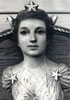
From WOMEN ON WAR: An Anthology of Women’s Writings from Antiquity to the Present edited by Daniela Gioseffi,and published by The Feminist Press @ CUNY Graduate Center, NY, March 2003. All rights reserved.
Translated from the French by
Daniela Gioseffi and L. B. Luttinger
Marguerite Duras (b. 1914 -1996) is a French novelist and author of many internationally reknown books. She was born at Gia Dinh, in Indochina, in the suburbs of Saigon, in 1914, a few weeks before the outbreak of the First World War. She wrote of the war crimes of World War II in her critically acclaimed memoir, The War, from which this excerpt comes. The description of her husband as a concentration camp survivor, and their struggle to live and go on is poignantly depicted. The entire book is an insight into what is often women’s lot during times of war, as they wait in tense anxiety in suspended lives for soldiers or loved one to return from the front lines or prison camps. Like Smith’s classic All’s Not Quiet— The War demonstrates the destruction of life’s normalcy, and is a story of youth’s love and passion destroyed and wasted by war. It is based upon Duras’s own life and marriage in 1939 to the poet Robert Antelme and events in Paris (c. 1942) under the Occupation and Résistance. Duras’s husband was arrested along with her sister-in-law, Marie-Laure, who died in deportation. Antelme survived and was brought back from Dachau by François Mitterrand, who introduced Marguerite to the Résistance and accompanied the Americans as they freed the camps. After the Liberation, Duras joined the French Communist Party, as many did in reaction to the Nazi Holocaust, which she left in 1950, after the Prague Uprising. By the age of thirty, in the stir of creativity of the post-war period, Duras became eminent among the Paris intelligentsia. Her neighbors at Saint Germain des Prés were Jean Paul Sartre and Simone de Beauvoir. Yet, it would take another forty years of hard work before she became a leading figure in the world of literature and the cinema.
From The War: “We Must Share the Crime”
There’s an awesome amount of murdered people. There’s really monumental numbers of dead. Seven million Jews have been exterminated—carried in cattle cars, then gassed in specifically engineered death factories, then burned in specially built ovens. In Paris, people don’t talk about the Jews as yet. Their babies were handed over to female officials responsible for strangling Jewish infants and experts in the art of execution by putting pressure on the carotid arteries. They smiled and said it was painless. This new countenance of death has been invented in Germany—organized, rationalized manufactured before it met with outrage. You’re amazed. ….Some people will always be overcome by it, inconsolable. One of the grandest civilized nations in the world, the age-long capital of music, has just systematically murdered eleven million human beings with the absolute efficiency of a national industry. The whole world looks at the mountain, the mass of death dealt by God’s creature to his fellow humans. Someone quotes the name of some German man of letters who’s been very upset and become extremely depressed and to whom these matters have given much fodder for thought. If Nazi crime is not seen in world terms, if it isn’t understood collectively, then that man in the concentration camp at Belsen who died alone but with the same communal soul and class cognition that made him undo a bolt on the railroad one night somewhere in Europe, without a leader, without a uniform, without a witness, has been betrayed. If you give a German and not a collective interpretation to the Nazi horror, you reduce the man in Belsen to regional dimensions. The only possible answer to this crime is to turn it into a crime committed by all humanity. To share it. Just as the idea of equality and brotherhood. In order to bear it, to stomach the idea of it, we must share the crime.
