Poems from The Striped World in this issue.
_______
Writing the Ocean & the Zoo: An Interview
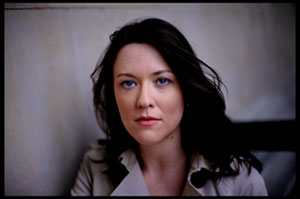
with the poet, Emma Jones
by Melissa Buckheit
MB: Hello, Emma. It is such a pleasure to
speak with you about your debut collection, The Striped World (Faber
and Faber, 2009), its movements, themes and influences, as well as your current
writing and travels since its publication. The Striped World wields
its own power of language and lyric on a confluence of themes and subjects—historical,
personal, & natural. When I first heard you read from your collection at
the Stanza Poetry Festival, in St. Andrews, Scotland in 2010, I was struck by
your control of language— below a surface staidness reminiscent of our
everyday speech, you reveal a power sourced in the idiosyncracy
of the colloquial, in the sentence form and within it, the question and answer,
as well as the roots of Latin and Anglo-Saxon. To this, an almost gentleness
toward the objects and subjects of your book emerges; your use of language sets
your subjects, narratives and ideas apart from the common, reveals their
humanity (or animality, I suppose), and particularly,
their complexity. The various speakers, whether you, a third-person narrator or
a character or person, are not black and white, but grey—above
all, they speak truthfully and directly. You often use unique pairings of nouns
and verbs to highlight the strange or a sense of survival. In your voice, there
is often playfulness, and a dark and mordant humor often linked to melancholy.
Please speak about some of these ideas—your use of language, emotion,
tone, depiction of subjects/objects, and your musicality and sources.
EJ: Thank you for reading the
poems so closely and sympathetically. And for
saying, very generously, that I have control of language. I don’t know if this
is true but I do have a tendency when I write to pare back. Not as part of some
minimalist philosophy but because I want a distilled language I suppose, a
concentration. And I do find that individual words will resonate more widely
and ambiguously the less you pad or accessorise them.
But that desire to pare back can also go hand in hand with an impulse to
imaginative extravagance, or the desire to knit together a variety of voices
and shifts in tone. There was a certain breakthrough when I began inserting ‘speech’
of people and often objects into my poems, and making the inanimate speak (it’s
funny, but I never noticed this tendency until the poems were collected, and
people pointed it out to me). This is a way I suppose of not locking the poem
into one perspective, or showing that you’re aware of the limits of
perspective, and are very interested in those limits… You say my speakers are ‘grey’,
and I like that. A friend once described them as exhibiting ‘sfumato’, and I like the cinematic or painterly quality of
both those descriptions, that sense of a fading in and out between speakers and
objects. This certainly happens throughout the poems, not that the process was
that self-conscious at the point of writing. But I like to admit polyphony and
fragmentation without sacrificing the shape and the momentum and the sense of
completeness in a poem, which are very important to the pleasure I get from
writing a poem, and from having written it – poems can appear to me very
musically, as shapes and as structures of sound, before I’m properly aware of
their ‘content’. And that sound has a visual quality, and can come to me as a
visual representation, a kind of primitive score. So I work on different parts
of the page according to that mental picture, and have the sensation that I’m
knitting together some ‘whole’, however fictive or ephemeral or naïve that
sensation might be.
I
like too that you say my characters speak directly and truthfully. I feel they
have no choice, that the types of creatures I write are always embarrassingly
sincere, even when the sensibility of a poem is ironic. I have a poem, for
instance, from the point of view of a goldfish in a little bowl, surrounded by
the dingy paraphernalia of a little goldfish bowl, whose worldview is
high-toned and quite kingly. The poem’s ironic but the fish is serious. Perhaps
that’s what you mean by humour linked to melancholy –
both humour and melancholy are often triggered by a recognition of the strange. And they illuminate the strange.
One of my favourite books is Charlie Chaplin’s
autobiography, which is a very melancholy book. There’s one chapter in there which is more or less a descriptive list of famous, suicidally depressed clowns. And when you write poems and
create speakers you often have the sense that you’re exhibiting a pack of
clowns, who may or may not know that they’re clowns, and that you might be the
biggest oaf of all. There’s a line from a Geoffrey Hill poem, which I’ll
misquote because I’m plucking it from memory, which goes something like ‘himself
a clown, and a judge of clowns.’ Maybe most poets feel that way. And to tie
these things together for a minute – the idea of different speakers and
subjects/objects, and the sense of a poem as a maudlin curious thing and as a
whole and as a performance – I think that certain antic shifts in tone
and voice are one of the strengths of poetry. I find it confusing when people
talk about a poet finding their ‘voice’, as though this were a unitary thing. I
don’t see why poets shouldn’t have as many voices as actors have characters.
MB: Yes, an interesting idea
of confluence. This is very true of ‘voices’. I agree from within my own poetry
writing. It is often challenging for others when one may write in many
different styles and with different voices, tones and sensibilities; I think that a poet is often expected, like you say, to
have one voice. This can be boring and is also quite limiting, as well. Emma, what
were you reading during the years when you wrote many of these poems? Were there sources which influenced you, particularly,
whether evident in your texts, or not?
EJ: I wrote one or two of the
poems when I was pretty young, an undergraduate. I was reading English at
Sydney University and was lucky enough to have teachers, some of them poets,
who introduced me to a pretty wide variety of literatures and theories, which
stimulated me: you know, Milton and the Modernists and contemporary American
poetry and Central European poetry and Australian novels all at once and without
a sense of hierarchy. I wrote most of the poems as a postgraduate student. I’ve
always read a lot in translation. It’s hard for me to pinpoint where an
influence begins or what my sources are. Like a lot of writers, I have a
tendency to syncretism and my work seems to reflect that more and more. It’s a sort
of sad casserole. Saying that, there are some encounters that have changed the
way I write, and which I can see blaring through, even though these are rarely
the things that are commented on: city architecture, ballads, religious art, the Blues. I’d say I’m as much influenced by music and
cinema as I am by literature.
MB: I’m also curious about the geographical
movements of the poems—you travel from Australia to Europe, England,
America, to the oceans and across ocean-beds, and back to Australia with its wide open spaces. How did place and the local, as the art
historian Lucy Lippard calls it, surface and shift
your work in this book, from narrative to style and beyond? Did travel also
influence specific poems?
EJ: I’m
an Australian who lives in Europe a lot of the time. My mother was English. I’ve
moved around a lot in the last five years. I don’t often feel very at home, or
very foreign. I think this movement has mostly inflected the visual vocabulary
of my poems, for want of a better phrase, and imagery in my poems isn’t
ornamental but does conceptual work. That is, I think through things. Certain things that appear –
very green fields, leafless trees, cobbles, the wrought-iron Rococo cages of
older zoos – wouldn’t have appeared if I’d spent all my time in
Australia. But are they always interpreted through a lens of strangeness,
because of where I grew up? Probably. But I don’t think I’m interested in
change and difference because I travel; I think I travel because I’m interested
in difference and change. And certainly there are things I’ve come across as I’ve
traveled that have been jumping-off points for poems. I spent a winter in
Provincetown, Massachusetts, which led to a very place-specific poem called ‘Citizenship’.
So a particular place will sometimes provide the narrative germ of a poem,
though in terms of their preoccupations they’re not really poems of landscape
or place as such. I wish I could write such grounded poems.
But
in terms of the local and the specific, I think Sydney has been very important
to me. It’s my city. I think it’s shaped my tendencies of thought. There are
certain motifs that recur in my poems – certain interpenetrations of
water and glass for example, and the motif of the reflected city – that
are probably imprinted in me because of Sydney. I wouldn’t say they were just
cosmetic, or decorative though. They’re recurrences through which I think things through. But local, yes. My
tropes would undoubtedly be different if I’d been from, say, Dresden.
MB: Your poems’ movements are vast in the best
sense of the word—you encompass strange and unique narratives, with
figurative shorter poems, mythology, history, personal narrative and parable.
Amongst these forms and experiments, you write about immigration, colonialism,
prejudices based on race, relationships, both familial and other, and the many
reflections and guises of the self. Please speak about this confluence in your
book. What organized your attention and focus? What were you essentially trying
to achieve?
EJ: I’m glad you use the word ‘confluence’,
because I find it hard to unpick where those different preoccupations end and
begin. The more political preoccupations I generally approach through
narrative, but even then, at the heart of these narratives there’s often a
character or figure or object that compresses (at least in my mind) those more
varied preoccupations to an indissoluble point – the parrot in ‘Zoos for
the Dead’, for example, or the pearls in ‘Farming’. I think in images and I
often write through compressed metaphors, which are the linguistic relatives of
images. And, as you say, in analogies and parables, which come to me as brief,
intense vignettes, almost like movie stills. These are the things that organize
my poems I guess, or at least the things around which the poems orbit. And
there’s that fascination with where the self begins and ends – the masks
of the self which are no less genuine for being masks.
And this feeds into the more ‘outward’ looking poems about things like
immigration and colonialism because these narratives and their consequences
partly organize the self. I think that there’s sometimes an assumption that
these more ‘philosophical’ preoccupations are solipsistic, and divorced from
the political. I think that it’s opposed to the solipsistic, to examine the
contingency of the self. And to be aware of your own contingency is a
foundation for a nuanced political perspective.
It’s
interesting to me that I didn’t realize the recurrent nature of my tropes and
preoccupations until I was choosing poems for the book, and going through my
work. Writing is the process through which I discover my preoccupations; I don’t
know and then express them.
MB: I like your articulation:
‘the masks of the self, which are no less genuine for being masks.’ This
connects to your previous idea about voices, sources, and the narratives and consequences which organize the self. There
are quite a few poems which touch upon the history of
peoples and events
in Australia, your birth country. Perhaps you could
speak about a few of these poems briefly—particularly their focus on
history and the depictions of insider/outsider vis-à-vis Australia and the
United Kingdom. There seems to be a liminal space
inhabited and created in some of these poems that captures the ‘inbetweenness’ of your subjects and their narratives,
including your own ancestors and family. I’m thinking of “Zoos for the Living,”
and “Zoos for the Dead.”
EJ: Yes, they’re a funny set
of twins, those poems. I wrote a long, bad poem when I was 21, and those two
phrases are the only things I salvaged from it. It was built around an opening
villanelle, and the phrase ‘zoos for the living and zoos for the dead’ was one
of the refrain lines, and the poems then had different sections built around
different lines of the villanelle. The idea was to show the guts underneath the
villanelle’s smooth surface. The phrases stayed with me after that poem, and I
knew I wanted to write poems with those titles, though I didn’t really know
what they’d be. I wrote ‘Zoos for the Dead’ first, over a couple of years. It’s
interesting that you speak of inbetweenness, because
that poem evolved similarly to the initial poem, in that it’s built around the
intersection of certain narratives and forms, and the inbetween
world they create. The poem starts as straight terza rima, which gets
increasingly interrupted and fractured as different narratives, real and
imagined, intersect. And then you have these other
inbetween elements – the imagined underwater
society, that alternative commonwealth, and the imagined, projected history of
the parrot Narcissus, and the shipwreck, and these things are liminal or hybrid or compensatory and mostly sad.
Narratives are where we keep our ancestors. Libraries are where we keep our
ancestors. Languages contain them, and all these things are zoos, where we
stand and stare, or so it went in my mind as I was writing the poem over time,
though I wasn’t conscious of these things in the blatant terms with which I can
speak of them now. I think I’d write it differently now.
I wrote
‘Zoos for the Living’ a couple of years after I finished ‘Zoos for the Dead.’
It was conceived as a sort of living twin to the other poem’s stiff little
effigy – it was about immediate ancestry, rather than more distant
ancestry, though there’s a little mirror there, in the sense that my mother was
English and came out to Australia, and she did this through an immigration
program that was part of the same general White Australia policy that saw mixed
race children being removed from their families, which is described in ‘Zoos
for the Dead.’ And the whole UK-Australia immigration pattern forms part of the
scheme of that other poem too, and for a long time I’d seen my very white skin
as a kind of telling material, a material consequence of a particular
worldview. And if we interpret ourselves through narrative, these, I thought,
were narratives for the living, they were more personal, though there’s a
drowned society here too – a flooded town in the case of ‘Zoos for the
Living’, rather than a shipwreck, and the interwoven narratives of that town.
One thing that I regret about that poem is that I ended up cutting a lot of the
quotation marks that were originally included – many of the phrases about
the history of the town were from a newspaper article and are quoted verbatim,
and that history is very much bound up with a kind of folk or bush poetry that
was my first experience of poetry, and is important to me for that reason. And
I made the quotes and my own words connect cohesively without any obvious
rupture, to mirror the smooth way in which the narratives we create often
smooth over the ruptures in our experience and personalities, and our distance
from ‘history’ – just as water covers a drowned town.
MB: The book’s title The Striped
World, prepares us for both an extended metaphor
and a
reality of animals in nature and animals in a zoo. The zoo is not only reserved
for animals, and the animals are a stand-in, it seems, for our human experience
as well— whether pacing, locked up, restless or speaking. And the animals
seem to also be animals. Your poem, “The Mind,” feels like one key among many
associations and intersections between your multiple themes and your chosen
metaphor—and their clear yet complex relationships; animals, characters—pearl,
tiger, the girl, creator, zoo—surface in
multiple poems. Please speak about some of these ideas and the concept of the
zoo.
EJ: A zoo is a kind of Garden
of Eden, but a fallen one. You know, there are the gathered animals, and then us,
the self-conscious apes, walking around, marveling at apes. A zoo is also a
tiny empire. I wasn’t even consciously interested in zoos until they began
surfacing again and again in my work, and now I have a fascination for them.
They have their own particular iconography. Elephant houses are Orientalist and domed – in the older zoos anyway –
and apes have quasi-natural enclosures. In most zoos, emphasis has shifted from
curiosity to conservation. But there’s still that element of curiosity, of
kitsch. I go to zoos wherever I travel and they all have, for me at least, that
atmosphere of a melancholy afternoon dream. And conceptually they cluster
together all sorts of things – notions of collection, arrangement,
taxonomy, perception, spectatorship, ownership, how I tell what I am, what you
are. There’s also a lineage of caged animals in poetry… It’s funny,
the title of the collection came to me quite late, though looking back it
unites so many of the poems. I’d been trawling through and reread my poem “Sentimental
Public Man” – which isn’t openly about zoos at all, and came across the
lines ‘my barred heart / saw the striped world move like a beast’, which I
realized was a concentration of what many of the poems were on about –
the way subjectivity is a little enclosure, and the world the thing that is
looked at, and that looks at you.
MB: Your book is dedicated to your mother,
Maureen Jones, who passed in 2007. Several poems seem to speak about your
relationship. The depiction of birth emerges again and again. I’m thinking of
your first poem, “Waking,” in particular. If you are comfortable, can you speak
about this subject and its relationship to the other themes in the book? Were
you still writing this book in 2007, or was it already complete before then?
EJ: I’m pretty fascinated by
birth, that point where you’re yourself and not yourself, separating from
another self, when you ‘come into your own’ in different ways, though of course
you’re not immediately individual. Most of the poems were written before 2007. A couple were written in late 2007 and early 2008 – ‘Conversation’
was the first poem I wrote after the death of my mother.
MB: I’m wondering what you have been
occupied with—both in work and writing— since The Striped
World came out. What preoccupations, investigations or themes are
you concerned with in your current work?
EJ: It’s been an interesting
couple of years. I’ve done a few poetry fellowships – a year in the Lake
District in England, some time in Latvia and Italy and, of course, Australia.
It’s been a time of real re-evaluation in terms of how I write. There was such
a wonderful lack of self-consciousness about the way I wrote the poems in The Striped World. I was a student,
reading a lot, and writing a lot, drawing on different things, but not
publishing much and not at all interested in the more sectarian side of the
poetry world. Then you publish and you’re ‘placed’ or asked to place yourself,
which isn’t intuitive for me, and you become more self-conscious about how you
write, and why you write. So I’ve experimented with some different forms of
writing; I’ve written more slowly, though I’ve always been a slow writer. I’d
say that what I’m working on is more overtly musical in a formal sense, and
more concerned with address. I’m working on some secular psalms, which draws
together a lot of things for me – a psalm is the ultimate apostrophe and
is also a song. Arab poetry has been one rich source for me in the last couple
of years. I’ve also been writing poems to do with metamorphosis, and with
cinema.
MB: I know you have been traveling a lot
recently. I’m curious about your interests with traveling and its influences on
current projects.
EJ: Australians travel a lot, so it’s a cultural thing partly. I’ve
wanted to travel since I was very young. Of course when you’re doing it there’s
always that worry that you’ve invested in some indulgent life-experiment or
other, but it’s important to me. For me, writing and traveling seem related
somehow. I think it’s influenced my recent poems in the sense that they’re not
very rooted; with one or two exceptions, they’re not ‘set’ anywhere at all.
MB: This current issue of The Drunken
Boat is partially-themed around ideas of self and other, dark and light,
death and loss, and dual experiences, for which I used an excerpt of Jacques Roubaud’s The Plurality of Worlds of Lewis, as an
inspiration and prompt. I feel like many of these subjects exist in your
writing. Can you speak personally about your conception of self and other,
among other ideas?
EJ: There’s a short poem in my book called ‘Equator’, about
those rituals that take place on ships when they ‘cross the line’, and it plays
with the idea of binaries and of dual experiences and the ways in which these
can be both profoundly real and also illusions. I’m really interested in
meaningful illusions. You know, in the fact of gradation – isn’t
everything shading into everything else in some way? – and
also in the undeniable isolation of certain states of being, certain situations
as we experience them. So, yes, ‘self and other’ crops up a lot as a point of
fascination – maybe it’s also behind that recurring birth motif –
because to me it’s astounding that we achieve inter-subjectivity and yet we do,
daily, and there’s that grey area of relationship, communication,
inter-personality, projection. And poetry – any art form actually –
is a space where you can dramatize this in all its fluctuation and uncertainty,
because it deals in provisional truth, not rational truth. It’s the sort of
mirror where distortion is ok, distortion is the
point, because distortion is a part of experienced reality. A Cubist painting
is a realist painting, etc... So I’ve been working on
some poems which deal with the idea of what constitutes self and other in a sort
of innocently literal sense—you know, reflections or shadows addressing
their ‘owners’, that sort of thing—that old childish fascination with
where ‘I’ ends and something else begins.
MB: Lastly,
I’d like to ask you about a preoccupation which has interested me for a long
time—and one about which I have spent many hours reading and researching.
You seem to try to balance a life of writing, traveling and teaching, among
other activities. Yet, in the midst of work such as teaching, which involves a
lot of speech and perhaps an over- exposure at times to language not
necessarily akin to poetry, there is the intention and necessity to create the
space for silence and solitude—utter aloneness. I believe this is
absolutely necessary for the self and for art, as well as spiritual and somatic
realities, in the most spacious
sense of those terms. How do we do this, and is it possible? How
do you carry these impulses, that don’t always converge? I also believe
there is a self we only know when we are fully alone—an experience which
again converges with the creation of literature, art, dance, music, etc... Additionally, travel allows us a freedom and relief; in
a way, we are concerned with how we create both an ‘inner space/world’ for the
writer, as women and people, for example, in the home, etc...,
as well as how we create an ‘outer space/world’ for the very same thing—freedom
of self and spirit. Both of these spaces can be freedoms or not, and hovering
near all of this reality, is the necessity to earn a living, which brings us
right back to balancing teaching (or any given work) and the creation of art.
This was a concern of Woolf’s, evident in many of her novels
and
personal writing/diaries, as well as some essays. I’ve just dredged up a lot
for you; perhaps you can speak about this, both personally and academically.
EJ: I had this idea for quite
a long time that I would be an academic, that it would be a sensible choice, a
good and sympathetic way of earning a living while I was writing poems, and of
finding that balance. And I think it would be, if I had the stamina for it. But
you know, I was a graduate student writing this thesis, and living with this
thesis, and I slowly began to realize that if I spent too much of my life
writing criticism that it would take something from the poetry, that I’d end up
feeding my poems to some monstrous form of the thesis, for decades. Or so it
went in my head. Some people can write poetry and criticism together very well,
but unfortunately I’m not one of them. I’ve had to accept my limitations there. Saying that, the fellowship I have at the moment involves
teaching, as opposed to research, and this has been great. It’s great giving an
undergraduate a Yeats poem or a Stevens poem for the
first time and watching that little bomb take root and rattle. But it does, as
you say, take a different mindset to do it well, an expansion outward that can
be at odds with the solitude that’s often needed for writing. One way that I
get around this is to have certain chunks of the week that are packed with work
and social commitments and to leave other days free for writing; it’s a
practical way to trick myself. I also find that I tend to write in seasons; I’ll
have a few months when for whatever reason I write like mad and then I’ll have
more fallow time, when I read a lot and think and wait. I think a lot of the
writing of poems is in the waiting… But I do like your suggestion of the self
that emerges in solitude which we can’t know at any other time, and I do think
it’s connected with the writing self, however we define that. Some of my poems
start life as ‘spoken’ phrases that come into my mind very clearly and without
warning, and because I tend to think in pictures rather than words I take these
moments seriously, because they’re unusual. And this happens most when I’ve
been able to pursue a sort of idleness and aloneness. Though perhaps I’m just
trying to justify a kind of idleness that I’d hate to live without! I think it
was Borges who said that the task of art is to transform what is happening to
us, what is continuously happening to us, into symbols, and that a poet never
rests, because a poet is always working, even when they dream. So perhaps that
can be a justification of sorts for what can seem like a vaguely voluptuous
life, traveling about and taking yourself very seriously and reading and
writing, which, at the end of the day, is staring at so much paper.
MB: This
makes great sense—I do believe there is an idleness and aloneness which
we cannot live without; we must seek it, for ourselves, and because what is
beneath the daily is its own sea. How good you’ve realized the work and
movement (traveling) which you seek. Thank you for speaking with us and
sharing your work, Emma.