
“Ngor ge shuin”; “Waah, lang jai” translates to: “My grandson”; “What a beautiful boy!”
_______
More poems and contributor notes in Chinese feature
_______
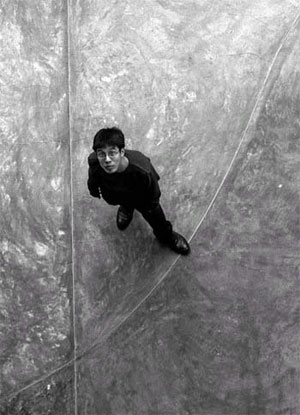
Toh Hsien Min
Grandmother Thng
You died when I was six. My peashoot mind
Broke into an empty flat. I had
To force the tears, so great was my disbelief;
So great my disbelief, so sternly firm
The ghastly coffin in the void-deck where
I dropped a magic pen into the drain
And the waters carried it away. I spurned
Your instructing comfort, soaking in my pain.
Your block’s lifts always were in disrepair,
Dim, slow, a stink of stale urine in it.
You soothed me with a Milo and Marie
Biscuits. Your lips were full, too large, I thought,
For you to have been beautiful. You hit
Me lightly for my impudence, and brought
Red chillies from the kitchen. You loved me.
Most days we would wade through Chinatown.
I nibbled on a salted cabbage leaf
Fresh from the brine, moving from stall to stall,
Sometimes losing you; you were so round,
Your arm was like a leg of lamb, and all
Your samfoos were unsleeved. It was a relief
To sit down in a dim sum restaurant
And roll the tea-cups in the scalding water.
Or else we stopped beside the bamboo hag
With her pots of soup, I ready to dissent
If you asked me to drink a soup of gag
Of herbs or baby chick knob-winged at slaughter.
Some days we turned the corner to Temple Street,
The asphalt squeaking with dirty water, the crowd
Less hoar-haired. There you bought at sundries shops
Your favorite sng buay, which I couldn’t eat
Because it was too sour. A few more stops
For medicine-hall powder or a loud
Exchange of words with a friend, in which you would lay
Your hand on me and claim me, “Ngor ge shuin”;
“Waah, lang jai” your friend would rejoin; and back
Up Neil Road we would trot. You used to say
First what a good boy I was, then switch tack
Bluntly, and though I made a face like a prune,
I would tread on your back to firmly massage
You. As you slept I crawled beneath your bed,
Trawling spiderwebs or playing at tents,
And rolled on it when you got up, or barraged
It with my weight, picking up the scent
Of Tiger Balm. Some days I quietly read
An Enid Blyton, or admired my aunt’s
Books, a Lady Chatterley’s Lover chief of them.
The woman on the Emma cover had
Your face: a plumpish one, with brows that danced,
And lines I would love to write, which greyly bred.
In the evening from work my parents came.
And after all these greening years I find
That I am no less salted by my grief,
Incapable of love still, heartworn, dead.
(Published in The Enclosure of Love, 2001)
The Country of Anaesthetes
In Asian civilisations there exists a tendency to central control.
Think of the river of Chinese empires beginning with the Qin,
the Mongol empire, the Mauryans, the Malacca Sultanate.
Greek democracy and Roman fori would take
a couple of millennia to come through, and even then,
think of how poorly they have been carried out, in places like
Indonesia or Taiwan. When Woodrow Wilson said
the Allies were making the world safe for democracy, he didn’t think
to make it safe from democracy. Now, China, Vietnam, North Korea
all embody the Asian tradition. It is not that they do not strive for
higher virtues, but that these consist in a subordination to the state,
rather than an exertion of the individual.
Little countries can also build little empires. Without military might
or geographic possibility, one presses on in other ways.
One could dominate in economics or culture. Here,
in the country of the anaesthetes, we build an empire of souls.
Our method is the supreme art. We give our citizens
a plethora of choices, but take away the facility of choice.
We detain them in concentration camps, thrust them beyond
their fragile bodies’ limits through forced marches
under blazing sun, through blades of lallang, spears of mimosa
and mud, against the assault of mosquitoes, until they understand
no other means of survival than to bend, double up, fall prone
to instructions mushrooming like artillery shells, and, key to all,
learn how not to feel, so that the early mists, noontime broiling
and the tepid night of blindness are one and the same,
a recoilless spinning out towards an amnesty of nothing.
In this way we trade senses for control, ability for efficiency,
the extremes for the average. Horace says merely to wish
is not enough, one must desire passionately, in order to
achieve anything, and if we are to be empowered over our people
we must not let them desire. Or rather, we must teach them
to desire what we want them to desire, and in this way replace
what they might feel with what they do not. It is well known
that a ripening fruit shares its mysterious charge with other fruit.
We must be this fruit. We must allow our people, from time to time,
a taste of our sweetness, which they are now unable to cry for
before the malic acid of youth and the bitterness of age,
so that we can gather up more sweetness,
more sweetness than even we can gauge.
Festival of the Hungry Ghosts
The Chinese family business next door is burning ancestral offerings
again, and the smoke is slipping through our glass doors like the spirits
supposed to be roaming the earth this month. Something as hostile in me
wants to march fiercely up to them with a fire extinguisher and spray
potassium bicarbonate all over their rusted metal urns, but then
all hell would break loose, and something much worse than smoke
might come through our glass doors during the witching hours.
Instead, I content myself with this: if it is true that whatever we burn
ends up in hell, then rampant inflation is the least of their worries,
for our incinerators burn a few hundred tons of garbage every day.
I do hope the spirits are better at recycling than we are, but if it also
worked in reverse, which, judging from daytime TV could well be the case,
things mightn’t be so bad. With an ecology between them and us,
our energy reserves would never run out, and population renewal
would cease to be an issue. And on top of that, hell would be free
of mosquitoes, the air would be sweet with aromatherapy and tobacco
and their forests will be lush and green, and if we still do not have
a burning desire for a hastened cremation we can comfort ourselves
every time we get hot under the collar, as I am right now thanks to
the acrid stench of combusted paper in my office, not only because
there’s no smoke without fire but also that we can return every summer
like a convection current to bless our children and our children’s children
with all the sweetness and warmth and light of our new demesne.
