Photo by Charles Valle
Kundiman www.kundiman.org
Contributors
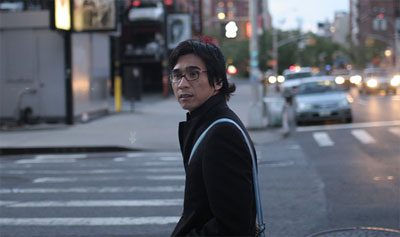
Joseph O. Legaspi
There are horses galloping.
Skeletons rattle their bones beneath the dirt.
I eat lamb for breakfast
and the ewes inside me lament.
Half moons are caught in my fingernails.
When the horses come they bring the road with them.
I stand
here, a dark valley.
The pigs squeal in forked tongues.
A figure approaches;
he has the lights of my fingernails to guide him.
My grandfather. My mother’s father,
the first to cease the world
as soon as I entered it.
He walks by, so close
the hairs of my arms brush his.
The roosters roar, laying their eggs.
Others follow: grandmother, aunts, cousins, uncles, grandfather.
I wait for the secrets of the dead to drip out of their mouths,
I wait to ride the fiery, galloping horses.
While I possess the sentimentality of unloved children—
as with love, I believed death with its bag of tricks happens
to other people, dark smoke of mourning fumigating their houses—
I’m struck with prickly astonishment when I realized it is August 12,
my father’s first birthday after his death. I step onto cracked pavement
and there he is steam rising from a manhole as if from an otherworldly
distance unfathomable, then he unfolds like a red carpet for a herd of thundering
wildebeests. How death plays tricks on you: this is Manhattan, a sultry late summer’s
twilight. The traffic horse is married to the landscape, humidity kisses skin to perspiration.
Here’s death’s candor before me, celebrating itself: mice chewing the electric circuitry of a house
until it falls into darkness. Here’s a day’s strange fusion of birth and death, a collision
of a beginning and an end: Do I pray or blow ghost candles? With birth life bursts
forth from a tear, it is bloody; with death life’s ripped away, drainage of one’s blood.
Birth comes painfully, expectantly; death holds no guarantees. This remembrance:
perhaps I loved my father—enough—to commemorate him. . . But death is no ars poetica,
writing is no transcendental match—measured, powerless, unequaled—this elegy dies here:
death the holy roller in its cinematic glory ascends like a song from a gospel church choir.
Moose are drawn to roadsides during rain,
explains Olga over oatmeal in the dining hall of an artist
colony in Vermont. She is a quaint-looking woman,
buck-teeth, dark hair parted in the middle, pulled back tightly,
perhaps, painfully, wide-rimmed, thick glasses
from reading too much by kerosene light,
t-shirt with sleeves rolled up her arms.
Again, I find myself in the company of women.
The others are matronly, mothers and grandmothers mostly,
from Midwestern states, and a Mormon college girl
from Idaho, all poets, oatmeal-replenished.
Her friend Amanda hit a moose once,
Olga continues, it happened on a drizzly late afternoon on a hillside
in Massachusetts, the animal bolted out of the hazy greenery
as if expulsed from the kingdom of ancient trees.
Amanda tried to veer, there was not even enough time to brake, and she
hit the bull, her car was totaled, crushed metal, oil puddle, hissing steam rising
and mingling with the drizzle. The moose vanished into the quivering
thicket of early spring. She called for help. Olga and three
other women came, picked up Amanda, searched for the moose
they found dead 100 feet away, they dragged the beast, tied
it onto their truck. I can only imagine this woman, in charge,
draining the buck’s blood, skinning the animal, scooping out
the viscera, the heart, her fingers between the liver and pancreas,
this woman crawling inside the rutting stag, hacking at the meat,
dividing the venison five ways. I think: I will write a poem
about this, and Elizabeth Bishop would not be happy,
but she is dead, like the moose. When I look at Olga I see her
snip the scrotum with her knife, then letting the sac dangle
between her teeth. What did it taste like? one woman asks.
Beef, Olga shrugs, If you’re used to eating venison, it tastes like beef.
for Ching-In
To you I am bacon
sizzling on an iron skillet,
bubbling forth sexy meatiness
to your doldrum life strip by fatty
strip of animal nitrate juiciness.
I am your food of joy,
gastronomic rock-&-roll, low-
carbohydrates South Beach diet
propaganda. How you clamp
like a fat-o-meter but as you can see
it is unnecessary. I’m svelte
to a T, a runner’s body, yet unable
to outrun you. See these horse-riding
hips, these flanks if they were any more
graceful would belong to a stallion: Pegasus.
But let me revise these metaphors—
there are no cornflakes nor crumbs
in this meatloaf; I’m lamb
in mint sauce—rather here’s an atlas
of my body, all smooth arches, steep
ridges, deep crevasse, lines plunging
down the side of my torso, gluteal slope
you can balance a cup on. And skin,
twenty square feet of tactile heaven.
(I moisturize everyday and exfoliate
at least twice weekly.) And nipples
like soldiers saluting to high authority.
I set my hair high, my tall faux-hawk,
a set of hair most men my junior pray for.
Here are further revisions. An organic metaphor:
my arms are thickened vines. Artful:
if I were a painting I would be a haloed peach
hovering over a four-poster bed. Oh, but I
do protest too much. You hear my body
hum, but you want it only to burn,
in a pit underground, and from the ashes
and charcoal, you unearth me, your roasted pig.
I’m hiding from the doe-eyed mailman
with his Hallmark greeting cards and sincere
gift packages predictably containing blank
journals, music, the current post-postmodern
literary tome, other tokens of the zeitgeist,
and my mother’s walnut brownies. You see,
I’m a sophist, a writer and a liar.
My mother has never baked brownies,
nor has she sent care packages laden with sweets,
or salts. The phone will ring and she’ll be at the other end.
My answering is being debated as I speak.
As this poem exhales away time, second
after fatalistic second, like a fox fallen through thin ice,
struggling to save its dear life in the frozen lake.
I find the previous simile overtly dramatic.
No matter, for now the noon sun shines,
my curtains are drawn, I called in sick and imagine
my birthday cake ablaze in the office conference room.
How could a thing made of milk and sugar be so lonesome?
But there won’t be cake. The cubicles offer no space
for such sweetness. I want to stay
in bed, fetal positioned under the blanket,
perhaps, take an Ambien and sleep through the day,
knowing there are 364 more like it. Such futile work.
There is too much of me in this poem: let the mailman bang
at my door, let my mother question what I am doing with my life,
let the baker bleed and feed me chocolate cupcakes with butter frosting.
I want to perform a ritual: a bloodletting of birds. Thirty
species of earth’s angels from an Adelie penguin
to a yellow-shafted flicker—finch, robin, pheasant,
in between. A prick, a drop of blood,
and once again, the ostrich dashes across
the African savanna, the swan postures on an inlet
under an orange twilight sky, and the mockingbird disappears
into tree shadows in the wilderness, echoing the painful beauty
of all my passing years.
