Moon Song has appeared in past issues as a poem-in-progress. We are pleased to present the entire poem in this issue.
To see other poems by Mordechai Beck, see our Spring Issue, Summer Issue and Fall.
______
Contact
Mordechai Beck
Moon Song
An Electronic Chapbook by 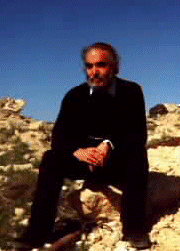 Mordechai Beck
Mordechai Beck
Nissan
We pulled out of Egypt, your face aglow,
with us, kinder, kine, and candles for the long journey,
and what was owed us after all those years of unpaid labour—
with interest (this was before Sinai, when interest was still permitted).
We pulled out with the taste of bitter herbs smarting our gums and
mouths and your fullness barely scraping the gangling tops of
the palm trees or the pyramids to which we’d contributed our full share
and which we finished by reciting a blessing:
“May they all be buried thus, speedily within our days.”
It was spring and the unknown birds sang us all the way down the Nile.
We pulled into the first synagogue with our burdens and 4,000 years of
exile and hagadda-retellings, as though it all happened yesterday, and
the fresh shoots of flowers and grass shoved their tiny hands through
the soil of our redeemed souls.
Someone in our carriage started to sing the Song of Songs until
someone else cautioned: “What will the Rabbis say?” For, at that very
instant, the sages were compiling a list of losses, of the four/fifths
of our fellow slaves who had no desire to leave the gefilte fish or
brine-soaked cucumbers, and who ended up in Egypt’s eternal dark. So
the rabbis commanded us to add Yizkor to the festive liturgy, and they
concluded as follows:
88888 Redemption, yes. But incomplete.
88888 Half a redemption.
88888 And your glow, moon, began to shrink.
Iyyar
Aleph, Yod, Yod, Resh. Letters making up your second face.
Aleph— Avraham, Yitzchak and Yaakov— two Yuden, Resh— Rachel.
Because of the exile I transliterate: Abraham, Isaac, Jacob, Rachelle.
All founders. All connected to the Land. Unreal Estate.
As constant as the moon.
Smasher of idols, Abraham was driven by a voice from Ur to Haran,
and from thence to the place which is always someplace ‘there,’ and
sometimes not there.
The first immigrant, the first ascender, the first to wage war in the
Promised Land to make it safe for his son Isaac.
How hard it is to be the first.
To be second is no bargain either.
Isaac cannot leave the Land even once.
Even in famine. The Land, and his children’s bitter rivalry blind him.
With his nostrils he blesses Jacob and Esau, but in the wrong order,
and ultimately perhaps it makes no difference.
Jacob, too, cannot see but in a way that saves him.
Wrestling with the dark angel of Seir on the banks of the Jordan, he is
smitten with sciatica— the burden of many a Jewish father trying to
prove to his family and friends how he can be firm and simultaneously
stand on God’s good land.
So Jacob crosses the Yaboq limping and blessed, father of twelve sons
who will father the nation that the moon was building on its far side.
In Egypt, the moribund patriarch requests a burial in the caves of
Hebron, near the oaks of Mamre. Thus do all his sons— the Jacobs,
and the Abes, the Hyman’s, the Moseses, and the Roberts— yearn for
the particular soil in which to bury their earthly remains.
As though they remember Mamre.
Listen to the celebrations in Dizengoff Square, the waving of the flag,
echoed by the nearby sea, the electrified singing and half-remembered
dancing, and the sounds of plastic hammers and sizzling grilled meat
smelling of Marrakesh and the mountains of Atlas.
It’s a plastic joy.
Only Rachelle cries—
a mournful, moonfull kind of weeping,
for those who didn’t return,
and for those who did.
Sivan
You count the days.
We, too.
Between the Valley of the Kings and the rock of Sinai,
we remember Rabbi Akiva, who backed Bar Kochba, the Star Man,
and sealed our fate for 1900 years.
So your sons grow shadows on their long cheeks,
as Sinai casts a light into the future.
Parked beneath the mountain of God in our caravan of cars and camels,
horses and hovercraft (how else do you think we crossed the Red Sea?)
we waited.
Don’t touch the mountain!
Don’t touch your women!
Get too near and you die.
Stray too far and you die, too.
( As with mountains, so with women?)
When the thunder starts and the noise of the shofar
we’re scared witless.
We imagine God
and we experience death, or is it the world-to-come?
We remain suspended between heaven and earth.
Our souls touch you, mother moon.
Our pure souls.
Tammuz
Back in camp we greet the invisible new moon on trust,
though why is not altogether clear.
Dark as death the heavens give us no sign, or perhaps
they do and we do not yet understand.
Like a virgin the moon hides its future;
she could go either way.
But we, the children of the unredeemed, cannot wait.
Released from the thraldom of Sinai we go mad.
Beneath your waning face, we dance around a gleaming calf
as though it could give us milkshake and cheese cakes eternally.
Mindless, we do not see the soldiers of Nebuchadnezzar surrounding our camp.
Av
As Tammuz ends so Av starts, only worse.
Now the moon joins in our weeping.
Denying the Land, spying on ourselves,
we have sinned against the universe.
Nothing will go right. Temples will fall.
We shall perish in Warsaw.
From Genesis to Genocide, we are condemned.
This is the song of Av – the month of the father –
that the former slaves sang when they were denied
visas into the doubtful land:
“To go through the world
making no mark,
like crossing a desert without
leaving a footprint.
A life of sand.”
Ellul
Once runners ran from the Sanhedrin’s gate
to announce the coming of the New Year.
Now there is no Sanhedrin
and the runners run elsewhere.
The runners run everywhere except to you.
They are running into study houses and the synagogue
shouting Gevalte! Yidden! Moshiach Zeit!
But no one listens.
Those in the study houses are no longer lovers.
The lovers are no longer in the synagogues.
They are in their houses, or in hotel bedrooms.
They are in the fields or on the beaches.
They are in other, less holy, lands.
They are surfing the web, and sending e-mails.
They are in love with the raw world as it is.
Your children have returned
but you do not recognise them.
Many of them do not recognize themselves.
Tishre
Happy birthday lunar rock!
Birthday and almost deathday.
The story is found in the Talmuds,
brought down, as they say, by Rashi.
How your sense of fairness almost brought
you crashing to your knees.
Why you thought that your Creator
was any less vicious or merciless
than the men He created in His invisible image
is anyone’s guess.
Can two kings inhabit one crown?
A nice question for a Jewish moon to ask.
Such a riddle, begging for an answer inevitably weighted against you.
You want small?
Be my guest.
Small?
Your wise, insolent question cut you down to your true size
and ended in complete submission to your erstwhile partner,
a mere shadow of your former self.
Only reflect, my poet in the sky,
forever catching the reflection of your brother the sun
only to lose it again. Only reflect,
from your tale of woe comes all dependencies —
men on women and women on men,
men on nature and nature on men,
God on man and man on God,
parents on children and children on parents—
a tragic outcome is guaranteed for all.
So this is your birthday?
Dying monthly, like a woman’s body,
half fulfilled, bloodless,
yearning for rebirth,
full of cratered hopes.
By you, this is the beginning, yet
your children celebrate their ancient exodus
on the other side of the calendar,
half a universe away.
Heshvan
Afterbirth exhaustion.
Month of bitterness, shadows, emptiness,
Marheshvan, mister-bitter.
The month when Noah first sniffed
the blent, flood-free, blood-free air,
full of the scents of the future—
of rainbows, grape-juice, the tents of Yafet.
The month of the scorpion,
and, some say, of artists.
A month of not-celebrating,
except for the rain,
except for the bread on the table,
except for the woman left in the ark.
Kislev
Wet winter days,
splashing the hills of Judea and
the dales of Galilee and running into the stony
depths of the sea of Tiberius, or at Acco where once the Romans
proposed a marble-statued bathhouse, in the Greek style.
Neither Aphrodite, not her Roman counterpart Venus, fazed
Rabban Gamliel who answered the questions of Proclus
regarding the former, only after emerging from the bath
and assuring the philosopher’s son that no statue, however beautiful,
could entice him away from Israel’s jealous God.
Besides, this goddess of love and beauty was married to the fearful,
hated Vulcan, generator of thunder.
Behind each light, the coming darkness.
Even in Acco, where the sun is bright, the naked Rabbi
would have intuited this.
Yafet can more easily dwell in the tents of Shem
than in the fields of Edom, which is Rome, the race of masters.
The Rabbis thought so, too, including Greek and Aramaic
in their Talmuds, but almost excluding Latin.
Moonlike, inspired Revolutionaries covered their dark faces
with spears of light, casting them forward in the shape of a candelabrum
under whose shadow, we light eight candles,
as though that sufficed against winter’s pushing dark.
Tevet
The darkest month
Borrowing from Hanuka
a few last days of light
slowly, slowly until,
around the tenth,
the Babylonians come down upon us.
Not like the flickerings of a film,
not like the words in a book,
nor even like an opera or a play with its music, backdrop and
velvet curtain.
But a real weight
ready to crush us
till our bones break
and our teeth lose their enamel
and our eyes are gouged out
and we are lost in eternal exile.
Yet oddly, the fast we keep, is not for destruction,
but only potential destruction,
recalling Nebuchanezar’s siege ramps, but not his death blows.
For things, as ever, might have happened differently;
the people might have repented,
God might have sent a plague, as he did in the days of Hezekiah,
and when Isaiah slew the troops of Senaharib with a plague,
And so we fast from dawn to dusk,
for things that might have been.
And you O moon, who were once so mighty
and are now so small,
you weep with us.
Shevat
A bucket full of days pouring
fat-eared wheat and round olives
and oil to soak our toes in.
A month split between Hillel and Shamai
over the moon, and over trees,
what else?
If you lived in the valleys of Shammai the
seeds came earlier to fruition
while up on Hillel’s hills the soil is thinner
and the growth slower.
Or perhaps it is the other way around.
For this you’d have to present yourself
to Rabbis Hillel or Shammai themselves,
on one foot — all the better to hear you with.
If one slapped your face, or pushes you over
with his builder’s stick,
then you’d know you’d be better off in
a Zen monastery,
where they do such things as part of the routine.
But if he hugs you and tells you
you’re God’s creature and that he loves you as himself,
then you will know that this is your house,
you shall plant a tree
and dance beneath the light of the full moon.
Adar
Full of reverses, surprises, disguises,
joy at the other fellow’s fall.
The last month, days of revenge.
How nice to occasionally win
And it is only occasionally.
Take away Haman and soon you find
Hadrian, Torquemada, Chmelnicki, Hitler
— to mention just a few —
all waiting in line for their turn of the screw.
Behind Vashti Esther, behind Mordechai
Petachya, behind Hatat Daniel.
Behind your face another face
and behind that yet another
night after night, month after month
forever turning, forever spinning,
not as in a circle but as a spiral
staircase designed by Escher or Borges,
which goes down and down into
infinite darkness.
Your face, O moon, holds all these things
and it holds nothing.
Look at us here, gathered beneath your loaned light,
and bless us,
as we bless you.
