To read a selection of poetry from One Above & One Below
______
To visit Copper Canyon Press
______
To order books at bn.com by Erin Belieu
______
One Above & One Below, copyright © by Erin Belieu. Used by permission of Copper Canyon Press www.coppercanyonpress.org
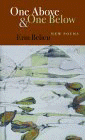
One Above & One Below
 by Erin Belieu
Publisher’s Note:
- This follow-up to her debut volume Infanta (which won the National Poetry Series) has a pointed urgency and direct, artful voice. Alternating between an urban and rural sensibility, between the ironic and empathic, the poems’ voices also have a note of a curious, restless young woman resisting the bubble of traditional female roles, pre-selected emotions, and gender-appropriate responses.
Review and Comment:
- In this new volume, Belieu has met and exceeded the expectations of
her
early readers.
—Boston Book Review
This second collection speaks in many voices: the edgy sophisticate of the first poem, whose muse is “like the gorgeous dykes/ who rule my health-club locker room”; the singer of the Western plains who begins “Plainsong,” “He lived in a sod house, / a formal nest of grass”; a different kind of all-American poet who plunges into italicized memory: “I smell the sugary,/ acid stink rising/ from the wood-slatted truck bed,/ and hear the glass-rattle bell/ the green bottles will make when my father loads them.” Belieu, whose first book, Infanta, was published as part of the National Poetry Series, moves comfortably from regular rhymed stanzas to free verse. The poet plays with contemporary ordeals (“On Being Fired Again,” “Dinner, After the Aquarium,” “News of the War”), explores historical material (“Chest for Arrows,” about Anne Boleyn), literary-historical tradition (“Francesca’s Complaint” after Dante’s Francesca da Rimini) or the film noir style (in response to Double Indemnity) and the romance of travel (“There You Are”: “inspired,” the note says, by George Packer’s The Village of Waiting)—and fits a form to every theme. The results are perfectly modulated but low on surprise. Issues—“I Can’t Write a Poem about Class Rage,” “Against Writing about Children”—get flat treatment, and probings of the self most often end up in familiar territory, “the clean, planetary light glowing/ off its mirrored walls.” But in the middle of “High Lonesome,” the young aunt watching kids mess around, “not paying us any mind,/ wearing her discontented face, diamond-/ chip earrings, and a shiny summer dress/ with quarter-sized spots of perspiration/daubed like perfume under each arm” is real, necessary, valuable.
—Publishers Weekly
Belieu’s second book (after Infanta, a “National Poetry” series selection) takes its title from the poem “Brown Recluse,” a tightly-rhymed metaphysical piece that posits the life-and-death equation—“spirit of the ratio/ one above and one below”—as central to the poet’s art. The prosody is refreshing here, but it is not what Belieu does best. Rather, she excels at a witty, drawn-out vernacular that requires a bit more space. Of her native Nebraska, she writes: “If you ever have a child,/ remember to assure her that/ one cannot really die of boredom, just an expression/ folks use to pass the time, a one milo field drifts/ into another and the same decrept shed, year after/ year, threatens to collapse.” Or farther along in the same poem: “You’ve never seen the sand hill cranes,/ but know the rites of their ethereal lovemaking.” Like the brown recluse spider who “pins her sleeve to the dead” in order to exist, this poet is wedded to a dark muse, one who is “busy rubbing lotion in her fresh tattoo.” But she has a youthful, upbeat spirit, and, with the exception of one poem about the death of a brother, the dark side does not always convince. Belieu is a young poet worth watching.
Library Journal
Included in Writer’s Digest listing of Ten Poets to Watch, April 2000
Erin Belieu was born and raised in Nebraska and educated at the University of Nebraska, The Ohio State University, and Boston University. A former editor at Agni, she currently serves as a contributing editor to The Kenyon Review. She has taught at Washington University, Boston University, Kenyon College, and currently teaches at Ohio University. Her book Infanta was chosen for the 1994 National Poetry Series.
