
Arthur’s poetry
in this issue.
His translation from the Chinese
The Silk Dragon was featured
in a previous issue with a selection
of work, and an interview with Sze.
_______
Quipu appears courtesy of Copper Canyon Press. All rights reserved.
Quipu
ISBN 1556592264
88 pages
$15
may be
ordered from Copper Canyon’s website
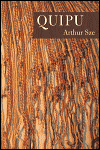
Quipu
by Arthur Sze
Reviews of Quipu:
- Quipu are knotted cords used for record-keeping in Inca
civilization, and, Sze reminds us, by the ancient Chinese. As in earlier
work, Sze (The Redshifting Web) weaves together details from
nature (especially from New Mexico, where he lives), questions from
philosophy, and discoveries from modern physics, collecting facts with a
Thoreau-like patience. To the hints of Taoism some readers have found in
his previous work, Sze adds a focus on domestic life and erotic love.
Liminal encounters between people and animals, lovers and strangers,
even rocks, fish and sky, create a poetry of simultaneity, and a
contemplative mindset: “A moment in the body,” he writes, “is beauty’s
memento mori: when I rake gravel in/ a courtyard, or sweep apricot
leaves off a deck,/ I know an inexorable inflorescence.” Sometimes Sze
has trouble putting his details together, letting the poems and
sequences go on too long, or degenerate into mere lists. As in the verse
of Charles Wright, however, powers of observation give the best poems
and sequences undeniable energies, whether considering a bowl, a candle
or a tile in Sze’s own living room, or else watching as “a broad-tailed
hummingbird whirs in the air—/ and in a dewdrop on a mimosa leaf/
is the day’s angular momentum.”
—Publishers Weekly
Whether incorporating nature, philosophy, history, or science, Sze’s poems are expansive. They unfold like the time-slowed cinematic recording of a flower’s blooming: the seed of an idea is germinated, thought or feeling buds, then the poem blooms entire. Sze has a refreshingly original sensibility and style, and he approaches writing like a collagist by joining disparate elements into a cohesive whole. This approach feels simultaneously familiar and radical because the poems are distilled to essentials we can grasp (an object, a sensation, a thought), but arranged in such odd order that readers will naturally want to search for associative meaning. This quality may make Sze’s poems seem too abstract or confounding to some readers. Yet, if one simply allows the poems in (in the same breathlike way Sze inhales the world, filters it through his perception, and exhales it back), they will resonate in surprising ways.
—Janet St. John, writing for BooklistLeave it to Arthur Sze to find a single image that intimates both the poetic form and thematic content of his latest book. Like quipu, the complex Incan data-recording system of assembling colorful knotted cords, Sze plaits isolated moments into tight, chromatic poems that dilate the cross-cultural consonance, though not universality, of human experience. Sze loops birth and death, certainty and mystery, and the resonant moments of clarity that knot those poles, into a prismatic textile of broad human dimensions. Quipu is testament to the rare balance of intellectual mass, surreal movement, and the rich image-scape of classical Chinese poetry that Sze since his 1982 collection Dazzled has progressively refined in his work.
—Elizabeth Zuba***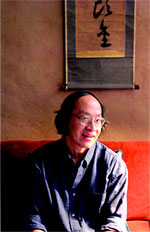 Arthur Sze, born in New York City in 1950, is a
second-generation Chinese American. Educated at the University of
California, Berkeley, Sze is the author of seven volumes of poetry,
including Archipelago (Copper Canyon, 1995), River River
(Lost Road, 1987), Dazzled (Floating Island, 1982), Two
Ravens (1976; revised edition, Tooth of Time, 1984), The Willow
Wind (1972; revised edition, Tooth of Time, 1981), The
Redshifting Web: Poems 1970—1998 (Copper Canyon Press, 1998),
a finalist for the 1999 Lenore Marshall Poetry Prize, and, most
recently, Quipu (Copper Canyon, 2005). Sze directs the Creative
Writing Program at the Institute for American Indian Art in Santa Fe,
New Mexico, where he has taught for more than a decade. He became
well-known in New Mexico as a distinctive and compelling presence in the
poetry of the region, and was co-publisher, with John Brandi, of Tooth
of Time books. He has won numerous awards; an Asian American Literary
Award, a Balcones Poetry Prize, a Lila Wallace-Reader’s Digest Writer’s
Award, a John Simon Guggenheim Memorial Foundation Fellowship, an
American Book Award, a Lannan Literary Award for Poetry, three Witter
Bynner Foundation for Poetry Fellowships, two National Endowment for the
Arts Creative Writing Fellowships, a George A. and Eliza Gardner Howard
Foundation Fellowship, a New Mexico Arts Division Interdisciplinary
Grand, and the Eisner Prize, University of California at Berkely. His
poems have also appeared in numerous magazines and anthologies, and he
has conducted residences at Brown University, Bard College and the
Naropa Institute. Rich in allusions, his poetry evinces a preference
for Asian juxtaposition rather than Western rhetoric. Sze made his debut
as an equally exceptional translator with the publication of The Silk
Dragon (Copper Canyon Press, 2001), which follow the trajectory of
Sze’s interests in Chinese literature, from the classic T’ang masters,
Wang Wei, Li Po and Tu Fu to important contemporary poets such as Wen
I-to and Yen Chen. (The Silk Dragon was featured in a previous
issue of The Drunken Boat along with a selection of work, and an interview with Sze.
Arthur Sze, born in New York City in 1950, is a
second-generation Chinese American. Educated at the University of
California, Berkeley, Sze is the author of seven volumes of poetry,
including Archipelago (Copper Canyon, 1995), River River
(Lost Road, 1987), Dazzled (Floating Island, 1982), Two
Ravens (1976; revised edition, Tooth of Time, 1984), The Willow
Wind (1972; revised edition, Tooth of Time, 1981), The
Redshifting Web: Poems 1970—1998 (Copper Canyon Press, 1998),
a finalist for the 1999 Lenore Marshall Poetry Prize, and, most
recently, Quipu (Copper Canyon, 2005). Sze directs the Creative
Writing Program at the Institute for American Indian Art in Santa Fe,
New Mexico, where he has taught for more than a decade. He became
well-known in New Mexico as a distinctive and compelling presence in the
poetry of the region, and was co-publisher, with John Brandi, of Tooth
of Time books. He has won numerous awards; an Asian American Literary
Award, a Balcones Poetry Prize, a Lila Wallace-Reader’s Digest Writer’s
Award, a John Simon Guggenheim Memorial Foundation Fellowship, an
American Book Award, a Lannan Literary Award for Poetry, three Witter
Bynner Foundation for Poetry Fellowships, two National Endowment for the
Arts Creative Writing Fellowships, a George A. and Eliza Gardner Howard
Foundation Fellowship, a New Mexico Arts Division Interdisciplinary
Grand, and the Eisner Prize, University of California at Berkely. His
poems have also appeared in numerous magazines and anthologies, and he
has conducted residences at Brown University, Bard College and the
Naropa Institute. Rich in allusions, his poetry evinces a preference
for Asian juxtaposition rather than Western rhetoric. Sze made his debut
as an equally exceptional translator with the publication of The Silk
Dragon (Copper Canyon Press, 2001), which follow the trajectory of
Sze’s interests in Chinese literature, from the classic T’ang masters,
Wang Wei, Li Po and Tu Fu to important contemporary poets such as Wen
I-to and Yen Chen. (The Silk Dragon was featured in a previous
issue of The Drunken Boat along with a selection of work, and an interview with Sze.
