
Renée’s poetry collections:
The Storm That Tames Us
La Alameda Press
9636 Guadalupe Trail NW
Albuquerque, NM 87114
$12, also available from the author.
The Skins of Possible Lives
$10, available from the author.
The X Poems
$4, available from the author.
Email [email protected] or place orders via mail:
56 Priestly Place
Corrales, NM 87048.
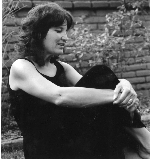 Renée Gregorio
Transforming the Strange
In the hills of the north, beside the stream
a wooden, water-powered fulcrum-pestle
fills with water, pounds down slowly
into the grains of rice in the mortar.
On the road to My Son,
three women in white ao dai, conical hats,
ride their bicycles down a dirt road
as one conversation, as white heron
stand on a soaked field.
At the marketplace, old women
chew betel nut, their lips and teeth red with it,
or they crouch down low, smoking cigarettes,
just talking to each other. Their rootedness,
desired as the day sun breaks through this sky
now flooded with clouds.
Indigo cloth stretched on lines of rope
dries in morning’s sun on the dirt path to Lao Cai.
I pass an old woman, smile at her and say hello.
She pats my hips hard as she goes by—
I like the way body becomes language here.
The way strange becomes everyday,
that the roads open out in front of us,
juicy as bitten pomegranate seeds,
abundant as monsoon rains,
delicately edged as the hand-laced
cotton cloth we buy to cover our table
when we arrive home.
The Old Quarter
This is the quarter of the merchants,
every street named for what’s sold there—
silk to religious articles, drums to nails and latches,
Chinese herbs to gravestones, bright gold chains
to plastic toys. Flowers to pigs to dogs to fish.
I don’t know how to return to where I began.
Looking at a map doesn’t help—Hang Quat to
Luong Van Can to Hang Bo around the corner
to Thuoc Bac to Hang Luoc to Hang Chieu—
much better to look up at faces and buildings
and the way the road curves, to enter
this named chaos with your whole body—
on the street, baskets filled with persimmons,
baguettes, gladiolas, tiny bulbs of garlic,
greens I have no name for. In a three-story building,
through an open window, I see a few paintings
on a wall, an empty easel. On the street a young woman
walks by with her shoulders bent under the weight
of her stick and cloth, an entire boutique on her back.
Here, where most of the earth’s healed over, and we are welcome,
where 60 percent of the population is under age 25.
At a Buddhist temple an 8-year-old boy gives us a tour, says:
You’re American? Americans killed the Vietnamese.
Where crossing the street is an act of faith—
whitewater surge of motorbikes, cyclists and cars—
I step into it calmly, place one foot in front of the other,
steadily moving toward the other side.
Chaotic and brazen, the drivers barrel forth,
making slight adjustments with vehicles
to accommodate my body’s passage.
Oddly I feel protected, nearly unafraid.
I know the turbulent nature of crossings.
Yet I sense a deep order I’ve never known,
arrive at the other side, buoyant
as a sampan on the River Yen.
The Color of Coca-Cola
At the Quan Hué Restaurant,
thin slivers of banana flower,
mung bean sprouts slightly steamed,
carrots shredded, peanuts crushed,
mint leaves, lemon, spiced with hot chili pepper,
then banh khoai, crispy yellow pancakes
of egg and rice flour, fried with pork and shrimp,
eaten with peanut-sesame sauce alongside
rice flour crepes, green banana, star fruit.
At the Moca Café on the “new specials” board,
always the same four items—beginning with almond-crusted
pork loin and ending with braised prawns in coconut sauce.
Vietnamese coffee, dark as the seeds of a papaya,
its thick layer of condensed milk waiting to be stirred,
to be taken in, richness and sweetness at once,
intensity nearly unbearable.
In early-morning light, near the Thu Bon River,
families gather at tiny tables on sidewalks
in front of their houses, eating baguettes, sipping noodle soup,
drinking the dark, rich sweetness, feeding their children.
Up north in Sapa I wake to the sound of a pig’s squealing
as he leaves this world in slaughter. The squeal seemed to go on
for an eternity that included all
the pork and bacon I’ve consumed in this life.
At dinner, over delectable stuffed squid, the music blares:
“I want to know what love is; I want you to show me.”
Phil Collins on the central coast of Viet Nam
sounding much like he did in London pub
after a white hotel sort of afternoon in that other life
so far away from this one. Or is it?
We move from city to village, shape-shifting—
or is it merely revealing the core of ourselves to ourselves?
In Hoi An, the restaurant owner announces:
“After 1981 Viet Nam lost its traditions.
Now it’s not the color of Viet Nam, but the color of Coca-Cola.”
