
Interview with
Eleni Sikelianos
_______
Review of Exchanges on Light in this issue
_______
Eleni’s poetry _______
Exchanges on Light is forthcoming in March, 2008
from La Presse. _______
in this issue
from Exchanges of Light
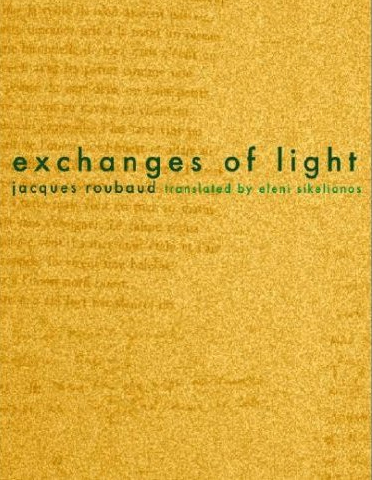
by Jacques Roubaud
Translated by Eleni Sikelianos
Third Night
Basil De C.
Over the past two nights, we have considered, first the nature of light, then its beauty.
Tonight we will focus on its movement.
You will agree that light’s mandate issues from the divine. Which is
why, again, I seek the answer to the question of light’s motion in the word of
God. For God said, “Let there be
light”; he didn’t say, “Light will be” or “Let light come to pass.” At the exact instant God spoke, light
rushed through the ether, through the sky, and, in an instant without
extension, lit all the world, the North as well as the South, the Orient as
well as the Occident. As soon as
God’s order was heard, it was instantaneously executed.
John Ph
Light is Creation’s first corporeal form; one could call it
corporeality itself. The problem
solves itself so easily if you simply hold this axiom in mind.
Dennis PH.
Visible light, descending light, is essentially slow, although
to our blind eyes it seems infinitely quick.
Lewis De B.
I maintain that light, being a body (its body being an
emanation issuing from luminous bodies) appears first in the intermediary space
between earth and sky, and then travels to us in a motion so rapid it escapes
our notice.
M. Goodman
I have trouble grasping both its instantaneity and its
ubiquity. It seems to me that an infinitely quick light would be motionless.
William H.
The paths,
cleared through the dark,
of
light
are
facts.
William
H.
The
paths, cleared through the dark, of light
that
goes without saying because we know
all
light goes, clearing its way, through the dark.
Basil
De C.
Light
doesn’t clear its way through the dark, it dissipates it, annihilates it; but
it crosses air, and air is a substance so subtle and diaphanous that light needs not the least instant to cross
it. Just as it brings sight
suddenly to the objects that strike it, and just as, without the least
interval, with a rapidity thought cannot conceive, it receives light’s streams
in all its extremities. Light
makes the ether more pleasant and the waters more limpid, and the latter, not
content simply to receive its luster, send back light’s reflection, throwing
off bright sparks. Light’s voyage is instantaneous because it is obeying divine
order, but also because it is, by nature, determined to leave darkness no
means, not even temporary, of survival. In the presence of light, there is no
dark.
M.
Goodman
Then
is emptiness dark? Doesn’t Heron
of Alexandria tell us that if there were no void, light could not make its way
through water? He goes on to say
that if this fluid, like air, had no pores, a vase of water would overflow
whenever light struck its surface, which it doesn’t do.
John
Ph.
Yes
it does; with light.
But
I would put it more like this: light, by its very nature propagates in all
directions in such a way that a point of light instantly produces a sphere of
every dimension unless an opaque body interrupts it and deforms some of
them. Matter’s extension into the
four dimensions (I don’t exclude reversible time) is concomitant to corporeality;
non-luminous matter is, by contrast, substance without true dimension,
therefore it can’t multiply or move by itself in any dimension at all. Light alone has the power to multiply
and propagate instantly in all directions. I’d say it is the agent, par
excellence, of the creation of all dimensions.
Lewis
de B.
For
the moment, I’d simply like to point out that a movement that takes an
infinitely small amount of time is not an instantaneous movement; an
imperceptible interval is not an instant of no duration. Reread Alhazen.
Dennis
Ps.
Although
moving in an instant that is (because of our own slowness), imperceptible,
visible light is essentially slow.
For it doesn’t emanate directly from an absolute luminous core, but from
a dark body (dark like ours, like all material bodies). A body, a dark body, is
a sponge for light; it absorbs real light and adulterates it. Heated like the
stars, it goes from red to white, but the glow it emits, which we call light,
is only a distortion of the true light it has swallowed and which we force it
to give back.
Dennis
Ps.
True
light clarifies matter in its subtle, ethereal state by acts of light,
incandescences of mundus
archetypus, of the world of
figures and forms. True, its motion is instantaneous; true, its speed is
infinite and in a way that escapes you because it’s not a matter of
simultaneity, but of a sequence in empty time.
William
H.
Any
light can always successively disperse
that
which it is, also
light
Lewis
De B.
Let’s
get this straight: simultaneity and sequentiality are two attributes of light
that our friends Dennis Ps. and William H, following their own theories, agree
to recognize in light (for reasons which, I must humbly say, escape me);
however, there’s a well-accepted notion that reconciles this
contradiction—the Ray of Light.
Rays of Light are the minimal units; individually, they’re sequential,
and collectively, they’re simultaneous. We know that light is organized in
parts that are both successive and simultaneous because you can stop arriving
light at a given moment and let light pass a moment later at the same spot;
simultaneously, you can stop light at one spot and let it flow through at
another. The portion of Light that is stopped cannot be the same as that which
passes. Let us call Rays of Light
those minimal Lights that can be stopped apart from the rest of Light, and can
be propagated singularly, that act or are activated solely in what the
remaining light cannot do or undergo.
Basil
De C.
Let’s
say, for example, we see the sun rising.
Clearly, our gaze can’t reach it without traveling across all the space
occupied by sky and air between it and us. Is anyone really capable of grasping
that distance? Yet our gaze or our visual ray will certainly never manage to
cross the air above the sea if it doesn’t first cross the air above the earth,
the entire distance from where we stand to the sea’s shore. And if other lands interrupt our line
of sight, our sight can’t leap across the air stretched out over these far-off
lands without first crossing the middle space. Let’s now suppose that there’s
nothing left beyond that but ocean. It occupies an immense expanse, but
regardless of its size, the visual ray must cross the air above it and whatever
else may lie beyond in order to reach the sun. And although I may have used the terms “before” and
“after,” didn’t our gaze cross all these spaces instantly?
John
PH.
Light
was the first form created from primal matter, and that’s why by nature it is
infinitely multiplied, spreading uniformly in infinite directions. But material extension cannot be
achieved by a finite multiplication of light because, as Aristotle showed in De Caelo et Mundo, the finite multiplication of an entity
could not create quantity. But an
infinite multiplication could. So light, simple in itself, multiplied
infinitely, created finite matter (and is still creating it). Creator of finite time, itself
infinite, it endlessly superinfinitizes within the confines of the universe,
creating further infinities, which are to infinity what infinity is to the
finite.
M.
Goodman.
I
once read a series of objections to the idea that luminous movements are
infinite. If I remember correctly, it went something like this:
“a.
what the instant is to the point, the point is to the line, which is why,
through exchange and permutation, what the instant is to the point, time is to
the line. Passing through a point
occupies an instant, and so traveling a line requires time. Therefore light,
crossing a segment of space, however short, travels in an interval that is not
void of time;
b.
light travels faster in a straight line than in an oblique one, but both the
fastest and the slowest require time (this argument seems weak to me);
c.
no force acts instantaneously, as a greater force would then have to act in
less than time;
d.
a before and an after in space assumes a before and an after in time;
e.
Instantaneity ensures that light lights an infinite number of places at the
same time. It would be God.”
M.
Goodman.
And
I read another argument somewhere that led to the same conclusion:
“light
is a transmutation; all transmutation is instantaneous unless it encounters
resistance; resistance assumes a contrary; but light has no contrary; it only
has loss.”
Dennis
PS.
The
loss of light is darkness; the darkness of a dark body is this darkness. It is not the Dark of the
more-than-luminous shadow. Light
has its own contrary (the photon, that blind approximation of light has its
antiparticle, which is itself), black Light, which infinitely exceeds visible
light; that is why your philosopher’s argument will not do. Physical dark is non-light. Dark Light is non-non-light, an
entirely different thing.
John
PH.
Rarefaction
is not loss. As I said, because light has spread matter by its infinite
self-multiplication in all spacio-temporal directions in infinitely multiplied
spherical layers, the outer edges (of each infinitude— infinites being
heirarchized) are more rarefied than the inner layers, and closer to the
primordial point of light. And since the farthest layer is the rarest, it gives
the illusion of emptiness.
William
H.
Hell
is a palace of strange architecture
Shut
in on all sides by the Stygian tributary,
A
theatre in which Pluto manifests his cruelty,
Where
one feels in death eternity’s factor.
The
foundation is coal, of sulfur the vault,
Cool
shadows run hot, flames rapt icebound,
Here
howls and tears never resound
Where
terror and rage govern torture.
Here
the proud Angel on high was deported,
And
the soul languishes for having insulted
That
Soul so perfect he brought the soul forth.
But
the greatest torment Hell can trace
Is
loss of the Master’s features,
Since
Paradise resides in the hour of seeing his face.
Basil
De C.
I’m
going to approach the problem differently to bring you to the truth. Nature loves everything that is useful
and good for living things, and strives to create that. Because living things
find it useful to see quickly, nature made sure that the visual flow would
arrive at sight’s object as quickly as possible; now, since the fastest motion
is the instantaneous, the visual flow instantly reaches sight’s object.
Lewis
De B.
Right.
And creme caramel was created simply to be confused with creme brulée! Let’s be serious: as soon as the Sun
appears on the horizon, Earth’s upper hemisphere is instantly and completely
illuminated. How does that happen?
Just as when you move the end of a long, taut rope, the whole rope moves
instantly because all its parts are united, and the first moves the next and so
on; so luminous energy moves, since all the bodies in the cosmos immediately
touch one another.
Lewis
De B.
And
I’d go further than that. Please follow me through this thought
experiment.
No
doubt at some time or other, you’ve found yourself walking over rough ground at
night without a torch, so that you had to use a stick to find your way, and you
must have noticed that you could feel the various objects that you encountered
through the intermediary of the stick and that you could even identify them
— trees, rocks, sand, water, grass, mud, whatever. True, these
perceptions are a bit confused and dim to those who aren’t used to it, but
think of people who were born blind and have used this method their whole
lives, and you’ll find it so perfect and precise that you might almost say they
see with their hands, or that their sticks are organs of some sixth sense given
them in place of sight. To make the analogy, I ask you to consider that light,
among what we call luminous bodies, is nothing more than instant motion, an
infinitely quick and infinitely animated action that arrives at your eyes
through the intermediary of the air and other transparent bodies, just as the
response or resistance of everything that this blind person encounters passes
into his hand through the mediation of the stick.
M.
Goodman.
But
don’t we find ourselves once again, by following an idea quite philosophically
distant from that of our friend Dennis Ps, faced with the notion that hidden
behind visible light (which is of a finite speed, as everyone knows) is a
parameter light that is non-local in essence and able, at the quantum level, to
instantaneously affect the farthest reaches of the universe?
Basil
De C.
Give
that power back to God.
Dennis
PS.
Let’s
retrace the steps of the illuminative sequence. Have the intelligence to
understand that this is what permits intelligences to see themselves as shared
light and to see the theophanic light available to them. Don’t confuse the
uniqueness of absolute light with the multiplicity of lights, which is only
dispersion and darkness.
William
H.
Dissipation,
diversity, signs of death, forced plurality.
John
PH.
Light
is not the flow of a body, like water, but a wave, like sound.
John
Ph.
That
was confirmed by Roger Bacon. On the other hand, Pythagoras saw it as fine
particles sent like numerable messages by luminous bodies.
Lewis
De B.
Having
considered this problem all my life, I have come to the conclusion that no one
has yet discovered a way to elucidate the relationship between waves and
particles.
William
H.
in
the grass
grains
waves
of
light
attach the earth
to black
and spit them
in the grass the
night real
to the
edges
of trees
beneath the earth
M.
Goodman
Newton
attempted to synthesize the granular concept and the undulatory concept. He
realized that light came in grains and thought it was conveyed by an
undulation, at least while passing through matter, and that this undulation
acted upon the grains, causing the corpuscles of light to pass regularly and
alternately through “fits of easy transmission” and “fits of easy reflection.”
Arriving at the surface separating the two zones, the grain of light will pass
easily if it’s in a fit of easy transmission but will be bounced back if it’s
in a fit of easy reflection.
Dennis
PS.
God
desired the finite transmission of visible light. God has 700,000 veils of light and shadow; if he took them
off, the radiance of his Face would reduce all who encountered his gaze to ash.
These veils are the ensemble of all perceptible and imperceptible universes,
and all these worlds exist inside man, visible to as many eyes. One sometimes opens them in dreams, and
they sometimes fall a bit into memory on their own.
Basil
De C.
Luminous
bodies were created in one fell swoop by the divine power and, without any
local disturbance, were instantly applied to the air capable of receiving
illumination. And light, the
divinely inspired negation of the rule of the non-distributive divisibility of
the All, arrived in an instant in every sky.
Editor’s Note:
The correct title for this volume is Exchanges on Light though the cover image sent out by the publisher, and used here, has the erratum of ‘Exchanges of Light.’ Exchanges on Light is forthcoming in March, 2008 from La Presse.
