Copyright © 2005 Victoria Edwards Tester
___________ For more poetry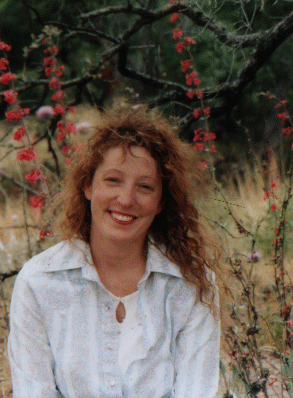
Victoria Edwards Tester
from Here is the Rose
Salt Houses
The man who did not recognize my face
walked out like the sea,
carrying the saddest photograph in the world.
I sat down in each of my chairs,
and found nothing broken.
My hands found the bones in my throat,
and I remembered
there would be nothing to eat in the house.
I saw how he had embedded the air
with carnations of salt.
And I rose and began to make salt houses.
Salt houses, clean carved and white carnations,
too beautiful for disbelief.
Open your eyes in salt and wish you were dead.
Bite a carnation,
and know that inside a child is arranging a row
of forks on a table, and kissing each fork
as he sets it in order.
That a woman who cannot eat is reaching into her chest
and bringing out a small white box.
Opening it in hope of music,
and finding the bones of her grandmother’s wrists.
But the delicate bones of the wrists
of those who can’t remember us
are the crystal hinges that guide us through doorways,
and even the salt houses have their windows,
where the light is too clear to be disturbed by the voice.
And when my child walks sadly in,
I say that the saddest photograph in the world
is only a wing tucked under the arm of a stranger.
That his own arm is only the pure curve
that sailed him into the world.
And if he asks what the opposite of a house is,
I must say that the doors are not against us,
and find some tiny sweetness for the tip of his tongue.
Arequipa, 1988
Suddenly what you have is enough.
A thousand birds could feed on your crumb,
but not one comes.
All around you, the plaza, the streets
filling with people who have come to fight
for their inheritance.
It is getting dark, and they must have it
before the circling birds nestle into the purple crevices
of the National Cathedral.
You are not undone by the birds,
you have already seen the light and the dark down
undersides of their outstretched wings.
You know the choking ascension,
like a candle stuck in the throat,
and how everyone would have to lay down
afterwards, sick on the public benches.
But tonight the people are refusing to look,
they are looking forward like soft monuments.
No one accidentally brushes you
with their shoulder, or glances at your watch.
If they had, you would have held your crumb
out to them. It would have been enough.
Everyone could have gone home,
walking straight.
For Yannis Ritsos, 1989
Last night a friend spoke of you
and the trees in his yard in Athens,
and smiled when he remembered the tree
his old godfather had created,
a hybrid, a mandarin whose fruit
was a nearly perfect square,
like nothing else in nature.
The thought of it seemed to give
him strength enough to describe you
in an unlifted voice:
a radiant man who’d enter a room
in a quiet shirt,
a man who had suffered. He paused,
as if thinking how at night all trees
are black.
Or as if he gently cupped
one of the square oranges in his hand,
without seeing it.
And in that pause, because you existed,
we were both silent, and happy.
December
1
My heart is a frozen iron bed frame
in a whitewashed house on Crete.
When my tongue touched the frozen iron,
I knew I would breathe quietly until spring.
2
In winter, the dried flowers on the graves
lose their second lives.
I lose mine too, the one I took
from the oven of your hands.
At night your hands wake up talking.
Catholics on one side,
Catholics on the other,
death is only the line between you.
3
You call me Papa
because your mother called you Mama
because her father called her Papa.
With your left hand you rock
the cradle of a United Arab People’s Republic.
With your right you rocked the child
who would never connect us
with the bridge of his hands.
4
In school they teach my living child
why onions make our eyes water.
At home, he makes a list of everyone
who has forgotten hope.
He wants to give us a second chance.
He crosses out his first name
and takes his second, Joseph,
he who shall add.
5
I can go to any point on a map of Crete,
but I cannot touch the silence that comes before
or after the Arabic syllables meaning we are married.
I save my pennies in order to go to Crete.
At night you dig them out of the garden
to pay for electricity and books.
Every time I spend a penny to turn on a light
in Houston, a star says amen!
and shuts down like a factory.
6
Even in the saucepan milk it isn’t evil.
It overflows like gray pigeons on the stove.
The last penny I have hidden in my pocket
prevents you from discovering
that the bird nest has gone from the chimney,
and that there is a country in the heart
where marriage is illegal.
7
You’ve gone for more milk,
my husband, my lamp, my brilliant detective.
My child says, Look, I’ve boiled the Christmas angel.
But I have stayed awake all night conjugating
the Arabic word for to say goodbye quietly.
The War
1
Charles Simic, can you hear me?
I am divorced from the bone of my country.
January, the telephone of my blood is ringing.
2
I want to report a murder.
It happened between a piano and Washington,
an alphabet and Baghdad,
an evil God and a beautiful rat.
It happened between the morning I was
feeling the new breath of children
and the night I spent asking a dog
why the stars are important.
3
A famous professor mails me an invitation
engraved on a grain of salt.
The grain of salt is the university’s white planet
where the righteous gather, responsible for a census.
4
Children who are interviewed explain
that a child expects to die in sunlight,
balancing an egg in a spoon.
The inscription on the egg
is only Arabic for I am fragile.
5
Today the New Year tried to leap from the roof
of the house. Ash Wednesday jumped in.
My Orthodox neighbor explains that even the end
of unhappiness is forbidden.
6
Summer, I laugh again by accident,
and find myself on my knees on Heights Blvd. and 9th.
My vision: the sky is falling
on General Schwarzkopf’s bright head.
7
I ask August, the month that the President hates,
to be as beautiful as ever.
I ask the wind to exchange the thumbs
of the President and Muammar Qaddafi.
8
I laugh again: my son tells me twice about the sea
otter who jumps over the back of a coyote.
I let my household chatter me silent as evil.
How can I run from joy or the history in my lungs?
The Circle and the Line
1
Your body is the union of grass blades
and wedding rings.
Darkness secedes from your green republic.
Your spinning diplomacy makes your opponents fall.
When you stop turning in circles to join them
the potatoes in the garden start crying
because now they are only potatoes.
And the potatobug rejoices.
2
When you stand upright the world gets fatter.
Ethiopia colors itself green as a bird
riding a boat carved from a melon.
Nothing so full and so light,
The hair of Abd al Arab is a sail over Africa,
he is standing upright.
When your shoulders are parallel to the horizon,
the crescent moon takes the shape of wheat
and the bread gives up hiding from the teacher.
3
Your body is the union of the rare
and the prolific.
Asked to weigh injustices, your hands
fall to your sides.
Your eyelashes balance the murders
of the child and the ant.
You cry over the smallness of their bodies,
and the lost fires in their jaws,
and their ways of carrying single crumbs
the distances of miracles.
Gold, don’t forgive yourself.
Grass, turn white.
Somalia
1
A green candelabra
whose candles were eaten for breakfast.
Horse made of sand, blowing
darkness into the eyes of the Italians.
Children so thin you cannot
hear the sound of a bell,
and the horse that doesn’t drink
because he lives by sand.
2
The first day we walked into the world,
we were going to make a world.
But everything had already been done.
Only the bees had to work,
and you cried for them, Somalia.
You set a table for your neighbor and the stranger.
You gave the mountains milk
and the duck silver.
You covered your eyes with shadows from the Koran.
3
You have seen these seven
thin cows before. You call
them by the names of the rich,
their slave names,
and they always answer.
You are Joseph in the house
of your mother, multiplied
by one million,
opening the book of hunger:
4
The rich have built
their bank on the foundation
of a single grain of rice.
When I prayed the rich dead,
my prayer became a skeleton
crossing the street to Nicaragua
Saying, remember Sandino could carry away
a rainbow between his thumb and forefinger.
5
They told us
when the wind snapped her fingers
everyone would live again.
6
Horse, you are riding,
as beautiful as revolution.
Let them call you by your name
that is rarely spoken,
the one that means impossible to kill.
Good morning, my Romanian broom!
Why does that small boy sit smiling
where someone sat him in the cabbage?
Why does he just sit there, broom, nibbling
at the yellow hearts of rabbits?
Where do you store your spotless crumbs, broom?
Why is it men feel guilty if they don’t break something?
Why don’t you taxi to the airport,
my broom, and sweep a clean red carpet
for Boris Yeltsin?
Why are they breaking the statues of Lenin, broom?
Broom, where are your notebooks?
Why do you drink Courvoisier?
Why don’t dictators eat from fancier plates?
Romanian, turn off that music.
Journal, Egypt
1
In Egypt, birds sing on
the other side of gray hieroglyphs.
My child is crying because he cannot attend
school in a language he can understand.
2
Because I have no money,
trees become more beautiful,
the red pomegranate
bends its twin heart towards
the ancient washing machine
on the balcony.
3
When I arrived I knew
I had to tear the white handkerchief
out of my chest and praise God
for showing me the road does not exist.
Here, our milk is rationed powder
our light is only the dust
that falls on us from Saqqara.
4
Churches and mosques warm
themselves in the fires of their own wars.
Once they were made from many bones
but now they only remember being the hips of men.
For the hipbones of men
they’ve built an afterlife
out of the boat of one thousand thousand lives.
I am glad they are useless now,
useless and so busy, bowing to each other
on their fat furniture.
Then the newspaper says they are not lazy after all.
This morning in the name of the holy they killed
Farag Foda, who spoke against theocracy
at the Cairo Book Fair.
5
If you are afraid of the hipbones of men,
at least answer me when I tell you
Christ is not dead,
he speaks Arabic,
he is a farmer
who came to Al-Qahara without
palm fronds in his hands.
I saw him six days ago,
twisting in the street, mouth open.
Now I am six days old
and nothing shall save me.
6
Sparrow that lives inside everything
under the sun,
you do not abandon us,
we abandon each other.
If I don’t paint the walls of my house white,
If I don’t let my few possessions fly out
of my windows,
abandon me, abandon my house in Egypt.
7
Egypt, a brown shutter
closed against the Mediterranean.
A bitter hook, Sadat’s eagle
on a ten-piaster piece.
I live in Egypt dreaming of Crete,
and Egypt offers me more dust
in a tiny green-patterned cup.
Take a flying leap
into the Nile,
and walk out without your veils,
your black gloves,
your Holy War against yourself.
If I can learn to hate justice.
To pray while asleep
If I can twist the Koran like a dove
around my neighbor’s neck.
8
All the minarets are made
from the hipbones of men.
But sometimes a living man ascends
and the tenderness in his voice
unrolls the green carpet of the world beneath our feet.
9
Where our bed meets history
the wall is green with birds,
the alphabet ignites the tree of life.
And I don’t even want the man on the street
who shows me the dust on his feet,
who kisses my left hand twice.
10
I think of the woman who dared
to have four husbands in Egypt.
They cut her in four pieces
and threw her in the Nile.
If anyone finds out, I’ll be divided
by ten, and all of you will go free,
innocent as commandments walking down mountains,
obeying the sound of your own voices.
11
In Egypt, no one will tell me where the Socialists are,
and one hundred thousand people live in the mausoleums
of the cities of the dead.
For twenty-nine days I have pressed my body
against the green shutters of a rented room
and thought of the people who want me afraid
of governments and God.
I have decided to give them my voice, instead.
12
Your silence is
the black bird inside the white cage of Iran,
the light that doesn’t escape the photograph negative.
And your voice? I think it is the nail through the trumpet
of a revolution led by men,
and the red string that fishes from your window tonight
for my shining questions.
Year
They make us the violets and the ashes.
They make us the yellow tongues of fire
singing the trees, and the black helicopters.
They make us Paradise and its shadow.
They cover our bed, they open the green cupboard,
they make you strong, they bring me your liver
in a jar, they send me your death without a telegram.
They won’t make us ghosts.
They tell us to live, and they make a new door.
They give me a distended belly.
They make the yellow wings to cradle our daughter.
They make you afraid, they light you a candle.
They make you wear your shoes on your hands
and they like it,
and they make you strong.
They make us a man and a bear,
they make us grease and dirt.
We do the dance of work.
They make one of us fall first.
They make us dust,
and we rise in the cloud of the rabbit
whose ears sacred.
They’ve never lied to us. They carve a new door
in the heart of the hummingbird.
When we knock the dead enter our hands
and I’m not sad anymore, this morning, my love.
They make us strong,
they make us cover our mouths and smile.
Alphabet
1
We planted our first rose and it grew like a dog.
We planted our favorite books of heaven on earth.
We planted your body, cousin to the poncianna.
Your hips like twin brothers your mother bore for love
and kept hidden in a basket.
We planted my body, the old one I had
kept shining for love and grass stains.
We planted the painted tin horse who would never ride
to war,
and the charm that would protect us from friends
who forget
to say blessings over gifts they envy.
We planted the brass bells that would chime
when the door opened,
and the ten tiny mice of Paradise who leapt from tree
to tree,
escaping the hungry birds.
We planted a cup of tea whose sugar sank to the bottom.
And that was everything.
2
We planted the music box I lost for fifteen minutes
at the Cairo airport,
we planted good-byes, we planted the duck papyrus.
In our new bed we planted the twin daughters of the rose
who had grown like a bear.
We planted our tapestry made in Iran,
we planted the wooden hummingbird that astonished
the Saudi engineer.
We planted ten oven-dried figs and an ancient
washing machine.
We planted our legal documents and the eggs
under the fig tree.
We planted six new boiled shining glasses
and the yellow bottle that would cure your hepatitis.
We planted a white eggplant, a potato, an onion.
A bag of rice, a fork, and a book of simple equations.
We planted six tiny hieroglyphic spoons
for you, the guests who would arrive
in a more delicate future,
and this alphabet for surviving famine.
Lovers
Do you remember finches happier than mice?
Do you remember the poncianna tree?
We’ve eaten the berries that make us beautiful.
The Egyptian police don’t need our photograph.
Where are the fingerprints on the papyrus of Paradise?
We’re the patterns of oil and dirt.
Will they trace the evidence back to our bodies?
Where’s the airport?
Our encyclopedias are travelling by ship.
Did we forget the tiny caption printed
beneath the dictator’s face?
Did you forget to shave? Did I forget the boiled glasses?
Together, we’re bringing the proof that history
leaps off its own shadow.
Egypt
1
In the silver shop we visited the man
with the softest voice in the world.
He was your shadow talking to us.
He wanted to circle your bracelet around my ankle,
and you said no,
this woman must be freer than rumors or histories.
He was in love with Sadat and the tiny piano,
he sold us the smiling duck with the bell in its mouth.
He sold us the sugar bowl that fit in your palm,
he sent his frowning partner to get the six
silver spoons cradling the hieroglyphs.
He sat in the window, weaving the birds
into the poncianna,
your hands into mine.
2
He composed the dust between Medin-et-Nasr
and Heliopolis.
He wove Bus 36 into the call to prayer,
the flies into the strawberries, the sickness into the curtains.
Before we left I slapped him, and he smiled sadly, knowing that we would leave Egypt
turned against each other,
that you would cry all night under the fig tree
without a liver,
that I would wake each morning sobbing for money,
throwing your peasant puppet over the balcony,
that you would walk ten miles to find a place to lay down,
yellow as a river.
3
For me, you searched for the trees of paradise
in every papyrus in the city.
Your last fifty piasters
bought me one more cup of coffee spiced with cardamom.
For our mattress you took the ancient one
from the Cairo Museum.
The ancient one, the ancient one.
Mahmoud-Khairi
1
I said it, he is an angel and I won’t take it back.
Call me the blind one who can’t find the ladder.
The one who travels East, turning the light black.
2
I can’t tell my love from yours.
Night asks me a question.
True, I died with the constellation
of stars in your chest.
I opened a window so you could lower yourself
into the ashes.
3
We stepped lightly over hell,
kissed two children, closed the window.
In the morning the ten tiny mice flew
out of the tapestry,
breaking all our threads on their way to Paradise.
4
You called me shining love.
Here is the red book, here is the green book.
For once, it was enough to open the Holy
and find the pages empty.
5
Russian black bear, you said
Be careful on the bus, they’ll mistake you for an atheist.
Throw us out of Alexandria. I’ll get hepatitis.
We’ll never make it across the River of the Dead.
6
Just one more onion
and then a tea out of hibiscus.
We’ll have to lock your son outside,
or he’ll never learn Arabic.
These are my hips, these are my knees.
Hold me close and forget the Friday
call to prayer and pray the thief
does not remember—Mahmoud-Khairi.
Thank you Sayeed Mohamet
Thank you Sayeed Mohamet
for calling when I was about to be struck by lightning.
Thank you for waking me up from my dream,
flying my kite over an ocean of military planes.
I poked out that boy’s right eye with a knife,
and felt much better when I heard your voice.
Thank you for the story of your miraculous exam,
how the air became a fountain flowing in northern India.
For nine hours you let us all rest.
We were the white shadow on the wall.
We didn’t want to take up our burdens again,
that was what we couldn’t tell you.
Thank you Sayeed Mohamet
for letting me say how soft the ears of the rabbit are.
I wasn’t ashamed.
I sat down all day and couldn’t get up again.
Thank you for calling ,it is so true we are sold into forests
and return home in our own languages.
When you said goodnight in Houston,
a light went on in Lucknow.
Thank you Sayeed Mohamet
for saying it is better to laugh at classical Arabic.
For congratulating me on Joseph, my son.
For saying it is better to have boys than girls.
Because girls are so extraordinary.
For saying how you engineered your self,
belong to your self, love your self.
Thank you for not calling again.
Thank you for taking my copy of Faiz Ahmed Faiz.
I hope that he calls you,
and that one small bell in Urdu sounds like Victoria.
Old Book
Rabbit, get me a chair
so I can sit with my back to the sea.
Rabbit, get me a map and a pair of binoculars.
Rabbit, go back to Egypt,
be careful not to cause any earthquakes.
Get me that boiled glass I forgot in the sink.
Bring me enough wood for a vegetable cart and a coffin.
Go to the forest and find me music played
on a rubber band.
Go to the gas station, bring me one part jasmine,
two parts alcohol.
Nail a calendar above my stove, rabbit.
Take a nap, don’t bother me on Wednesdays.
Rabbit, please open my skull like a flower
so I can read this book in peace.
The Right and the Left
We invented the chair in honor
of the five dancing spiders
inside Joseph’s body who will sing on July 23
until the end of all birthdays!
____________
Once we discovered money,
stealing from each other like twin brothers,
sleeping inside the cash register.
We were ugly children, we were beautiful thieves.
Together, we returned the afterbirth,
and the River of the Dead.
____________
Now we’re the size of grief,
smaller than passports and too big to go to Sweden.
We’re late for our flight to a Socialist country.
____________
Listen: for two years we were
a woman and a man meeting at a border
where it is forbidden to speak.
Whenever we touched, barbed wire dissolved into stanzas.
So we married on the Day of the Fools,
smuggling our lust into the church!
We leaf through books without illumination.
We covered entire forests when I closed your eyelids.
______________
We’re five birds who passed through customs
without moving our wings!
That’s how we came back from Egypt,
not saying a word about the illegal newspaper.
You thanked me for being a quiet revolutionary,
and then you went to live with your mother.
____________
On the bus the man from India says I am a peacock
and my hands are like the peacock’s feet:
if they weren’t so ugly I couldn’t be so real.
____________
My hands, we’re alone!
Thank God we carry happy ancestors in our blood.
Coyote
Here is the sound that will save
your life, my love.
The one that will whisper behind your knees
when they chase you into the valley where the stars
are a rabbit you carry inside your shirt.
Here is the child who will sit on your shoulders
in Cairo and Houston and Guatemala,
or wherever you walk denouncing the owners.
Here is the light that will forsake the eyes
of your enemies who aren’t born yet,
and your enemies who are still hardening
to gold in their chairs.
Here is the touch erasing the night
I said it is better to die
than to live with so much deliberate death.
Here is the dark that will save your life,
when the candles have been eaten.
When even the painted tin horse has ridden to war.
When you are alone and the tiny
clay cathedral of Santa Rosa de Lima has forgotten you
were always a rose.
And here is the rose.
Return
Do the prizes go to the valiant?
Is the wind stripped of her shirts?
When I spit did you ask the wind to carry it?
Did you visit the crystal dining rooms
where the valiant sit?
Were they shining like their forks
when they interrogated our roosters?
Our hammers?
The insides of our guitars?
Did they paint the old cages?
Did they clear the tables and wash the old documents?
Did they try the little try of the valiant?
Will they arrive in beautiful empty ships?
Did the wind steal back her four shirts?
Did you drink tea
when you went to the mountains?
Victoria Edwards Tester has taught English in Peru, worked as a journalist in Egypt and as a photographer at the Mexico-U.S. border. She studied literature, creative writing and art history at the University of Houston, where she was a fervent activist against the Gulf War, and was also a border rights activist who collected and translated border crossing stories. She abandoned her doctoral studies in 1994 to live a more reclusive life in the mountains of New Mexico. Her book Miracles of Sainted Earth (University of New Mexico Press) won the 2003 WILLA Literary Award in Poetry, an award given to those books that, in the spirit of Willa Cather, best portray the lives of women in the Southwest. She is also the author of a memoir Dying in the City of Flowers (Five Star Press), which recounts her harrowing search for her young child in Peru. Now she has recently written, at the request of a Hollywood director, a screenplay whose haunting story is set at the Mexico-U.S. border. At present she is grateful to be at work finishing two long projects: a book of stories told in the voices of fifteen women of historical New Mexico, and a film about the Irish Famine, which will be translated into Irish Gaelic. She sometimes teaches creative writing, independently, or through the Extended University Program at Western New Mexico University.
