In this issue:
Interview with Ivón Gordon Vailakis
Prose by Ivón
Translations by J.C. Todd from
Colibries
Her translations of
Gabriela Mistral
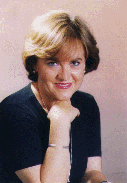 Ivón Gordon Vailakis
Poems from La Manzanilla
“The word and the world are between us”
(Nos separa la palabra y el mundo)
The word and the world are between us
and the world and the word
the end of the rosary is in the tail
of the Kabalistic serpent.
While I listen to the Kaddish
my grandmother prays the rosary.
Each day I walk towards the aromas
of what I am
between palpitations and silences.
I sink beyond the light in the Kol Nidrei.
I sink beyond
just before the great fast
my grandmother prays the rosary
we are what we think
and the word creates the world
and we entangle ourselves in the end of the tail.
“The death of Octavio Paz in April”
(La muerte de Octavio Paz en abril)
The death of Octavio Paz in April
the stone marks the stone
on any night.
He makes love in a room
where the pillow smells of noon
and the portrait of his childhood
looks at him with promise.
Paz confronted the unsayable
he confronted the hate of others
he confronted the void of silence
and he confronted the noise of fame
he wanted to live between the love of his room
and lose himself between the walls of a caress
he forgot Elena Garro hurrying to
Lola at three o’clock.
He fell whiter and whiter
at the root which grew from within
until he became almost invisible.
The stone strikes the stone
until becoming a true labyrinth
between sleeping steps it awakens the light
it blindly begs to be named
in the void of forgetfulness.
“The door rests in silence”
(La puerta está en silencio)
and no one opens it.
The names in cemeteries
are witnesses to legacy.
Gravestones don’t lie
about learned languages.
Their secrets
already rest beneath the earth.
Silence has triumphed.
Survival has triumphed.
Every crime committed: to believe in the Torah,
in the secret of tribes. For there is a right
to triumph over nothingness.
There is a right not to do evil
to have been children and believe in life.
And to think the stone beats as hard
as the pulse in your finger
and you fall into the door of a house
even just to visit.
“Tired of waiting”
(Cansado de esperar)
Tired of waiting
I return to my native land
to gather steps sitting in chairs
to gather in the hands of clocks echoes
of conversations recorded on a golden tape,
and I wonder where I am not in me.
I search in the synagogue the rabbi’s impenetrable prayer
the stream of water that falls in the words of the Zohar
I leave swollen flowers on the steps
and sink more into distances and farewells.
The echo of the Shofar opens the fruitful year.
You look at me with the incredulity of the centuries
you ask me where I learned to distinguish between
the horn and the serpent
between unleavened bread and the 5 o’clock rosary.
I inform you that all these years
I have kept the rites of Rosh Hashana
with writings hidden in a napkin
and a fig sweet immersed in impatience.
I don’t know the words of the Kaddish, I only have a compass
pointing towards the origins
and a tape recorder full of silences
and spaces drowning in the brims of eyes
while someone persecuted by the galloping
Inquisition
moans the silence of a Hebrew recorded
on the rolls of the Torah
in the secret room off to the side.
“Poet of arms crossed”
(Poeta de brazos crusados)
Poet of arms crossed
between the south and north.
You left so many secrets
hidden in little drawers full of marvels
between San Diego and Tijuana.
You no longer no walk arm in arm
with your friends like some reflection of a cricket.
You left us there in the middle of the street.
Your long mane,
your green wool sweater, and your bag hanging
from your slow, stooping shoulder.
You carried all your poetry with you
awarded with prayers and sorrowful pitchers
we forget about the snapdragon translations
in the old woman’s vault
we forget about poets from the border
and the genealogy which calls us poets.
You tremble with the memory
of your lovers at the bullfighter’s house
of your last flight
with drummond de andrade, mark strand, tom robbins
and all the others who passed through your dusty lips
like beggars we were left searching in your lost eyes
the nourishment of silence and abandonment
all your great pals abandoned you
yours, yes yours roberto jones
as we used to call him
we abandoned you on the distant street
and we didn’t pick you up like you did
with those of us left in the uncertainty
of the hunger of your tacos
and the suffering seasoned with spicy chile
because you don’t speak of the rapidly beating heart
that comes from the north and the calendar
because you don’t write poems in the street
that aren’t strained through the cleft of addiction.
roberto jones, poet
why did you leave us
like children selling newspapers
without tomorrow’s edition?
“At times I see you”
(A veces te veo)
At times I see you
among the crowds that emerge from the shadow
at times I see you in the origin
of the room beside the rain.
And I see you
mending with a needle and a light bulb
the memories of war.
I see you in each thread forgetting your memory
like a fish in the air
I see your eyes reddened by the black thread
in the black stocking scooped from memory
fragile from putting on yourself time and again the same patch.
When I question you
about those times in Charlottenburger
or some other street in Berlin.
So many unanswered
questions.
Like how you escaped from those camps
of unhinged blood.
You fall silent like a Trappist monk
you change the subject
You go back to the light bulb
to the difficulty of mending an old stocking.
You speak endlessly about the voltage of unknown mailboxes.
I try to gather the threads from the floor
but with you sole you step on my finger
like a memory of your past.
Preceding poems translated by
Ivón Gordon Vailakis, Rebecca Bernadz, and Jay Miscoviecs
The Women from Potamiés
wrap their hair with sage.
They walk the stoned covered streets
like birds leaving the nest
and with their shadows they illuminate the way.
They catch the footsteps from the sun
and let time rest on their backs.
Their faces are scorched by the Cretan wind
their faces recognize dreams
so they won’t tumble.
They rock the warmth of the afternoon.
with their rough hands.
They peel walnuts
and mix the syrup of their dreams
with coral threads.
Naked before dusk
they pray for the heavenly traces of the earth
they pray for the bushes, they pray for the oak trees
they pray for the fragrance of the olives.
Their body is embellished with oil and oregano.
They cook with herbs that grow next to the bushes
and season them with syrup made from tenderness
simmered in the zomba.
They add oregano to the lure of the afternoon.
They sit in the balcony of the sky
and they look at the ground and the oak leaves
sharing with them delights and sorrows.
The wind whispers at their backs
and embraces them like leaves.
They peel oranges and chew corals.
From their mouth a breath of island escapes.
from Poems of Salt
Extend the hands
Extend the hands
over the other’s body
and from the hands
light will beam
light that cures all
with the hands
you will lodge in the flames of fire
and the word.
You have joined
the two sides
in marriage
in front of the mirror.
You have joined by chance
conflicting sides:
tenderness and devotion
give each other
desire,
an unconscious palpitation arises
between anger and blasphemy
as they struggle to disappear.
You fly high
next to your lover
after suffering hunger and thirst
you try to attune to the divine curse
you cover your face
and return
to celebrate the marriage
in front of the mirror
that stands there intact
after your flight.
Preceding poems translated by
Ivón Gordon Vailakis
