|
Also in this issue by Aliki Barnstone:
In Defense of a Poetics of Witness
Eva and Chagall
Eva Poems
New poems from Bright Body
_______
Aliki’s website
_______
Abayomi’s poems in this issue.
_______
Photo of Aliki Barnstone by Katherine Dumas
|
On The Importance of Whitman,
Responsibilities of Poets, Cultural & Ethical
Relativism, And Living As A Poet in Las
Vegas:
An Interview with Aliki Barnstone
By Abayomi Animashaun
This interview took place at the house of Aliki Barnstone in Henderson,
Nevada. In the first section,
the poet explores – with little interruption from the interviewer – the
responsibilities of poets in an age replete with so much destruction and
loss. More specifically, she talks about the possible appropriation of
another culture’s – or person’s – suffering for personal gain. In the second
section, she talks about the importance of Whitman and life as a poet in Las Vegas.
***
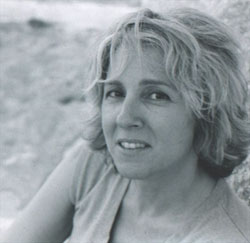 Aliki Barnstone is a poet,
translator, critic, and editor. Her books of poems are Blue Earth
(Iris, 2004), Wild With It (Sheep Meadow, 2002), a National Books
Critics Circle Notable Book, Madly in Love (Carnegie-Mellon, 1997),
Windows in Providence (Curbstone, 1981), and The Real Tin Flower
(which was introduced by Anne Sexton and was published by Macmillan in 1968,
when she was twelve years old). She has been nominated for the Pulitzer Prize
twice. She edited A Book of Women Poets from Antiquity to Now (Schocken, 1980; second edition, 1992), The Calvinist
Roots of the Modern Era (University Press of New England, 1997), The Shambhala Anthology of Women’s Spiritual Poetry (Shambhala, 1999; 2003), and she introduced and wrote the
readers’ notes for H.D.’s Trilogy (New
Directions, 1998). Her poems have appeared in Boulevard, The
Georgia Review, New Letters, Pleiades, Prairie Schooner,
The Southern Review, TriQuarterly, Virginia
Quarterly Review, and elsewhere. She has recorded a collaborative C.D.
with musician Frank Haney. Her translation, The Collected Poems of C.P. Cavafy: A New Translation is forthcoming in with W.W.
Norton in 2006. Also forthcoming in 2006 is her study of the development of
Emily Dickinson’s poetry, Changing Rapture: The Development of Emily
Dickinson’s Poetry, which will appear with University Press of New
England in 2006. Barnstone currently is Professor
of English in the Creative Writing International Program at the University of Nevada,
Las Vegas. (Photo of Aliki Barnstone by Katherine Dumas.) Aliki Barnstone is a poet,
translator, critic, and editor. Her books of poems are Blue Earth
(Iris, 2004), Wild With It (Sheep Meadow, 2002), a National Books
Critics Circle Notable Book, Madly in Love (Carnegie-Mellon, 1997),
Windows in Providence (Curbstone, 1981), and The Real Tin Flower
(which was introduced by Anne Sexton and was published by Macmillan in 1968,
when she was twelve years old). She has been nominated for the Pulitzer Prize
twice. She edited A Book of Women Poets from Antiquity to Now (Schocken, 1980; second edition, 1992), The Calvinist
Roots of the Modern Era (University Press of New England, 1997), The Shambhala Anthology of Women’s Spiritual Poetry (Shambhala, 1999; 2003), and she introduced and wrote the
readers’ notes for H.D.’s Trilogy (New
Directions, 1998). Her poems have appeared in Boulevard, The
Georgia Review, New Letters, Pleiades, Prairie Schooner,
The Southern Review, TriQuarterly, Virginia
Quarterly Review, and elsewhere. She has recorded a collaborative C.D.
with musician Frank Haney. Her translation, The Collected Poems of C.P. Cavafy: A New Translation is forthcoming in with W.W.
Norton in 2006. Also forthcoming in 2006 is her study of the development of
Emily Dickinson’s poetry, Changing Rapture: The Development of Emily
Dickinson’s Poetry, which will appear with University Press of New
England in 2006. Barnstone currently is Professor
of English in the Creative Writing International Program at the University of Nevada,
Las Vegas. (Photo of Aliki Barnstone by Katherine Dumas.)
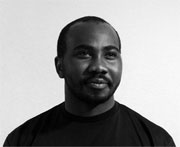 Abayomi Animashaun is a Nigerian émigré who came to
the United States
in the late 1990s. His works have appeared or are forthcoming in such places
as New Orphic Review and The Guardian. He has served as an editorial
staff for Red Rock Review, and he was a finalist for the Marble Faun
Prize in Poetry from the William Faulkner Society in 2004. Abayomi Animashaun is a Nigerian émigré who came to
the United States
in the late 1990s. His works have appeared or are forthcoming in such places
as New Orphic Review and The Guardian. He has served as an editorial
staff for Red Rock Review, and he was a finalist for the Marble Faun
Prize in Poetry from the William Faulkner Society in 2004.
* * *
I
Aliki Barnstone:
I was having a conversation with a poet/friend of mine, who is also doing the
imaginary poets thing (feature on The Imaginary Poets). And, of course, the assignment was to translate a poem
by a poet who writes in a foreign language. But we invent the poet. And we
also wrote essays on how that poet influenced our work never letting on that
we invented the poet in the biography of the poet. So that raises the
question, since in a certain sense, when you are translating an imaginary
poet you may, at your worst or critical moments, say you are appropriating a
culture that you are not a part of and appropriating a suffering that you
yourself have not experienced. So one of the questions that is always raised—
particularly about the Holocaust, but not just about the Holocaust— when
someone imagines being a witness to an atrocity or some kind of human suffering
that she/he has not actually experienced, [is] are you appropriating
that suffering for your own gain, whether it is only to write the poem, and
can you, in fact, ever really approximate that suffering. Of course you
can’t; ultimately. But imagining the suffering of others,
is that a problem or is it what every human being should be doing?
I don’t think the question is a bad question. I mean, we have to wrestle with
it. But I think that the answer has to come back to the human responsibility
to imagining the suffering of others. It is a huge failure of the imagination
and of the human spirit to make war, with the rationale that certain people
have to lose for a greater good. Maybe that’s true. Maybe certain people have
to suffer for some greater good. Maybe that’s true,
I’d like to think that maybe not. Maybe people have to sacrifice for some
greater good, but the idea that you have to punish the innocent for some kind
of greater good, I think that is a failure of the
human imagination and a failure of the human spirit to say that that must
happen…. I think that is a huge problem, and not just a huge problem, but
maybe the beginnings of evil. Ultimately, the artist must wrestle with the
question “am I appropriating, for my own gain, the suffering of others.” I
think that the greater question is are you willing to go into those terrible
territories that will keep you awake at night and when you wake up make you
feel exhausted.
II
Abayomi Animashaun:
Where are you originally from and how did you come to Vegas?
Aliki Barnstone: I was born in New Haven,
Connecticut; I grew up in Bloomington, Indiana,
and I came to Vegas because I got a job here. Before I got the job, my
husband said there’s no way in F-ing hell I am
moving to Las Vegas
for any reason under any circumstances.
Abayomi Animashaun:
Why doesn’t he like Vegas?
Aliki Barnstone:
I think he likes it now. But, at the time we hadn’t been here. And when we
came we were actually very taken with the landscape. (And I am still taken
with the landscape) We were in South Dakota
then, and what we realized was that living in Las Vegas and teaching at UNLV is all
around a better deal. For one thing, it’s warm and the sky is blue almost
everyday.
Abayomi Animashaun:
So how does the landscape affect your writing?
Aliki Barnstone:
I think it’s amazing. Actually, I have a manuscript of poems almost all of
which take place in Las Vegas.
On a daily basis, I find it so astonishing that you have this city full of
strip malls and subdivisions, and the strip and towering over this crazy city
is the beautiful sky and sometimes clouds making crazy formations and the
mountains are always these, you know, cathedrals of beauty that overwhelm the
twenty-first century urban sprawl. So you constantly have that contrast
between a natural beauty that simply can’t be overwhelmed and the city. That
contrast in Vegas, between this monument to materialism and the natural-made
kind of timeless monument of the mountain is a source of great inspiration
for me.
Particularly now that I am leaving for awhile; I have come to appreciate what
an interesting place this has been for me. Besides which, I actually have, to
my surprise, a lot of attachments here. To the place, to friends, and also I
have been blessed with beautiful students. I am so lucky. I mean when you
have students to hang out with, and to mentor, it makes life worthwhile. I
mean, this is my life work. My life work is ‘I am a poet’, but to say that ‘my
work is my own work that I create’
and to not realize that ‘my right work is my teaching’, is to deny one of the
greatest pleasures in my life. I mean that there are several things that give
me great pleasure and give my life meaning: my family, my friends, my
students, and my own work. When I say my own work, my own work encompasses
all of the things I said previously.
We have many talents, and there is a kind of autonomous self-interest involved in
saying ‘my work’, as if ‘my work were only what I make’ and not one’s
community and one’s relationships with others. Writing, or making any kind of
art, is a relational activity; it’s not merely an autonomous activity. If it
were an autonomous activity, we wouldn’t need readers. And having a dialogue
with others who want to make art is part of the work; it’s part of the work
of one’s own creation, because one’s own creation is never one’s own.
Abayomi Animashaun:
There is something communal, I guess the better word
is relational — since it’s the word you used — in what you are saying. I’m
thinking that has something to do with your Greek background. The Greeks, or
the ancient Greeks I should say, theirs was a more communal society. Do you
think that’s where you are getting this? Because, not all American poets
share this view that you are championing right now, that writing is a communal/relational
thing.
Aliki Barnstone:
Well, I don’t want to be ethnocentric. I’m multi-hyphenated.
Abayomi Animashaun: /Aliki Barnstone:
[laugh]
Aliki Barnstone:
My father is Jewish; my mother is Greek. Those are two really tribal
cultures. By which I mean (and one makes these generalizations with a certain
amount of hesitation—anyway, I’ll say it) Greeks and Jews are very
interested in family and very interested in the idea of community. I grew up
with two parents who are extremely generous people, and I feel really lucky
because they are not only generous with material things. What I mean by
generous is a kind of generosity of spirit. The things that made the largest
impression on me when I was a child was this idea
that to have people in your home, to be hospitable, is one of the virtues and
pleasures of living. I mean the idea in the bible that you cannot entertain
angels unawares. That comes from Greek myth.
Abayomi Animashaun:
Zeus was/is the protector of all guests.
Aliki Barnstone:
Yes. The notion that one can exist in the world happily without others seems
to me leads to a kind of scarcity in one’s life. If one has others and can
have conversations, be it with people of like mind or even with people of not
like mind, and feel a sense of joy, then the world is better. And one’s own
world is better. If you aren’t willing to, in your small way, do something in
the community in which you live then you will suffer. You may not suffer
materially, but you’ll suffer spiritually. I firmly believe that.
Since I’ve been doing this project with my imaginary poet, whose name is Eva
Victoria Perera and she’s a Sephardic Jew from Thessaloniki who survives the Holocaust, I have been
getting very involved in Jewish ethics and Jewish thought (which, of course,
extends to Christian ethics and Christian thought, and Moslem ethics and
Moslem thought because Judaism is the source of monotheism. I should say one
of the sources, because, of course, there is always a connection between the
pantheon of the gods and monotheism which people want to reject, but, anyway,
that’s another story) One Jewish law is called Tz’dakah—
and it doesn’t mean charity, it means justice, which is very interesting to
me. What it means, and what the law commands, is that people must give to others
who are less fortunate than themselves, which is usually considered charity,
but in Jewish law it’s justice. And I think that that’s fascinating that in
order to be just you must share
what you have with others. Of course that extends into the Christian notion
(Jesus was a Rabbi, of course) of taking care of the poor and so on, which I
consider to be the best of organized religion — [and this] is when it creates
a justice, which is a social justice in which you feed others, you clothe
others, you house others, you take care of others, when people are sick you
heal them— that is justice; that’s not mere charity and pity. So that notion
that as a spiritual human being you are responsible for others and for the
comfort of others is really important to me, and, yes, I think it goes back
to my Greek and Jewish cultural heritage. But it’s just not mine. This is not
something that is unique to those two cultures.
Abayomi Animashaun:
No, because it’s true for the Yoruba as well.
Aliki Barnstone:
Of course. One of the things that one realizes is that the best of cultures
and the best spiritual/religious traditions is not the modes of social
control — meaning punishment, going to heaven, going to hell, and so on — but
the way in which the spirit is shared by all. This is the thing that I keep coming
back to— that if one shares in the celebration of life, if one shares in the
suffering in life, that one can look to any spiritual tradition and one will
find that the law of the spirit is that you must give to others and that the
giver receives.
Abayomi Animashaun:
Is there such a thing as the role of poetry in society — more specifically in
a place like Las Vegas
where people say culture does not exist?
Aliki Barnstone:
Yes! Of course there is. When I first got here. There was a lovely place
called the Enigma Café, and it was owned by Lenadams Dorris. And one of the
sad things that happened is that the beautiful place closed. But, what was so
great was that in this lovely place, for poetry readings there was standing room
only. I mean, there were little notices on the table that the limit for the
number of people that could legally be in the Enigma Café for poetry readings
was a hundred and twenty. Because people were so enthusiastic and so hungry
for this experience that a poetry reading was a great draw. And, I think
that one of the big secrets about Las
Vegas is that, yeah, there is a world of poetry.
You see, the idea that for an art to be viable, or for any kind of mode of
communication, to be effective, it has to go out to millions is just not true.
You know, you have a city that has about a million and half people. So what,
if thirty people come to a poetry reading? Does that mean that it’s
insignificant? Of course not. It means that poetry reaches a small audience.
That does not make it an insignificant audience. The arts should not aspire
to stand along side Madonna. Or to have everybody know who Wole Soyinka is, in the same way that everybody right now knows
who The Runaway Bride is. In twenty
years, who is going to know about The Runaway
Bride? Or maybe when this interview comes out who’s going to know about The Runaway Bride? Who cares? We don’t
have to aspire to that kind of thing. What we have to aspire to is to have
the art available to those people who are interested, and to say ‘hey have
you ever been to a poetry reading (which is what we do with our students)?
Well, come along, I’ll give you a point of extra credit on your grade if you
come to a reading’. Well, I can’t tell how many of my students have been
motivated by that grand extra point of credit added to their total grade. You
know, ‘if you go to five poetry readings then, by god, you’ll up your grade
from a B+ to an A-’. They say, ‘I’ve never been to a poetry/fiction reading,’
and they say ‘I’m gonna go again because that was
pretty amazing’. I do give them credit. But what happens with, say, those
five students a semester [who discover] that literature is a living art? Then
those five students might pass along to five of their friends that ‘oh did
you know literature is a living art? Did you know there are writers walking
around, who actually are not dead, and who might be funny?’ So there’s idea that
in order to reach people, you have to reach in this kind of shallow watered
down way – this sensational, hysterical kind of way -… The arts are available
to all. Maybe there are some people who aren’t ready. But there are
plenty of people who are ready.
Of course this is not New York.
This is not Minneapolis, St. Paul. This is not even Bloomington, Indiana.
But that does not mean that there aren’t people here who are hungry for the
arts. In fact, maybe we are hungrier than others. Because we don’t take it
for granted. On the other hand, think about the people we have been able to
hear read and speak. We’ve had – in the six years I’ve been here – Jorie Graham. We’ve had Mark Doty. We’ve had Gerald
Stern. We’ve had Stephen Dobyns. We’ve had Brenda
Hillman. We’ve had Tobias Wolff. We’ve had Russell Banks. We’ve had Mark
Strand. We’ve had Marvin Bell. I just can go on and on and on. I
didn’t cover half the list of the wonderful poets and fiction writers
who have come through here in Las
Vegas. So okay— there is no culture here. But
somehow there is culture here. Not only that, but, you know, in the craziest
place in the world, in the casinos there are great works of art – I mean, I
have my criticisms about that, but on the other hand why not? Why not
appreciate what we’ve got?
You see, we’re in this lucky situation actually. Lucky is a good word for Las Vegas, since
everybody wants to be lucky in a situation – the gambling situation, the
gaming situation – where they think it’s luck. It’s not really luck; it’s not
all luck. You go and put your money in the slot machine, and you are
guaranteed to lose.
Abayomi Animashaun: /Aliki Barnstone:
[laugh]
Aliki Barnstone:
[picking up where she left off] otherwise they wouldn’t be making the
billions that they are. But we are lucky in this respect: we are living in
this city that is really at the extreme end of American capitalism, American
kitsch, American brilliance in advertising and creating desire that is at the
extreme end of giving people every kind of access to every kind of addiction
that they might indulge in, that is a consumerist
paradise. So we really have a laboratory, as artists, to critique in a way
that artists should. And that’s good. For us to expose the materialism and
shallowness and stupidity of the world, that’s part of our responsibility, I
would say.
We also live in a city that is full of beauty, despite the
fact that when we say to people who don’t live here ‘oh, I live in Las Vegas’ they kind of
go, ‘oh, and how is that.’ But, we are not deprived. I just went to see Claire
Bloom in her one woman show – Shakespeare’s Women – we’re not deprived. If
we want to see a dance performance, if we want to go to a theatre
performance, if we want to go to a poetry reading or fiction reading, we can
do it. It’s just that it’s not like being in New York, where there’s so much. Look, I
love New York.
It’s just that Las Vegas
is not known for the arts, but we are lucky in that we are not living in a
wasteland where there is nothing. There’s something.
Abayomi Animashaun: A
lot of people think that it’s just a wasteland.
Aliki Barnstone:
Yeah! The desert is a wasteland. You know, we’ve already been exposed to all this radioactivity, so why not put toxic nuclear waste
seventy-five miles from a major metropolitan area? And there’s nothing going
on here except for prostitution and stripping and gambling and buffets where you
can eat yourself into oblivion.
Abayomi Animashaun:
Or stupidity!
Abayomi Animashaun: /Aliki Barnstone:
[laugh]
Abayomi Animashaun:
So what can we do to encourage the arts here, since you believe they do exist
– especially poetry?
Aliki Barnstone:
Well I think we can do what we’re doing. There are quite a few people around
here who are really interested in bringing poets here, and the best thing
that we could do would be for all of us, who are
interested in celebrating the art of poetry, to get together. In other words
there is the Red Rock Review, there is the Las Vegas Poets Society, there is the
City of Las Vegas,
there is the Nevada Humanities Committee, The Nevada Arts Council, and then
there’s UNLV. My feeling is that we should be together in this. Oh! And
there’s the public library too.
The best thing, I think, would be for all of us to get together in our common
cause. And we have achieved that at various points. What I’m hoping for is
that we’ll create a collaboration that won’t fall apart every time someone
forgets to notify someone else of something going on. I think that one of the
things that we could do is to create community by talking to each other about
what’s going on, and I think that that’s been one of our failings as a
community is to try to get everybody in it together. And in other places
people do it. It’s work. It involves everybody having faith that one person
is not better than the other, and I don’t think we’ve established that here.
Abayomi Animashaun:
You talk a lot about Whitman. . .
Aliki Barnstone:
I like that guy.
Abayomi Animashaun:
What exactly have you learned from him, and what would his response be to the
near exponential rise of poetry magazines, contests, MFA programs, the po-biz as some call it?
Aliki Barnstone:
There are many things that I have learned from Whitman. I mean just on the
level of language – his expansiveness, his cataloguing, his
enumerations – as Ginsberg says. But the greatest thing is that when he says:
“I celebrate myself and sing myself/ and what I assume you shall assume. What
does that mean? It doesn’t mean that you only will think what I think. I
think that maybe is a misunderstanding. ‘…and what I assume you shall assume.”
Well I left out a line “I celebrate myself and sing myself /for every atom belonging in me as
good belongs to you/ and what I assume you shall
assume.” So, he speaks of the interconnectedness of all beings.
. .
Abayomi Animashaun:
Right!
Aliki Barnstone:
. . .And ‘for every atom belonging to me as good
belongs to you /and what I assume you shall assume.’ That’s an assumption. To
assume something, means to take on a burden. So ‘. . .what I assume, you
shall assume’ means that you will not only celebrate with me, you will not
only celebrate myself, but because myself is yourself, you will celebrate
yourself, and what I suffer you too will suffer. Because you will take on the
burden of my suffering and I will take on the burden of your suffering. So,
what I learned from Whitman is that you may want to separate yourself from
others, but, ultimately, you can’t.
And in terms of what would he think about the proliferation of MFA programs,
poetry contests, poetry journals. I think he would
love it. Because what Whitman teaches us is that we all are created. He says “…I
stop somewhere waiting for you. . .” at the end of Song of Myself. He does not live without the reader. And the
reader is the co-creator. So I think that he would say, as Robert Pinsky said to me years ago with regards to poets and
poetry, the more the merrier. I mean, why do we have to take
this self-centered kind of attitude that there’s not enough room for
everybody; so let’s just smash people down. ‘You’re not worthy of
writing poetry, you’re not even worthy of reading poetry.’ That’s bullshit.
The more the merrier. The more people who write the better. The more people
who read the better.
Now, okay, we’re going to start evaluating: well, maybe some people are better
poets than others. Maybe some people get into MFA programs and others don’t.
Maybe some people publish their poems and others don’t. So what? One of my
favorite art teachers – he was a studio art teacher in drawing and painting—
he still lives; his name is Marvin Brown— and he was my teacher when I was at
Brown – began the class by saying: ‘I want you to imagine what it would be
like to be an amateur artist.’ Let’s just say someone writes poetry, and that
person is an amateur poet, good. Maybe that person’s love for the arts will
allow him/her to hear the voice and become a good poet; maybe not. But
ultimately, it’s good for us all if people write poetry. It’s good for us all
if people read poetry. And not just so that those slim volumes of
contemporary poetry will sell like hot cakes, which they never will, but
because I ultimately believe that making art is a spiritual practice and
because if you can hear, if you can see, if you can appreciate the beauty of
the art, then you are ultimately appreciating the beauty of the human spirit
and that does some good. It does a lot more good than CNN.
I’m an idealist, you know. I think we all need a little cutting wit. Because
you can criticize, because you can see evil, the bad, the mundane, the
mediocre, or the stupid does not mean that you can’t be an idealist. In fact,
it should help you in your path to creating. I mean – and this is very
Platonic – but having an ideal is not such a terrible thing. Having an ideal
means that you can see the possibility for a better world. Cynicism is a bad
thing, because it allows you to say the only way of establishing democracy is
to kill a bunch of people. So you have the ideal of democracy, but your
cynical attitude allows you to do the worst things to achieve that ideal.
Abayomi Animashaun:
Often I find that people mistake the word cynicism for the word skepticism. I
was just thinking of Wole Soyinka when he said that we shouldn’t lose our
sense of skepticism. I think maybe a sense of skepticism plays into what you
are saying also, because you need to have the eye for and be able to evaluate
things clearly for you to be able to have a certain ideal.
Aliki Barnstone:
Yeah! I remember the first time I heard Wole speak. He was talking about
cultural/ethical relativism. In other words, I remember when I went to China – he
didn’t use this example – in 1985. When I was there, the
oversees travelers were segregated from the Chinese. So, you would
always be with other travelers in China. And I remember, there were people who would say democracy is not part of
the Chinese tradition, so it’s not important to the Chinese to have
democracy. Well this was a few, short, years before Tiananmen
Square, which completely proved them wrong. There is no cultural
justification for treating people as if they had no feelings and they can
not decide for themselves what their form of government should be or what
they wanted for themselves.
The idea that because you are Chinese means that you don’t have the desire
for freedom of speech, or that you think that it’s okay to be sent to a labor camp – as Er Tai Gao
was -… The idea that there are certain cultures in which people do not have
the same expectations for their conditions as others – in other words, if you
are American, well, of course, you are expected to be able to vote, of course,
you are expected to have a democratic society, but if you are Chinese, no…
The example that Wole used (I’m going off track here) was female
circumcision. Why do we think, he said (if my memory holds, and I think it
does) that women in Africa
don’t mind this because it’s culturally sanctioned. Why do we think that? Why
would we think that? So he was showing the folly of that. So you have to have
a sense of skepticism. You can’t, as Whitman says, take things at second or
third hand.
Abayomi Animashaun:
What do you think is the most engaging and/or disturbing tendencies with the
new generation of poets that you’ve come across in workshops?
Aliki Barnstone:
The thing that I find – I’m going to start with the negative, so we can end
up with the positive – disturbing. . .Okay, there
are several things that I find disturbing. One is an unwillingness to read
and to know the tradition. I think that writers/artists should want to know
the tradition, and should want to know what’s going on right now. I also
think that writers should not stay within the borders of this country. This country
is a vast country; we have many, many, different cultures here. I disagree
with people who say the arts are not diverse enough here. I think that there
is wonderful richness here in all senses. I also think that we need to read
the literature of other countries. You see, then
these silly categories stop meaning so much. Because the imagination has many
different ways of creating poetry.
The kind [of trend] that drives me to distraction is not having anything at
stake, and sometimes I see that. Most of the time, I have to say, I’m happy.
I mean, really. I want students to want to read; I want them to want to
write; I want them to want to try new things; I want them to be at play, and
I want them to work hard. What I love is that, for example, this semester with
my undergraduate workshop, I assigned Robert Pinsky’s
The Sounds of Poetry, which is a
wonderful book. I recommend it. I do think that being able to hear music is
absolutely the key. My students were rather confused at the beginning. But by
mid-semester, there was not one student in my workshop who wasn’t hearing the
music, and I don’t mean the music only of the poems that we read by
established writers. They were hearing their own music. They were
hearing the music of the language, and that makes me so happy. Generally, I
find that students are happy to be turned on to things. They resist things
that are hard at first, but so do we all. I mean we are always struggling
against our desire for homeostasis. But generally, students are interested in
being better than they think they are. I personally – to just pat myself on
the back for a moment – think that’s one of my talents as a teacher. I do
think that my students are better than their own self-imposed limits. I don’t
think it; I know it. I think that when you say ‘yeah, it’s hard’ but let’s
just take a look at it, it’s fun. ‘There are great rewards in difficulties’ Bauderlaire
says. Let’s have some fun with it. Play plus practice equals work.
So I think students in workshops – at the undergraduate and graduate level –
they want to have a good experience, and sometimes I get disturbed by
students snipping at each other, but more often I discover that students are workshopping on their own. They’re creating their own
small community outside the classroom. More often I find that.
Abayomi Animashaun:
Last question. What’s your favorite casino and why?
Aliki Barnstone:
The Mirage, because it has fish tanks and plants.
Abayomi Animashaun: /Aliki Barnstone:
[laugh]
Abayomi Animashaun:
Thanks, Aliki, for your time.
Aliki Barnstone:
Sure. You’re welcome.

|