 To read Arthur Sze’s translations of
T’ao Ch’ien
Li Ch’ing-chao
Tu Fu
Li Ho
Wen I-to
Li Po
Li Shang-yin
Wang Wei
_________
Poems from Arthur Sze’s The Silk Dragon:Translations from the Chinese appear courtesy of Copper Canyon Press, www.coppercanyonpress.org
_________
Read our interview with Arthur Sze in this issue.
_________
Read a selection of Sze’s poetry in an earlier issue.
_________
At bn.com, a complete list of titles by Arthur Sze
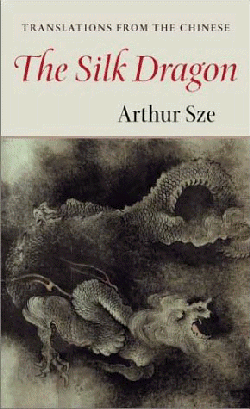
The Silk Dragon
Translated by Arthur Sze
Publisher’s Note:
- Arthur Sze has rare qualifications when it comes to translating Chinese: he is an award-winning poet who was raised in both languages. A second-generation Chinese-American, Sze has gathered over 70 poems that have had a profound effect on both American poetics and Sze’s own maturation as an artist. His anthology features poets who have become literary icons to generations of Chinese readers and scholars. Here are the quiet nature poems of Li Ching Chao alongside the remorseful exile poems of Su Tung-p’o. Also included is an informative insightful essay on Sze’s methods and processes of translating ideogramic poetry.
From the Back Cover:
- The Silk Dragon presents a complex vision of the vitality, diversity, and power of the Chinese poetic tradition, ranging from such great T’ang dynasty masters as Wang Wei, Li Po, and Tu Fu to pivotal contemporary poets Wen I-to and Yen Chen. Arthur Sze writes: “I have only translated poems that have deeply engaged me; and it has sometimes taken me many years to feel ready to work on one.” Although Sze calls translation an “impossible task,” his introduction nevertheless provides a unique glimpse into exactly how he translates a poem—from the first rough, literal draft to the finished poem.
Review and Comment:
-
In this small, select collection of poems, Sze, author of six
previous books of poetry and professor of creative writing at the
Institute of American Indian Arts in New Mexico, has made
accessible to Western readers the works of 18 Chinese poets previously translated into English
sparsely, if at all. Among the most valuable aspects of this sensitively crafted collection is the
introduction, in which Sze describes, in fascinating detail, his translation process, from the word
clusters he creates for each Chinese ideogram to the finished poem. The Silk Dragon (Sze’s
metaphor for poetry) begins with the timeless poems of T’ao Ch’ien (“Evening dew moistens my
clothes;/ but so what if my clothes are wet / I choose not to avoid anything that comes”) and moves
on to such masters of poetry as Wang Wei, Li Po, and Shen Chou, to name just a few. Toward the
end, the reader is introduced to the contemporary poetry of Yen Chen, whose distinctive “party”
voice nonetheless reflects his heritage: “The traveling bells ring quick/ like beans jumping in the frying
pan.” Recommended.
— Judy Clarence, California State Univ. Lib., Hayward, for Library Journal
-
The discovery of classic Chinese poetry has been one of the most important literary events in world literature in the twentieth century. Readers fell in love with it and poets were influenced. Over the last hundred years, there have been many translations into English, but only a few as fine as these. Arthur Sze is not only one of our best poets, he’s now also one of our great translators.
—Charles Simic
Make room on your book shelf for this moving collection of Chinese poetry. True to the title of the book, each poem is a miniature silk dragon, lustrous and magical in its beauty. Even specialists of Chinese poetry will have much to learn from it.
—Michelle Yeh
Arthur Sze is the author of six previous books of poetry, including The Redshifting Weband Archipelago. He has received the Asian American Literary Award for his poetry and translation, a prestigious Lannan Literary Award, and was recently a finalist for the Leonore Marshall Poetry Prize. He teaches at the Institute of American Indian Arts.
